• TalkBass has been independent since 1998. Add your voice.
    Create a free account to reply to discussions, view embedded media, and browse with fewer display ads.
    Join freeLog in
    Want zero display ads or expanded classifieds tools? Compare plans.

What is the purpose of fret markers?

Sorry to derail with a serious, on-topic reply (;))...

Here’s what Wikipedia has to say (so you know it’s true!):

Marker dots (see Inlay (guitar)) on the face of the fretboard are usually placed at frets 3, 5, 7, 9, 12 (double dot to indicate the octave), 15, 17, 19, 21, 24 (double dot to indicate the second octave). It's also common that there are marker dots on the "upper" side of the neck, near the edge of the fretboard, where the player can easily see which fret he or she is on. Sometimes the dots are replaced with bars, the octave positions having a wider bar. Classical guitars almost never feature position markers, especially on the fretboard's face, whereas electric guitars usually do. This is due to several factors:

1) Electric guitars do not rely on a resonating body chamber to produce sound and therefore the inert bodywood may be carved more deeply to allow better access to higher frets.

2) Electric guitars also sport an extended high-end range, due to the above reason. Typically, up to 24 frets are used.

3) Electric guitars vary greatly in terms of scale length, depth of lower and - if present - upper rout and where these connect to the neck at its heel, and number of frets (usually between 21 and 24). In contrast, classical guitar dimensions are standardised, with the 12th fret aligning with the neck-end of the body, use of only 19 frets, and scale length of 25.6".

While it may be perceived that position markers are featured on popular instruments to accommodate their typically lesser-educated users (in contrast to classical instruments), on the contrary, for the above reasons, position markers are of much help to electric guitarists of any level of competence.

upload_2019-11-10_1-51-7.gif


...actually, I did the same thing...:)
 
So Anyway, I sat in at a music party Friday night and got to play a '64 PBass.
Maybe it was the lighting, maybe it was the two Zwickel Lagers, maybe I'm use to my Rickenbacker, maybe I just suck... but it seemed the side fret markers were pretty small. I had to check myself several times by tilting the bass so I could see the fretboard. I'm glad they were there.
But it was a cool bass and the guy who owned it had some fun stories to go with it.
 
  • Like
Reactions: TexasEdition
Hey... you want to really infuriate an upright bassist?

Tell him/her you actually committed the unforgivable sin and added side dot markers at the 3rd, 5th, 7th, 9th, and 12th "fret" of your own upright. But be prepared for either profanity, a pop in the nose, or a coronary and lawsuit. But, hey, tough... I find side dot markers very helpful on ANY fretted/fretless stringed instrument (including classical guitars). Fingerboard markers/inlays? Well, they don't bother me, yet I don't really look at them much, so either way is fine. But some of the various inlays I've seen are very nice (some very ornate) and really add to the look of the instrument.
 
I approached this as a thinking exercise, and thought someone may have the answer to this. But this may turn into a little pet side project. As far as I can tell, the earliest forms of stringed instruments had no markers of any kind. Even the earliest forms of fretted instruments. However, by the time of Orvile Gibson, it seemed to be already established and Leo Fender followed suit.

Some of the earliest Martin's from the mid 1800's had them, as well as some early banjos. Interesting to note they were on the 5th, 7th, and 12th, and usually rather ornate (not just a dot). What strikes this as interesting to me is that it marks the IV, V, and octave intervals which coinsides with a lot of the perochial and vernacular music that was popular among the proletariat class at the time.
 
I don't think he really needs them, and I'm not even sure he has his eyes open... For Victor, it could just be the "Monkeys and the Bananas" story... We do it because it's they way it always has been done.
Perhaps. But some people said in this thread that the side dots were enough for them. And if there were none, would they still be OK? I doubt it. Thus, even if they rely on small fret markers, they are still fret markers.
 
  • Like
Reactions: Watchootognbout
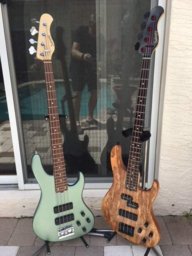
I've been enjoying my Aerodyne Jazz for about a month now. One of the things that struck me as attractive is the clean rosewood fretboard wtihout fret markers. I was also noodling around on a fretless bass at the music store the other day that had dot markers.... And then it hit me... Why are they there? When I play bass, guitar, etc...
I can't see the fret markers. So what purpose do they serve me? Sidemarkers not withstanding... Their purpose is obvious.

I have a banjo that has beutiful decortive abalone markers. Some of them are attractive in that sense. Some of them are signature to the brand (Rickenbacker).

I know I think too hard about things some times, and this is probably one of them... But I've now come to hate dot markers... I like the bars, rick triangles, and any kind of fancy decorative markers, or of course, nothing at all.
I hate those gigantic black triangles that Fender and others have been putting on their fretboards for quite some time. Give me the dots, or no marks at all any day.
 
For some it is like bling, probably for others to show you what they are playing, for others its a guide. I unconsciously use them all the time. And when i first started playing guitar, I used them. When I went to bass I realized I was using the wrong fingers as a guide. When I played, i tracked my hand placement by looking where my pinky finger was. When I started playing bass, I kept catching myself going 2 or 3 frets off. Only then I realized i taught myself wrong.
 
  • Like
Reactions: equill
I feel as though fretboard dots are for the benefit of the other people in your band. I played with a guitar player who had no face dots and there was that added curve when we were showing each other new parts, especially on the higher frets (where are you? is that the 7th or ninth?)
 
  • Like
Reactions: Fuzzbass
If someone in your band is trying to follow along visually, those markers would be handy.
My guitar instructor asked me NOT to bring my B.C. Rich WarBeast, because it had no fret-markers.

Interesting. I can't believe I've never thought of that aspect.

I sometimes use the side dots for reference, but never the face dots. I like face dots on my vintage basses for the obvious reason, but have a few "modern" builds with clean boards because I love the look.

I've had a sub guitarist say that the B string on my fiver made it tricky for him to follow along. I haven't yet gotten an objection to lack of face dots, but I can see how it could pose a problem. My music instructor (a guitarist) has never complained about lack of face dots... but I usually bring a vintage-style bass for lessons. I'll have to see what he thinks. He and some bandleaders I work with have excellent ears, but that doesn't mean they never use their eyes.
 
  • Like
Reactions: TexasEdition
I play a fretless hollowbody that has lines because it's a defret and I needed to fill the fret slots. But in principle I don't like a lined fretless board because I don't like physically interrupting the grain structure of the fingerboard wood with saw kerfs all the way across the full width of the board.

Because I don't play fretless all the time, I added small fret position dots to the board of my unlined fretless. They are the same size as side dots, and I located them under the E string. I did all 21 of the fret positions. To me, it's very helpful. The neck also has the usual side dots at 5, 7, 12, etc. which line up precisely with the dots I added on the face of the board.

They are tiny white dots on the face of an ebony board. I've never played the bass in a dark room. If I ever do so, I'm probably screwed.