• TalkBass has been independent since 1998. Add your voice.
    Create a free account to reply to discussions, view embedded media, and browse with fewer display ads.
    Join freeLog in
    Want zero display ads or expanded classifieds tools? Compare plans.

What the &$@# is this

And what would that reason be? There are plenty of maple NT Steinberger clones from that era with no neck issues (I own two).

From what Phil Kubicki explained to me, your basic string set has the most tension on the D and G strings and less on the E and A (and B if applicable). You can double check your average 105-85-65-45 set on D'Addario to see the tension. When the headstock is removed, all of the tension is transfered to the nut, which can make them more prone to twisting in the long run.

Personally, I have seen a few twisted necks in person. A local store I frequent used to sell Hohner, Cort, Spirits, etc. in the 80's when it was popular. Eventually, some made their way back and couldn't be repaired and were kept for parts, since they weren't good for anything else. These particular ones consisted of a cheap Spirit and a cheap Hohner. Trust me, it wasn't pretty!!!

Correct me if I'm wrong, but Warwick used to have something on their site about the Noddy bass and specifically mentioned that they were prone to warping.
 
From what Phil Kubicki explained to me, your basic string set has the most tension on the D and G strings and less on the E and A (and B if applicable). You can double check your average 105-85-65-45 set on D'Addario to see the tension. When the headstock is removed, all of the tension is transfered to the nut, which can make them more prone to twisting in the long run.
I looked at it from an engineering POV, and irrespective of Phil's opinion (and I respect Phil; I own an X Factor) I see nothing that backs this up. Most headless basses don't have a nut, rather a zero fret. The tension will be the same on any neck, and across the neck, with the same string set, scale and tuning.
 
So, it looks like before Warwick copied Spector's NS2 design (that'd be Ned Steinberger for those of you just tuning into our show) they copied another of good old Ned's designs.....

Actually they didn't just copy it, they paid for it. Which is more than alot of big names ever did with Fender.

Does anyone ever complain that Ernie Ball copied the Bongo design from the BMW designers? Did Cort steal Elrick's design? Did OLP steal the Stingray design? They were all licensed by the original designers. Just like Warwick licensed the original design. With how it seems copyrights are handled in these cases, they sure could have just taken it and changed the headstock, but they actually payed for the design.

No one ever looks at those other examples in a bad way, so why do people look at the Warwick/Steinberger collaboration in such a negative light? Stuart Spector uses the design, MOST accusations come from guys that say Warwick copied Stuart Spector, Spector didn't even design it himself.
 
Actually they didn't just copy it, they paid for it. Which is more than alot of big names ever did with Fender

They paid for it only after being sued for it... twice. As for bringing up Fender, that's a Straw Man argument that has little to do with this specific discussion.

Does anyone ever complain that Ernie Ball copied the Bongo design from the BMW designers? Did Cort steal Elrick's design? Did OLP steal the Stingray design? They were all licensed by the original designers.

Except there's one crucial point differentiating Cort & Elrick, OLP & StingRay/Sterlings/Spectors, Ernie Ball & BMW working together, which were all agreements to license various body shapes and other issues of luithery: Warwick knowingly used the Spector design without permission until Spector sued them for Trademark Infringement and got Warwick to pay a licensing fee. They also did it not once but twice, the second time after Kramer's bankruptcy and the formation of Stuart Spector Designs, in which Warwick had ceased payment of their legal fees. Even then, it took several years for Stuart to regain the "Spector" name and yet again sue Warwick for Trademark Infringement... which they won, again.

Please, anyone who would utter "Ernie Ball copied the Bongo design from the BMW designers" shows that they have absolutely no idea about how the Bongo was designed by both companies and what each had to do with the bass. In a one-sentence review, BMW DesignWorks worked on how a bass could be brought into the 21st century in terms of looks and ergonomics, and Ernie Ball took those sketches and turned them into a usable bass that the market could produce and sustain as a product. :rollno:

Stuart Spector uses the design, MOST accusations come from guys that say Warwick copied Stuart Spector, Spector didn't even design it himself.

To which Stuart has never denied Ned's involvement in the design of NS body shape. From the first paragraph of the "Basses" section of his website: "With a body designed by Ned Steinberger, this is the legendary NS bass known throughout the world." From the history page of the site: "In 1976 Spector and some co-op friends visited a cabinet shop where the woodworking machinery was being sold off. The guy was moving on to something else. He had an assistant named Ned Steinberger; Ned moved into our place, where he was designing and building furniture. He became fascinated with the idea that we were nutty enough to make musical instruments, and he said, 'Hey, I think I could design a bass guitar.' I said, 'Great—be my guest.' He came back a week later with the first version of the NS carved-body bass, which we’re still making to this day."

If you're going to discuss a topic, please try and know a passing interest in it. :rolleyes:
 
I looked at it from an engineering POV, and irrespective of Phil's opinion (and I respect Phil; I own an X Factor) I see nothing that backs this up. Most headless basses don't have a nut, rather a zero fret. The tension will be the same on any neck, and across the neck, with the same string set, scale and tuning.

I'm no expert, but I accept what the experts have said. Steinberger did it partly because they wanted their Trans Trem equipped guitars to be able to transpose tunings and not budge. Even though very few basses had the bass Trans Trem, Ned was very keen on the long term stability of the neck with the headstock removed.

Phil is also a very bright guy. I'd assume it would be easy as hell to sell a basic wood neck, but he doesn't. The headstock also accepts some of the tension. With that removed, it's all on the nut. Zero frets have no bearing on this. Perhaps it's more of a fault of string manufacturers for selling strings that have more tension on the higher strings.

I'm not saying that all headless necks made from wood will warp, but there's a greater probability compared to a graphite or Kubicki neck. Since graphite technology has gone a really long way, I'd think using wood wouldn't be much of a problem these days with graphite reinforcement bars, which weren't particularly available at the time when headless guitars and basses were most popular.

Besides, when Phil and Ned say it can happen, Warwick used to say that some of these Warped, and seeing those 2 twisted basses....I'm sticking to what the best are using.
 
Comments based on secondhand hearsay; show me the engineering as to why. It is a very simple mechanical structure.

Secondhand hearsay from Phil and Ned Steinberger?!?! ....and which instruments have you designed? These guys are credible sources. If you'd like, you can e-mail them and tell them why they're wrong.

I also had first hand experience with the cheapies that are now scrap heaps, unless I don't count for being smrt enuft. These were definitely twisted from the treble side and beyond repair, according to their repair guy.
 
Secondhand hearsay from Phil and Ned Steinberger?!?! ....and which instruments have you designed? These guys are credible sources. If you'd like, you can e-mail them and tell them why they're wrong.
You made the claim, and backed it up with nothing. I'll email Ned and Phil.
It's basic Mech Eng, and there is nothing at all I've seen to support why a headless design is more prone to warping vis a vis a headed design.
 
You made the claim, and backed it up with nothing. I'll email Ned and Phil.
It's basic Mech Eng, and there is nothing at all I've seen to support why a headless design is more prone to warping vis a vis a headed design.

Other than the D and G being the heaviest strings? :eyebrow:

Go for it and be sure to inform us what they say. I'm very confident in them since they made a living doing this. Just be sure to be respectful. Having dealt with both, they're very bright and also very kind individuals.

Nonetheless, the good ones mostly use composite. Zon, Status, Steinberger, and Kubicki....they're not noobs.
 
Other than the D and G being the heaviest strings? :eyebrow:
But using the same string set on an otherwise identical headed bass will produce basically the same load through the nut area, so i see nothing yet from you that indicates why a headless bass is inherently more prone to warping or twisting. As I keep saying, it's a very simple mechanical structure, with simple load paths, with the neck not even really being under all that much tension.

Go for it and be sure to inform us what they say. I'm very confident in them since they made a living doing this. Just be sure to be respectful. Having dealt with both, they're very bright and also very kind individuals.
Thanks Mom. I've recently received my X Factor bridge back from Phil, and have emailled Ned on other issues in the past.

Nonetheless, the good ones mostly use composite. Zon, Status, Steinberger, and Kubicki....they're not noobs.
Apart from the Zon, I have each of these.

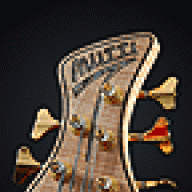
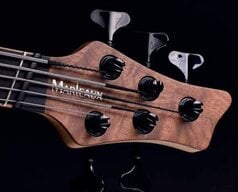
Non composite headless builder OTTOMH: David King, PBC Bunker, LeFay, Marleaux, Frenz, Schack and Washburn (licenced by Status) not to mention all the Japanese and Korean makers apart from Hohner/Steinberger.
 
But using the same string set on an otherwise identical headed bass will produce basically the same load through the nut area, so i see nothing yet from you that indicates why a headless bass is inherently more prone to warping or twisting. As I keep saying, it's a very simple mechanical structure, with simple load paths, with the neck not even really being under all that much tension.

Thanks Mom. I've recently received my X Factor bridge back from Phil, and have emailled Ned on other issues in the past.

Apart from the Zon, I have each of these.

Non composite headless builder OTTOMH: David King, PBC Bunker, LeFay, Marleaux, Frenz, Schack and Washburn (licenced by Status) not to mention all the Japanese and Korean makers apart from Hohner/Steinberger.


You don't hafta be such a jerk about it!!!:scowl:

David King, Bunker, and other builders have better gaphite reinforcement and other reinforcement techniques that were NOT available or mastered at the time when this was most popular. Graphite products were very expensive, limited to a small hanfull of manufacturers, and didn't allow enough flex to have a truss rod at the time, which is why Phil picked his choice at the time. The fact remains that most cheapies don't have the same level of reinforcement and have a higher risk of some form of twisting eventually.

Physics are important to bass, but luthiers know certain tricks to make stuff work in their favor. You may know physics, but these guys make a living doing it their way. Armchair engineers are one thing, but I'd put money on Ned and Phil. If regular wood were a more feasible option, they wouldn't have needed reinforced necks and could have sold more units easier and cheaper. Clearly physics isn't the answer to everything or there wouldn't be 30" and 32" scale basses with a good low B.

Besides, the Warwick site admitted that these basses were prone to warping when there was still a feature!!!!!!

Until then, I'm sticking with Ned and Phil. They seem to know a thing or two.
 
A few years ago, I saw a used one in not-so-good condition for sale, for about $500. The sound and feel however made me decide against buying it. It would have been only for nostalgic reasons anyway ...
 
You don't hafta be such a jerk about it!!!:scowl:

David King, Bunker, and other builders have better gaphite reinforcement and other reinforcement techniques that were NOT available or mastered at the time when this was most popular. Graphite products were very expensive, limited to a small hanfull of manufacturers, and didn't allow enough flex to have a truss rod at the time, which is why Phil picked his choice at the time. The fact remains that most cheapies don't have the same level of reinforcement and have a higher risk of some form of twisting eventually.

Besides, the Warwick site admitted that these basses were prone to warping when there was still a feature!!!!!!

Until then, I'm sticking with Ned and Phil. They seem to know a thing or two.

Not trying to fan the flames here...actually hoping to quench
them a bit.

Graphite is not the miracle material - I've built many necks
with and many without, and some of the wood-only necks
are stiffer and more stable than some of the graphite-equipped
ones.

Also, even 100% graphite necks require a truss rod.
Modulus has come to terms with this, and almost everyone
that I can think of uses TRs in their graphite necks.

Actually, the only neck I've ever handled that was
to stiff to adjust with the truss rod was a wenge 6-string,
without graphite.

As a builder myself, I have to agree that I can see no logical
reason that a headstock would decrease the likelihood of twist.
Regardless of who's saying it, it's really true - the forces
of the strings on the neck are simple, and the point
at which they anchor should do almost nothing to change that.

(Actually - particularly on a 4-inline HP, I could see the
longer moment arm on the D and G making it MORE likely,
not less, since the string has greater leverage to deform
the treble side of the neck...but this would be a minimal
effect anyway).

Finally, a multitude of reasons could have contributed to the
Warwick's tendency to twist. Some Steinbergers twisted too -
I've worked on them. Many, many, many basses with
headstocks twist also. In my experience, it just can't be tied
to easily to any one factor, except the asymmetrical loads
presented by most 45-105 sets.


Physics are important to bass, but luthiers know certain tricks to make stuff work in their favor. You may know physics, but these guys make a living doing it their way. Armchair engineers are one thing, but I'd put money on Ned and Phil. If regular wood were a more feasible option, they wouldn't have needed reinforced necks and could have sold more units easier and cheaper. Clearly physics isn't the answer to everything or there wouldn't be 30" and 32" scale basses with a good low B.

I have to be honest here too. A lot of the 'innovations'
in modern guitarbuiding are, at best, debatable.

"Selling units", particularly at the smaller scale, often involves
setting yourself apart in some way. I don't doubt that some
part, large or small, of the innovations in the industry are
driven by the desire or need to be different.

Sometimes, different things really can be unique, and even better. The Parker guitar neck is like that - something like
half the weight of a standard neck, and *very* stiff.

Other 'innovations' can be successful from a marketing
perspective, with the only real requirement being that
they don't actually make the instrument worse.
No names mentioned here.

No disrespect meant here (I mean that!), but the phrase
"armchair engineers" applies to a lot of guitar and bass builders,
too. I've met many people whose understanding of the stresses
and physics in instruments was diametrically opposed to mine.

Some of these things, like the Fodera Extended-B headstock,
get debated ad nauseam. Others are more subtle, but
equally debatable.

Who's right, if we both build a good, stable instrument? Does it matter?

Peace,
Martin Keith
 
Thank you Martin. Very well put and I agree with everything, except....
Also, even 100% graphite necks require a truss rod.
Modulus has come to terms with this, and almost everyone
that I can think of uses TRs in their graphite necks.
I would exchange 'need' for 'desirable in many circumstances' as neither my XL2 or my Status S2000 need a TR, and incorporating it into the structure would only weaken it. I've done Ned's chair test on my XL2 and when I had a refret done on the S2000 I hung my weight off the end of the neck with the body clamped to the bench; tiny fractional movement only. Stiffer than hell.

Adding the TR adds some functionality in allowing setting releif.

Spade, sorry if I came off wrong before, but there are so many half truths and distortions esp around MI gear that I question until I understand. The problem with the 'net is by usual characteristic bluntness (ie I seldom sugarcoat anything) is sometimes taken as rude when it's not meant that way.

Cheers to you both, gents.