• TalkBass has been independent since 1998. Add your voice.
    Create a free account to reply to discussions, view embedded media, and browse with fewer display ads.
    Join freeLog in
    Want zero display ads or expanded classifieds tools? Compare plans.

What to Do With Creased Acme Drivers?

I am wondering this too--I was considering acme cabs, but by the sound of it, the woofers are going to bust at every gig! What are you guys doing to break your cabs? If I get one, am i going to break mine?

I seriously doubt it. Just don't do what Lonny did, do what I do! Mine have lasted since 1999, and that's with letting other bassists share my rig at loud rock venues and watching my my power amp bounce off the limiters!

They CAN handle immense power but excessive clipping will blow the bulbs (though I'd recommend the new polyswitch protection instead) and using 30Hz highpass filtering and avoiding excessive bass boost in the 60Hz area will keep you safe from over-excursion. If you want loads of midrange and little deep bottom, buy another cab!

Alex
 
...do what I do!

I do. :bassist:

Although I haven't had mine as long as you've had yours, I've used mine exclusively for over four years without any issue. I've blown my bulbs once, but it was when my B2s were being used outdoors as a PA for a small stage setup. The vocalist grabbed the mic out of the stand, stood in front of the cabs and caused a huge feedback spike that blew the bulbs. I can't imagine blowing a bulb playing bass, but obviously many people do.
 
Just for the record...

1. I experienced a shutdown situation with my Stewart MAYBE twice in more than four years of steady use.

2. The amp was rarely, if ever pushed to clipping.

3. Those long-throw woofers jump around a LOT, especially when you dig in a bit and punch out a slaptastic blur of notes.

Just when I thought I'd found a lasting fix after yet another round of replacement cones, a few months would go by and I'd begin to notice the telltale creasing, to be followed soon enough by the eventual Woofer Meltdown (usually at a gig). An expensive proposition - not just for new cones but also for experimenting with different rack componentry - and an un-fun way to spend your off evenings unscrewing grilles and drivers and resoldering and putting it all back together. Getting home at 4am from a Friday gig and having to set up and test my sound system for damage before the Saturday gig became standard operating procedure...to the point where I said to myself this is stupid, I don't want to worry about this anymore!

Lonnybass
 
You can break any cabinet made.

I have a B4 with very close to 4,000 gig hours on it and it STILL kicks butt. I have a B2 with close to 1,500 hours on it without issue.

I believe this is the most typical experience, but there is no debating, if you have the type of experience Lonnybass did, you simply have to use different cabs. You have to be able to confidently rely on your gear.
 
Assuming you can actually hear your tone from the cabs and are not being totally drowned out by the rest of your band, it's pretty easy to hear when the cones are over-excursing, it sounds like a certain type of overdriven growl. The nice thing with any direct radiator pro audio cab is that you have to ignore this speaker distortion and keep playing louder to cause damage, as Xmax tends to be quite a lot less than Xlim.

When I first had an OBP-3 preamp in my bass I quickly learnt what this sounds like: 18dB of boost in the lows quickly eats up all your cone excursion.

For some bassists (and most guitarists) this over-excursion growl is part of their sound - I wonder if this is the case with you Lonny and that's why you ran into trouble so frequently? That would make sense based on how growly Schroeders are!

Alex
 
For some bassists (and most guitarists) this over-excursion growl is part of their sound - I wonder if this is the case with you Lonny and that's why you ran into trouble so frequently? That would make sense based on how growly Schroeders are!

Alex

Nope, I'm all about clean and punchy growl versus overdriven growl. :cool:

Lonnybass
 
Nope, I'm all about clean and punchy growl versus overdriven growl. :cool:

Ah but that's what it sounds like - a certain added throatiness and compression to the tone. Certainly nothing like amp overdrive. I've heard recording bassists refer to it as bring out the growl of the string windings - technically it isn't that but it does sound similar.

Alex
 
I was amazed I stuck it out for so long too. As great as they sounded, babying those cabinets just became a daily "maintenance" issue for me that I just couldn't handle!

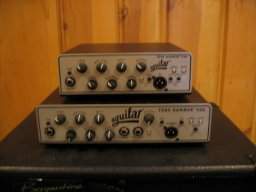
Here's the rack I was using:

--Alembic F-1X tube preamp
--Behringer Multi-com (compressor)
--Aphex parametric EQ (5 band, used to put in mids and roll off lows)
--Stewart World 2.1 (in stereo)
--2 x B2s (4 ohms) Lonnybass

Hi Lonnybass,

For me, your rig explains your experience. I've owned 8 ohm Low B2's for a number of years. I've never creased a driver, but I had to make some gear changes to make my rig sound good. The first was to get rid of my F-1X. That preamp has a natural, extremely scooped frequency shape (which you can mostly adjust out by turning the bass and treble way down and turning the midrange way up). The second was to get away from my Stewart World 2.1. That amp did not go well with Acmes, especially when bridged. I had much better results with my Demeter VTBP 201/Mackie 1400i combination.

Now I'm using those cabs with either a Demeter / QSC combination or an Epifani 902C. Unlike the Stewart, the Epifani's switching amplifier seems to have plenty of headroom to drive the Acmes. And like the way-too-heavy Mackie, the QSC has 30 Hz low frequency filters that help control excess excursion.

Everybody's experiences are different, of course, but for me, this is a great-sounding, no maintenance rig. (And once I switched out the Stewart, I never had a light bulb issue again!)

Cordially,
Greg Backstrom
 
Have them reconed, most likely the speakers he uses are made by Eminence anyway. Orange County speaker does an amazing job and they are fast too. I just had them recone an Ampeg 15 for me and they had it back to me in 3 days.

http://www.speakerrepair.com/
Our Sound Engineer gets our PA speakers from there.. and he raves about how "great" Orange County Speaker is. Our PA does sound pretty darn good.. might be worth your time to get in touch with them. Good hunting! :smug:
 
I haven't any experience with the World 2.1 but I do know of at least one bassist using it very successfully with a pair of Low-B2s in various rock bands. (Un?)fortunately they only run on US power and can't be switched to 230V for those of us the other side of the pond.

Power amps are funny things - there's little doubt in my mind that all pro amps meet the specs they claim, however from what I know about amp design no amp that meets its specs meets them precisely - the specs should be a minimum performance requirement. With bass guitar being very dynamic the ratio between peak and average power that an amp can deliver really matters - IMO that's why some of the old style heavy power amps can perform better due to the burst power output greatly exceeding the continuous power ouput.

Saying that I've certainly found my PLX 3002 drives my Acmes far better than my (admittedly half the power) Mackie M1400.

Alex
 
This has all been very interesting for me to follow. Greg, Josh, Alex (and the rest of ya'll!), all very interesting and highly informed insights.

For me, ditching my Alembic F-1x was never an option...that warm fat tubey goodness never failed to put a smile on my face...and that's with the controls at 2-10-2. I rarely, if ever touched them, and when I did, it was to reduce the bass setting. Mids were put in as needed using my rack parametric EQ.

With regards to the power amp, the Stew only let me down twice - and it's because I had it plugged into a Furman, which I found out afterwards that this was a big no-no with these amps. Interestingly, I still managed to crease cones and wreck voice coils with my Crown.

Eventually, I got to a point where I had to make a decision. It really became a "peace of mind issue" - did I want to spend more time and money troubleshooting, switching out componentry, trying to get to the bottom of the issue, and still worrying about potential damage? Clearly, there is a lot of science behind this stuff, and as we all know, a range of precautions and measures that need to be taken in minimizing those telltale spidery lines from appearing! An expensive and sometimes nervewracking proposition for me. Switching to the Schroeder 2x1210 setup was slightly bittersweet (honestly, I kind of felt like I was defecting after all those years as an Acme supporter!) but I haven't had a maintenance issue since.

Lonnybass
 
Interesting? Yes. Informative? Not necessarily so! The puzzle remains unsolved and I find that bothersome. If I were considering buying an Acme cab, I'd be saying "jeez...make up your mind! One source says the Acme cabs require a lot of power but another source says the cones crease when the correct power is applied!" I'd be somewhat hesitant to plunk down major bucks for a failure-prone cab.

Riis
 
Interesting? Yes. Informative? Not necessarily so! The puzzle remains unsolved and I find that bothersome. If I were considering buying an Acme cab, I'd be saying "jeez...make up your mind! One source says the Acme cabs require a lot of power but another source says the cones crease when the correct power is applied!" I'd be somewhat hesitant to plunk down major bucks for a failure-prone cab.

IMO I solved the puzzle. Obviously that has been overlooked.

Lonny was trying to get too much output in the 60-80Hz region because he was restricting the output in the 30-50Hz region. Power handling of most ported cabs is lowest an octave above the port tuning frequency and in the lows greatest at the port tuning frequency.

There is no point using a ported cab tuned to 30Hz if you EQ it out because that just means that all the bottom from your low B has to come to from the 2nd harmonic where the power handling is least. Let the 1st harmonic ring out and you will have tons of bottom without troubling the cab because the load will be shared between speaker cone and port.

He was also failing to hear the warning signal of the growly distortion of the speakers exceeding Xmax - as I said earlier, I think that the punchy growly lows he likes relies on this growl. Even if that's not the case, his liking of his Schroeder cabs suggests that the Acmes were exactly what he shouldn't have been using as the two designs couldn't be more far removed, particularly in their tone and output across the frequency spectrum.

As I've said before, do what I do and you will not have a problem! Also, try and EQ this much deep bottom out of any other similarly sized cab, and then hit them with this much power and you'll run into trouble far more quickly

Alex

P.S. I do have to give Lonny props for continuing to persevere for so long - but I think the change was a very wise, if somewhat overdue, move!
 
While Lonny's puzzle might remain unsolved, there are quite a few of us who have weighed in here about our positive Acme experiences. And I'd also say the "failure-prone" is a harsh overstatement, at least imo...

Heck, while I admit to having to realistically approach how much volume I would get from it, I've used the 130 watt Trace head listed in my profile a plethora of times with my B2 with no problems.


Oh, I'm on your side on this one. I own a B-4 and would buy another in a heartbeat. I say "failure-prone" from the perspective of a potential Acme purchaser after reading this thread. Face it, a couple of posting members have voiced concerns as to whether the Acme would be a suitable and reliable choice. I hate to leave them with the wrong impression.

Riis
 
Hey, this thread has resulted in me having a brain-drizzle.

I wonder if Andy would ever be interested in offering a version of his cabs with higher wattage (which I assume would mean more robust) speakers. Jim Bergantino uses a similar 'long throw' high xmax design in his larger cabs, and those things handle power and slapping and wumping like nobody's business.

It always struck me as unusual that the Acme's are known to 'want a lot of power' due to that deep low end extension, but then had one of the lower 'suggested maximu power ratings'... I think 250 watts for the B2... can't quite remember.

I know Andy is trying to keep costs down, but I can imagine that those cabs with more powerful drivers in them might really be something.

Just a though.
 
I thought you promised I could borrow them on Saturday night! :hyper:

Lonnybass

Would if I could but I can't so I won't. Need the cab for the Elks BBQ gig Saturday evening in Virginia Beach. What's really sad is that I'm not kidding. Won't crease the speakers but I do invariably spill barbecue sauce and beer on the carpet upholstery. Call it an occupational hazard.

I'm curious as to whether a major change in the signal chain (preamp, EQ, power amp) would have made the difference as suggested. What kind of response would one expect given the same signal chain but with a sealed cab?

Riis
 
Oh, I'm on your side on this one. I own a B-4 and would buy another in a heartbeat. I say "failure-prone" from the perspective of a potential Acme purchaser after reading this thread. Face it, a couple of posting members have voiced concerns as to whether the Acme would be a suitable and reliable choice. I hate to leave them with the wrong impression.

Riis

Agreed. IMHO, as a long time Acme user, any question about Acme's reliability would be misplaced.

I'd also like ot give props to Lonny for not taking any of what has been written here and misunderstood it as a criticism of himself personally. I've seen far too many internet discussions go south when discussion is perceived as personal attack.