• TalkBass has been independent since 1998. Add your voice.
    Create a free account to reply to discussions, view embedded media, and browse with fewer display ads.
    Join freeLog in
    Want zero display ads or expanded classifieds tools? Compare plans.

What's On Your Workbench?

I always run those at the slowest speed in my router.
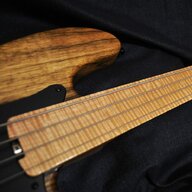
Amana recommends reducing RPM and feed rate by 30-50%, so yeah. My primary router (Porter-Cable 892) bottoms out at 10krpm, so that's where I run these little mini bits. Except, the purpose of this bit is to take a fairly shallow cut, and in not-very-hard wood, so I might run it up to 16krpm if it chatters or or burns at the lower speed.
 
So, honest question. Over the weekend my wife said -
"I don't wanna even think about how much money you've spent on building this bass. You probably could have just bought one by now."
How do you guys deal with that?!?!? :eek:

A long time ago my wife and I decided to give ourselves an equal allowance each month to spend on anything we want with no questions asked. We call it a "fun fund" and it works great for us.
 
A long time ago my wife and I decided to give ourselves an equal allowance each month to spend on anything we want with no questions asked. We call it a "fun fund" and it works great for us.

My wife and I do the same thing and it works great. :thumbsup:

Funny though, she always has a surplus of cash and I'm nearly always completely strapped. :roflmao:
 
Yesterday I tore into my Jazz Bass Special again, because I wanted to replace the extremely janky pickup foam with something better, and I also wanted to shield the electronics cavity since I've been having a little trouble with noise.

And of course the *&^%$#@! pickup wires broke at the connection points on BOTH pickups despite my attempts to be gentle. This is something like the third time one or both has broken. These are some older SD Basslines pickups, and I have to say, maybe SD has improved over the years, but these are not very well made. The hookup wires are hair-thin and they're attached to tiny little solder points with no protection at all. By way of comparison, a newer Precision pickup I have lying around that came out of some random Squier uses heavier, more flexible wire and there's a big blob of goop over the solder point to give it some strain relief.

So now I have an Epic Custom Shop PJ1 set on the way...
 
Gonna try to fix the pickup yourself? I like to resolder and then tack down the wire with hot glue, next to the solder point. I don't like to goop up the solder joint itself since that makes repair more difficult in the future, but tacking the wire down with glue near the solder point should pretty much eliminate possibility of damage.

Eh, I'm probably not going to bother trying to fix them again, to be honest. I've already fixed them a couple times (clearly not well enough!) and I'm not so in love with them that I really want to put a lot more effort into them, especially when I have another set on order that look better constructed and that I hope to like better.

Your idea of tacking down the wire near the solder point is a good one, though. Maybe I'll take some better hookup wire and see if I can get them back in working condition.
 
  • Like
Reactions: dwizum
Ugh, wiring and soldering. I'm seriously dreading this part on my build. I am no good at it at all.

I have been soldering since I was a kid so I might have a skewed perspective on this, but if you have a powerful iron with the right tip, soldering should be easy. I think a lot of people don't like soldering because of inferior equipment rather than the process of soldering itself. And to be clear, you don't need to spend a ton of money to get something that works. A while back my Weller iron broke and the heater element replacement parts weren't readily available so I picked up a cheap iron on Amazon as a stopgap. It was about $15, 60 W variable temperature with a few tips included. Worked way better than I would have expected so I still haven't ordered a replacement heater element for my old iron.

IME anything less powerful than about 50 W will almost certainly result in a poor soldering experience with things like soldering grounding wires to pots. Also, avoid the "pencil tips" because they can't transfer enough heat for things other than small components. A bit of flux paste will also make things easier, though for years I didn't use anything but flux core solder and that was fine for most things.

Good luck!
 
That's the easy part: a line is a wire! If you meant why some wire connects somewhere, yeah, there is a bit more to learn to figure that out.
Yeah, that's probably my issue. I look at all these lines and go "Okay, why does that go there?" And just trying to understand how and why a tone knob does what it does and what that little pill attached to it is doing......I'm lost.
 
  • Like
Reactions: Jeff Siddall
Also, avoid the "pencil tips" because they can't transfer enough heat for things other than small components.

Yeah, changing tips changed my experience with soldering. I have no idea why the conical tip seems to be the default on irons, because (IMO) it sucks. Maybe it's good for tiny surface-mount components or something, but for guitar electronics I find that it is just too hard to transfer a reasonable amount of heat with it. Switching to a chisel tip made everything about 10x easier.
 
  • Like
Reactions: Jeff Siddall
Yeah, that's probably my issue. I look at all these lines and go "Okay, why does that go there?" And just trying to understand how and why a tone knob does what it does and what that little pill attached to it is doing......I'm lost.

Hah, yeah, the tone knob. Looks simple enough: a capacitor and a pot, but exactly how it functions is dependant on the pickup, volume pot, tone pot, amplifier, even the patch cord. I am working on a new Natural Tone preamp designed to eliminate all those "dependant on..." factors -- but that's a separate topic.

Regarding the tone control, the simple way to think about it is that a capacitor (I assume that is the "little pill" you are referring to) only passes high frequencies. The tone knob controls how much of those high frequencies get diverted to ground and thus how much are missing from the remaining signal that goes to the amplifier.

 
FWIW, I bought this Weller soldering station a few years ago, and it's been more than adequate for anything I'm likely to solder, including a few DIY pedal kits and all manner of guitar wiring. It's not a Pro level setup, but I'm not a Pro, so no need for digital readouts. I've since seen it a few times on the bench of Pro amp techs on Youtube anyway, so it must be pretty good. Shop around, I think I paid $27 for it a few years ago. The tips are removable, and you can get a tip set that's sold separately that's good for pretty much anything:
https://www.amazon.com/Weller-WLC100-40-Watt-Soldering-Station/dp/B000AS28UC/ref=sr_1_2_sspa?dchild=1&keywords=weller+soldering+station&qid=1594146660&sr=8-2-spons&psc=1&spLa=ZW5jcnlwdGVkUXVhbGlmaWVyPUExQ0FYM1o1WEJFQ1hDJmVuY3J5cHRlZElkPUEwMTk3OTkwMTRYSkROVlFORzhHQyZlbmNyeXB0ZWRBZElkPUEwNTcyMzA1MzhUM0Y0SDhIREhGQiZ3aWRnZXROYW1lPXNwX2F0ZiZhY3Rpb249Y2xpY2tSZWRpcmVjdCZkb05vdExvZ0NsaWNrPXRydWU=

[URL]https://www.amazon.com/gp/aw/d/B07VYLBSG8/ref=sspa_mw_detail_1?ie=UTF8&psc=1
[/URL]
 
Last edited:
As an Amazon Associate, TalkBass may receive commissions from qualifying purchases made via links on this site.
Hah, yeah, the tone knob. Looks simple enough: a capacitor and a pot, but exactly how it functions is dependant on the pickup, volume pot, tone pot, amplifier, even the patch cord. I am working on a new Natural Tone preamp designed to eliminate all those "dependant on..." factors -- but that's a separate topic.

Regarding the tone control, the simple way to think about it is that a capacitor (I assume that is the "little pill" you are referring to) only passes high frequencies. The tone knob controls how much of those high frequencies get diverted to ground and thus how much are missing from the remaining signal that goes to the amplifier.
Okay, this is the single most basic explanation I've ever found. :thumbsup:
 
FWIW, I bought this Weller soldering station a few years ago, and it's been more than adequate for anything I'm likely to solder, including a few DIY pedal kits and all manner of guitar wiring. It's not a Pro level setup, but I'm not a Pro, so no need for digital readouts. I've since seen it a few times on the bench of Pro amp techs on Youtube anyway, so it must be pretty good.

I just got the exact same model after assessing what I really need for pedal building and bass electronics. It's much better than my old pencil that plugged into the wall outlet. Made sure mine came with the chisel tip. Transfers heat very quickly.
 
IMG_0476.JPG

Glued up the arms and legs to the cylinder. Need to carve a finial...I bought a nice hunk of purple heart for that...and to use tung oil to finish it off.
 
Greetings Luthier's Corner!

We are all...well, mostly...busy people. Sometimes we have something we want to share, but we don't have the time to write up a thread about it. I think that leads to a lot of talented builders lurking, because they're just too busy.

Let's see some more lutherie pr0n!


Taking some time off from "wood" things.

'34 SS1
 

Attachments

  • IMG_2397.jpg
    IMG_2397.jpg
    114 KB · Views: 60