The most important thing about P Basses is that there should be no "difference", unless the way you feel about that particular bass makes a difference to you. Genius product.

Enjoy the benefits of a premium membership!
Upgrade Account
-
TalkBass has been independent since 1998. Add your voice.
Create a free account to reply to discussions, view embedded media, and browse with fewer display ads.
Join free Log in
Want zero display ads or expanded classifieds tools? Compare plans.
You are using an out of date browser. It may not display this or other websites correctly.
You should upgrade or use an alternative browser.
You should upgrade or use an alternative browser.
What's REALLY the difference between all the different P-Bass models?
- Thread starter Tazziedevil
- Start date
More options
Who Replied?

I got a G&l LB 100 because I like a flatter neck and could get it with a 12” radius. I wanted to string it with flats so I got it with a quarter sawn neck option. I knew I’d want to string it with flats. I also prefer a matte finish or no finish on a neck. These preferences came from years and years of classical guitar, but with G&L you can have it the way you like it and the finish on the thing is shockingly tough. After 3 years I still can’t find any swirls in the finish. Just some swirls on the pick-guard. Nothing needs swapping out not the bridge, pickups, or tuners. And all this plus real Leo dna.

I went to a guitar center And tried all the different fender jazz basses. Not P basses but I think the principle is the same. I found that I like the professional series best. They are, of course, the most money, too. I wound up buying a sire V7. I gig entirely on upright bass so it was a real stretch for me to justify spending $2000+ on a “slab”. The sire was $600 shipped with the case. And I like it. (haven’t A/B’d it with the fender professional.)

I’m not confused by it, it seems pretty straight forward to me.That's the problem...while they do all sound a lot alike, each model sounds a bit different. I've had real vintage 50s and 60s Ps, 80s Ps, American Standards, no two were alike. Different pickups, different woods used. Then there's the feel issue...weight, neck profile, fingerboard material (maple vs. pau ferro vs. rosewood), different fret sizes, etc. While having a variety of models may be good from the standpoint of having a model for every budget from $100 Squiers to $$$$$ Custom Shop basses, it just leads to buyer confusion. You have to sit and play a lot of them and if dealers where you live don't stock a lot of the models, it sucks.
But yes, if you aren't too picky pretty much any P you pull off the wall will give you that sound.
The number of Jazz Bass models seems even greater to me, especially when you factor in non-Fender jazz rip offs like Sire etc. But I’m not interested in them. They seem to be mostly what local stores carry. It’s harder to find P basses - but for sure every one of them has a different voice, I don’t think that’s different with any other style of bass either. They’re all individuals. Every J is a J, but a Standard from 1994 feels and sounds a lot different compared to a Flea sig, or an Elite. But when you’re not really interested in any Jazz however, it’s a lot easier to filter them all out, and only look for P basses.

That's confusing?Except for the Tribute model vs USA model LB-100?

I’m not confused by it, it seems pretty straight forward to me.
OK, you want a vintage P bass sound like you hear on records from the 60s. You don't have the money for whatever the heck Fender now calls their vintage reissues (American Originals?) or Custom Shop. So which one do you buy?
I don't find it at all straight forward when they all come with different pickups but each is advertised as "vinatge spec"...then why are they different?
In the "good old days" up until the first Precision Bass Special came out in the late 70s, you had one choice: a P bass. At various point in time, you had a choice of fingerboard and neck width, at others you didn't even have that choice. The only other thing to decide was whether you wanted a custom color finish (today you can't choose this!!!). While the basses changed over time...a 51 P is different than a 55 which is different than a 58, etc....at any given time there was only one model being sold.
Today (skipping 5 strings, leftys and the 6 artist models, but including Squiers) there are 11 models to choose from.
That’s still easy and straightforward.OK, you want a vintage P bass sound like you hear on records from the 60s. You don't have the money for whatever the heck Fender now calls their vintage reissues (American Originals?) or Custom Shop. So which one do you buy?
I don't find it at all straight forward when they all come with different pickups but each is advertised as "vinatge spec"...then why are they different?
In the "good old days" up until the first Precision Bass Special came out in the late 70s, you had one choice: a P bass. At various point in time, you had a choice of fingerboard and neck width, at others you didn't even have that choice. The only other thing to decide was whether you wanted a custom color finish (today you can't choose this!!!). While the basses changed over time...a 51 P is different than a 55 which is different than a 58, etc....at any given time there was only one model being sold.
Today (skipping 5 strings, leftys and the 6 artist models, but including Squiers) there are 11 models to choose from.
Players (and the former Standards) are basically 70s spec Precisions. The Standard pickup is akin to the 70s Dimarzio pickups that were popular then. The Players are Alnico V, more like a vintage spec. If neither pickup set is working for you, you can easily buy a Duncan SPB-1 set, a GZR set, an Aguilar set, or one of many other pickups that will get you that “vintage sound”.
If you want a bass that feels like a vintage instrument, try a custom shop or a roadworn. If you want one that plays like how a vintage instrument would have played new, but a Vintera or an American Original.
If you consider nitro valuable, you have certain options. If you don’t, you have more options.
Just like if you want an A width neck you have certain options; if you want a C width neck you have certain options. If you're good with B width, more options.
The problem is that “vintage” doesn’t mean anything specific, and different P bass buyers want different things, and there are enough of each set of preferences to support a whole different model. The question is what do you want? What is important to you in a P bass?
And actually, you *can* choose custom colours, if the mod shop is available in your country. They offer all kinds of options - neck width, fretboard wood, and many finishes.OK, you want a vintage P bass sound like you hear on records from the 60s. You don't have the money for whatever the heck Fender now calls their vintage reissues (American Originals?) or Custom Shop. So which one do you buy?
I don't find it at all straight forward when they all come with different pickups but each is advertised as "vinatge spec"...then why are they different?
In the "good old days" up until the first Precision Bass Special came out in the late 70s, you had one choice: a P bass. At various point in time, you had a choice of fingerboard and neck width, at others you didn't even have that choice. The only other thing to decide was whether you wanted a custom color finish (today you can't choose this!!!). While the basses changed over time...a 51 P is different than a 55 which is different than a 58, etc....at any given time there was only one model being sold.
Today (skipping 5 strings, leftys and the 6 artist models, but including Squiers) there are 11 models to choose from.
Would you like for there to be fewer options? Fine - only shop amongst the Player series P basses, or the American Professionals. You’ve just successfully limited your options.
Why would you want to do that? I don’t really get what your complaint is. I mean I understand your words, it just doesn’t make sense to me.

OK, you want a vintage P bass sound like you hear on records from the 60s. You don't have the money for whatever the heck Fender now calls their vintage reissues (American Originals?) or Custom Shop. So which one do you buy?
I don't find it at all straight forward when they all come with different pickups but each is advertised as "vinatge spec"...then why are they different?
In the "good old days" up until the first Precision Bass Special came out in the late 70s, you had one choice: a P bass. At various point in time, you had a choice of fingerboard and neck width, at others you didn't even have that choice. The only other thing to decide was whether you wanted a custom color finish (today you can't choose this!!!). While the basses changed over time...a 51 P is different than a 55 which is different than a 58, etc....at any given time there was only one model being sold.
Today (skipping 5 strings, leftys and the 6 artist models, but including Squiers) there are 11 models to choose from.
This exactly it. Reading the official Fender blurb about each model, they all sound exactly the same on paper. Unless you're steeped in Fender lore It's a confusing mess.
Made in Japan re-issue? Vintage? American Standard? No idea!
What’s complicated?? It’s a p bass. Go to a store and play one until you find one you like. It’s just a bass guitar, it isn’t global supply chain management for feeding starving people. There are like zero consequences for picking the “wrong” one, they’re all P basses.This exactly it. Reading the official Fender blurb about each model, they all sound exactly the same on paper. Unless you're steeped in Fender lore It's a confusing mess.
Made in Japan re-issue? Vintage? American Standard? No idea!
What’s complicated?? It’s a p bass. Go to a store and play one until you find one you like. It’s just a bass guitar, it isn’t global supply chain management for feeding starving people. There are like zero consequences for picking the “wrong” one, they’re all P basses.
Well, you would think something like a P-bass wouldn't be complicated, but seeing as how we've just established there are at least 11 variants...
That doesn’t make something complicated.Well, you would think something like a P-bass wouldn't be complicated, but seeing as how we've just established there are at least 11 variants...
How many different types and brands of bass guitars are there? Yet here we are talking about just one.

...in fact, as I recall, years ago I had a MIM Jazz Bass, and decided I wanted "the real thing." Went to Guitar Center, bought a MIA Jazz. Kept it a couple of days, played it A/B with the MIM Jazz with my Acoustic 360 amp. Took it back. I actually preferred the MIM. Go figure.
The same thing happened to me with a MIA and a MIJ. I bought the Japanese.
That doesn’t make something complicated.
How many different types and brands of bass guitars are there? Yet here we are talking about just one.
how many types? Many.
We’re talking about just one because I’m after real world opinions about the 11 variants all of wildly different prices of one model of bass
since you don’t really have anything to add, maybe you should unsubscribe from this thread.
Lol that’s not how the internet works.how many types? Many.
We’re talking about just one because I’m after real world opinions about the 11 variants all of wildly different prices of one model of bass
since you don’t really have anything to add, maybe you should unsubscribe from this thread.
Since the question has been answered ad nauseum and would have been answered anyway by a simple google search and doing the same product research that any other consumer does on the internet, maybe you shouldn’t have created this post if you don’t like opinions from strangers. You’re taking a pretty adversarial position towards someone who has tried to make it simple (my first post, several pages ago, you liked it, so apparently I've contributed something), who just doesn’t understand why it’s a complicated issue for anyone. I hear that you’re confused, but I fail to understand what’s confusing, especially after the post from @dmt on page 2. What width neck do you like? What kind of P bass tone do you like? Maple or rosewood or pao ferro? What colour do you like? What’s your budget? Are light weight tuners or high mass bridges important for you? Answering all of those questions should get you the answer you need. If you want help, you could start by answering those questions - unless you're really not looking for help, but instead company, which is fine, but there isn't really any help left to offer you.
Last edited:
And actually, you *can* choose custom colours, if the mod shop is available in your country. They offer all kinds of options - neck width, fretboard wood, and many finishes.
Here's the Mod Shop btw - you may need to change the country setting for the website to US. Unfortunately, this provides you with many more options, not fewer:
Invalid Link Removed

You summed up the American Performer neck...and the mexican Playeri don’t really need a J pickup, and I’m not a huge fan of the baseball bat neck. Something between a jazz and super thick neck would be ideal for me!
Lol that’s not how the internet works.
Since the question has been answered ad nauseum and would have been answered anyway by a simple google search and doing the same product research that any other consumer does on the internet, maybe you shouldn’t have created this post if you don’t like opinions from strangers. You’re taking a pretty adversarial position towards someone who has tried to make it simple (my first post, several pages ago, you liked it, so apparently I've contributed something), who just doesn’t understand why it’s a complicated issue for anyone. I hear that you’re confused, but I fail to understand what’s confusing, especially after the post from @dmt on page 2. What width neck do you like? What kind of P bass tone do you like? Maple or rosewood or pao ferro? What colour do you like? What’s your budget? Are light weight tuners or high mass bridges important for you? Answering all of those questions should get you the answer you need. If you want help, you could start by answering those questions - unless you're really not looking for help, but instead company, which is fine, but there isn't really any help left to offer you.
your first post was helpful. Since then all you’ve really done is say over and over “I don’t understand what’s so confusing” even after someone pointed out there’s 11 different variations of something you say is “Just a P-Bass”. My question isn’t “is a P-bass any good?” It’s “is there $2,000 worth of difference between the entry level and the top model?” the thread has sorted of meandered since then, but threads don’t automatically close and lock after the first helpful post.
I could (and did) google the various models, but couldn’t find exactly the answer I was looking for. I figured I’d ask a community who has specific ideas about my exact question- a bunch of bassists.
to summarise:
-I prefer a neck that’s not super thick
-I prefer rosewood over maple, insure of Pau Ferro
-i don’t need a J pickup ( so eliminates several models)
-I want a deep, warm, thumpy tone
My budget could allow the “American Performer”. But obviously I don’t want to spend more than I have to.

I would consider something like this “New”, through on a set of Labella flat wounds and run with it, it seems to be what you are describing.
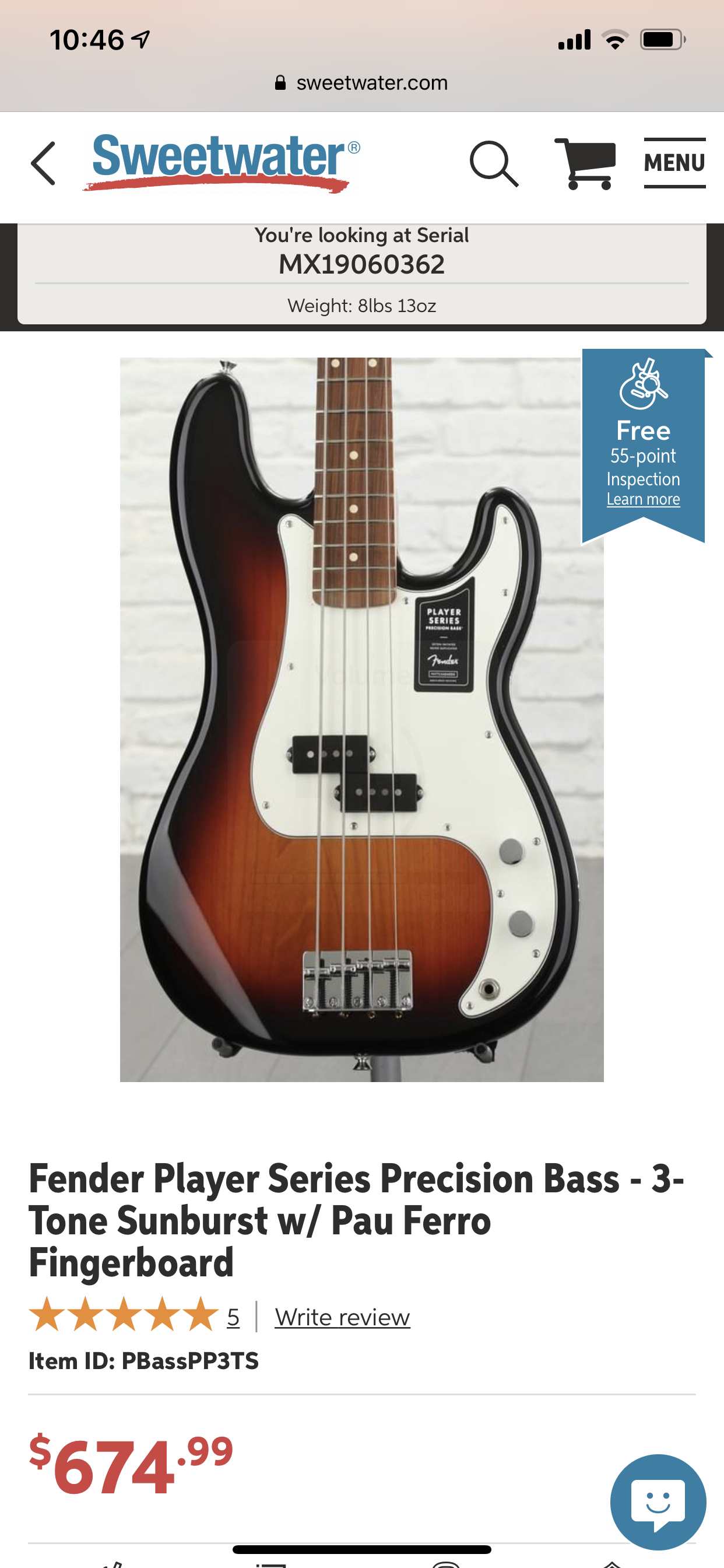
Thanks - when you say "not super thick" do you mean front to back, or width at the nut?your first post was helpful. Since then all you’ve really done is say over and over “I don’t understand what’s so confusing” even after someone pointed out there’s 11 different variations of something you say is “Just a P-Bass”. My question isn’t “is a P-bass any good?” It’s “is there $2,000 worth of difference between the entry level and the top model?” the thread has sorted of meandered since then, but threads don’t automatically close and lock after the first helpful post.
I could (and did) google the various models, but couldn’t find exactly the answer I was looking for. I figured I’d ask a community who has specific ideas about my exact question- a bunch of bassists.
to summarise:
-I prefer a neck that’s not super thick
-I prefer rosewood over maple, insure of Pau Ferro
-i don’t need a J pickup ( so eliminates several models)
-I want a deep, warm, thumpy tone
My budget could allow the “American Performer”. But obviously I don’t want to spend more than I have to.
The Player Series has a modern C neck profile that most people seem to be happy with, but does not have rounded edges on the fretboards - to get that you have to go to the American Professional, or a used American Standard. However, if you're looking for a J width neck, your Fender options are limited - there have been a few, but not many. However, the 60s and 50s models (like the Vintera, Classic series, Roadworn Series, American Originals, American Vintage Reissues, and many of the various Custom Shop models) have a 1.75" nut width, which many people find off putting. Start with the Player series as the baseline.
If you want Rosewood, you're looking at American models, currently - the former Standards (MIM) had Rosewood, but CITES makes that cost prohibitive these days. For me, I think Pao ferro is fine, I just am not super enamoured with the looks of the paler examples. I have seen some with dark pao ferro that look to me just like rosewood, but if you're ordering online it's a crapshoot.
In addition to a neck that's the same shape as the neck on the Player, the Performer has rosewood as an option, and lightweight tuners like on the Professional. Unfortunately, it also has the greasebucket tone circuit, which I really dislike, and what is for me the useless appendage of a J pickup. So I rule those out right away. I can't justify the price difference.
For me, I don't like wider nut width necks, having owned a '57 AVRI and a Classic 50s. I played both for years and then fell in love with a used American Standard. I like the rolled fretboard edges that only come on the older American Standard, the Professional, and the Elites, and for me, for a primary workhorse, the neck differences are worth the extra money. I also like the string-through bridge option on each of these models, and the lightweight tuners, and I also like getting a case.
Those features aside though, I have owned several Standards (the MIM ones, versus the "American Standards"). I can play those all day long, and the Players are basically the same thing. My standard thing to do on Standards when I get one is to throw out the crap pickups that come in them and drop in something else - these days I really like a Duncan SPB-1. The Players however have different, possibly better, pickups than the Standards did - it's a matter of taste.
Deep, warm, and thumpy mean different things to different people, and for some they can get there with the tone knob and EQ'ing; for some of us, a pickup replacement is needed or desired. The SPB-1 can get me into some very classic vintage-style tone, but is also very versatile with a turn of the tone knob. I have a set of EMG GZR's here that I haven't had a chance to try out yet though, and I hear they're similar, slightly stronger low end, and they're also a solderless install, so you can't go wrong with those either, but they're a bit more expensive. The Vmod pickup on the Professionals is ok, IMO, and the CS62 on the former American Standard is also ok. Both pretty versatile. I still prefer the SPB-1. If you want a similar pickup from Fender, you're looking at the Pure Vintage '63, which is only stock on the American Original 60s P, which means you have to deal with the wider neck. If you can access the Mod Shop, you get to have an American Professional body (and bridge and tuners) with *many* different colour options, several pickup options, several pickguard options, a few neck profile and width options, and the main fretboard, options, plus a case for about what you'd pay for an American Original, or more than twice what you'd pay for a Player. It just depends on whether those options are worth it to you.
Best bang for the buck is a Player, IMHO. If you were gigging a lot, I'd suggest that the Pro has a more comfortable neck and this alone might make it worth the extra dough for you. The neck is the main thing for me - everything else can be replaced or upgraded if desired, but does not *need* to be replaced or upgraded. You can buy a Player and keep it stock for the next 30 years and still be happy with it. They're basically 70s spec Fenders, only consistently better quality.
My seeming obtuseness is due to the fact that these days the differences are mostly features, not so much quality. It's really a matter of what features you need or want. There *are* a lot of options, but most of them I can rule out right away. There are also a lot of Jazz bass options, and most of those I can also rule out right away, if and when I go shopping for a Jazz, which rarely happens anymore.
Last edited:


