
Yep, it would sound EXACTLY like a concrete and steel bass........
So good for Rock AND Metal???

TalkBass has been independent since 1998. Add your voice.
Create a free account to reply to discussions, view embedded media, and browse with fewer display ads.
Join free Log in
Want zero display ads or expanded classifieds tools? Compare plans.
Yep, it would sound EXACTLY like a concrete and steel bass........
So good for Rock AND Metal???

^ That.

The problem there is that it implies that you can take any old bass parts (neck and body made of basswood and an ebonal board) slap a Sadowsky, Ken Smith or Fodera preamp, pickups, a decent bridge and tuners and you get that sound.

There is more to it than JUST the wood...but the wood choices are absolutely a large part of what makes a bass sound as it does.

The bridge and the nut are where the strings come into contact with the guitar. What type of glue was used to hold the nut on? What metal is the bridge? How humid is it? Is it cold outside (ie. below freezing). These things effect how the strings vibrate. The wood plays no noticeable difference.
For the test we used the exact same neck, bridge, electronics (without desoldering), strings, nut, tuners, string tree, etc...EVERYTHING but the wood was the SAME. In fact, we went so far as to take measurements on the setup (including pickup distance from strings) so we could ensure that EVERYTHING was indeed the same, and that the ONLY variable was the body wood itself. This test was done over a 2-3 hour period indoors, so ears were fresh, temp was stable, and humidity didn't change.
Guess what ?
It was EASY to hear the differences
In a solidbody eletric instrument the electronics and strings are a mere 95% of the signal. Even "the best" ears can be fooled.
The problem there is that it implies that you can take any old bass parts (neck and body made of basswood and an ebonal board) slap a Sadowsky, Ken Smith or Fodera preamp, pickups, a decent bridge and tuners and you get that sound.
It doesn't work that way. You make basses and people pay for them?

I wish I had the resources to do this. I'd love to be able to find exactly the wood I want on a bass without having to rely on what's at the music shop.I'll repeat what I said in another thread...
A few years back, a friend and I did a test. I got 4 P Bass bodies, all 5 lbs (+/- 1 ounce)....woods tested were mahogany, alder, ash, and maple capped ash.
For the test we used the exact same neck, bridge, electronics (without desoldering), strings, nut, tuners, string tree, etc...EVERYTHING but the wood was the SAME. In fact, we went so far as to take measurements on the setup (including pickup distance from strings) so we could ensure that EVERYTHING was indeed the same, and that the ONLY variable was the body wood itself. This test was done over a 2-3 hour period indoors, so ears were fresh, temp was stable, and humidity didn't change.
Guess what ?
It was EASY to hear the differences from one body wood to another. You didn't even have to "begin" to strain yourself. In fact, we preferred alder as the best tone, with mahogany as a "second choice", for it's big fat thump. Alder was certainly the most balanced sounding.
Remember, all these bodies were +/- 1 oz, so the largest possibly variation between bodies was 2 ounces. That's all. Of course those who believe that body wood doesn't matter, MUST, by definition, also believe that weight cannot possibly make a difference, so to some it is a moot point....but we wanted to make sure that we would eliminate as many variables as we could.
If wood type affected tone as much as many people believe, where are the sound clips? Any double blind tests?
Everything else is heresay.


I tend to agree with this. I believe that pre-conceptions can affect our senses greatly.

If wood type affected tone as much as many people believe, where are the sound clips? Any double blind tests?
Everything else is heresay.

Now I'm no expert on guitar electronics, nor bass building, but I would assume that magnetic pickups, which are simply a different kind of transducer, operate in a similar manner. Feel free to correct me, though.

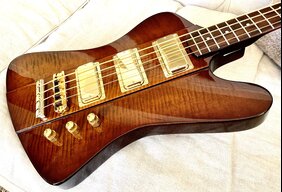
Our basic preamp & pickup combo is all Bartolini (we do offer a few different combinations, but that's the choice on over 80% of what we build). I really don't think our basses sound like anyone else's basses (and those guys you mention up there are pretty damn good too), and since that is such a basic, generic electronics setup in the "bass guitar world", why don't we all sound the same? All being Lakland, Elrick, Sukop, Modulus, Zon, and on and on all use basically the exact same set up we do!
There is more to it than JUST the wood...but the wood choices are absolutely a large part of what makes a bass sound as it does.


