

Enjoy the benefits of a premium membership!
Upgrade Account
-
TalkBass has been independent since 1998. Add your voice.
Create a free account to reply to discussions, view embedded media, and browse with fewer display ads.
Join free Log in
Want zero display ads or expanded classifieds tools? Compare plans.
You are using an out of date browser. It may not display this or other websites correctly.
You should upgrade or use an alternative browser.
You should upgrade or use an alternative browser.
Where exactly is the " sweet spot" pickup placement
- Thread starter Stephen
- Start date
More options
Who Replied?
I think many people place their right hand on the pickup housing for support while they pluck the strings. If the pickup is placed midway-ish between the neck and bridge, you get a certain comfort; the string is neither too loose or too tight to play, and the sound is neither too bassy or too trebly/nasal. A nice middle ground, and as such can be called a sweet spot for a pickup, but it is not a scientific sweet spot. But we all abide by feel, right?
Yes, this is true, which is why everyone should at least once in their life have tried a WESTONE bass with the sliding pickup in. The one who posted a few posts ago said himself that a notch up or down the rail of the pickup DOES really make a huge difference. Huge! Not small! Otherwise Westone wouldn't make any of these basses. I think Teuffel/Tesla guitars (no bass) are the only ones with these features today. But it's a avant garde boutique design, and priced accordingly.
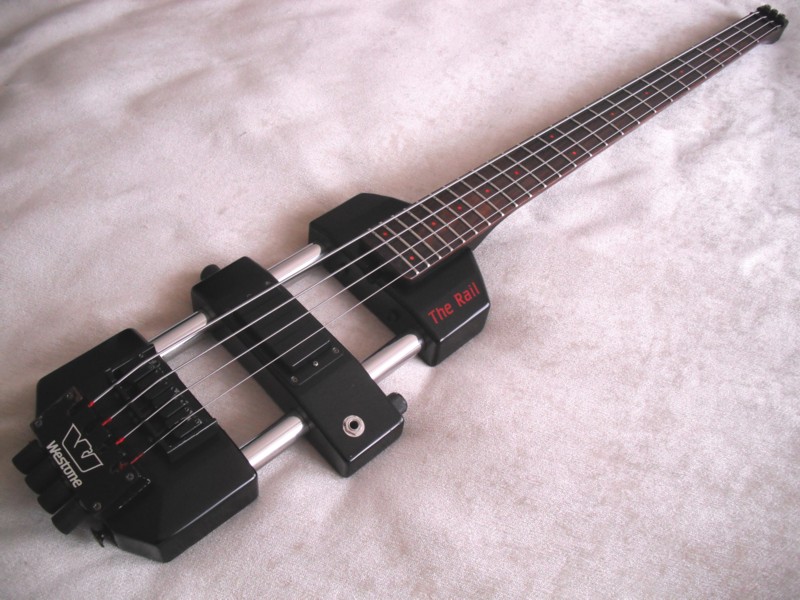
This bass - for sure - has its pickup placed on the sweet spot, which is anywhere on the rail...
I have one, and since I support my right hand on the pickup, you get a double effect as you move it from bridge and forward: 1. The pickup forward makes the sound bassier.
2. Plucking over the pickup as it moves forward gets increased string movement and more bass as it gets more "floppy" nearer the neck.
It's really brilliant!
For single pickup basses its going to be between where neck and bridge pup would be as general rule. So you get more a sound inbetween neck and bridge placement position. Not as bright as bridge, not as dark as neck.
With strat guitars the middle pickup is creditied with providing the qauck sound of strat due to its placement. I dunno the specif reason why other then supposedly related to harmonics pickup sensitivity somehow.
With strat guitars the middle pickup is creditied with providing the qauck sound of strat due to its placement. I dunno the specif reason why other then supposedly related to harmonics pickup sensitivity somehow.
I've waited and waited for someone to comment his excellent java applet and diagram, and I find it peculiar that no one's dared to comment it yet. There is - if one should take this playful applet and chart diagram seriously - a sweet spot. Or no really, but clearly an opposite, a no-no spot. It shows clearly in this applet. Even for bass. Even regardless of scale, bass and so on. Or regardless of fret.
No matter where you fret, or scale, there's always a serious DIP - i e node - right after the 5 K mark. So if you use one pickup you shouldn't place it there.
The applet is fine but it isn't showing me a sweet spot. It shows me that there are frequency nulls that depend on the pickup placement and the open string frequency and the pickup sensing aperture (width). Most of us already know this and that may be why no one has "dared" to comment on the applet. The pattern of frequency nulls varies quite a bit from string to string so if you found a sweet spot on one string it would not be so sweet on the others.
Yeah, I don't find your dip at just above 5k. Yes, I see it is there when you first open the applet but of course the applet defaults to parameters suitable for a regular guitar. Set the scale length to 34, the open string frequency to 41 to 98 Hz (suitable for a traditionally tuned four string bass) and the pickup width to 0.75 and you find that null has shifted in frequency. In fact it tied to the pickup width and open string frequency. And I have to ask you, exactly how would I put the pickup on my Jazz bass in the 5kHz position?? You seem to be missing the point that the null frequency is set by the pickup width and open string tuning, it is going to be at the frequency the applet predicts (assuming the applet is correct) no matter where you put the pickup. Given that you tune your bass the way you tune your bass for other reasons that will not change the only way you can control the location of that null is to use wider or narrower pickups and its location will still vary from string to string.
So that null you see and the humps on either side of it have nothing to do with the semi-mythical sweet spot which has to do with the pickup location.
Ken
With strat guitars the middle pickup is creditied with providing the qauck sound of strat due to its placement. I dunno the specif reason why other then supposedly related to harmonics pickup sensitivity somehow.
Not only, you get more quack if one of the combined pickups are OUT OF PHASE too, with each other. And they have to be single coils with narrower aperture. But the placement is important, but not solely. Place any humbucker in either sweet spot, serial, pararell, out of phase, in phase, and that quack hollow sound is gone.
Yeah, I don't find your dip at just above 5k. Yes, I see it is there when you first open the applet but of course the applet defaults to parameters suitable for a regular guitar. Set the scale length to 34, the open string frequency to 41 to 98 Hz (suitable for a traditionally tuned four string bass) and the pickup width to 0.75 and you find that null has shifted in frequency.
Of course I've tried to do this. But it still shows the same. I downloaded the latest Java, Firefox latest, and so on.MacBook Pro latest one. Still shows the same dip. But as fast as I add another pickup and move them, those nulls aren't that pronounced. And it changes as you move them around.
Well then, let's assume it's correct then, but then it may not be. I tried the same now, on another PC/Windows I have with Iinternet explorer and latest Java included. Same thing happens. Follow instructions clearly. As I "fret" or choose a fretting point it only moves up everything accordingly.In fact it tied to the pickup width and open string frequency. And I have to ask you, exactly how would I put the pickup on my Jazz bass in the 5kHz position?? You seem to be missing the point that the null frequency is set by the pickup width and open string tuning, it is going to be at the frequency the applet predicts (assuming the applet is correct) no matter where you put the pickup.
Given that you tune your bass the way you tune your bass for other reasons that will not change the only way you can control the location of that null is to use wider or narrower pickups and its location will still vary from string to string.
So that null you see and the humps on either side of it have nothing to do with the semi-mythical sweet spot which has to do with the pickup location.
Funny thing all things changes when I add a pickup. Then it becomes a non-issue. The nulls aren't to the right of 5K.
Of course I've tried to do this. But it still shows the same.
Well it is working differently on your computers from mine then. I have the latest Java, Firefox, and Windows 7/64.
With a 34 inch scale and 0.75 inch pickup width I get that null at about 8 kHz on the 98 Hz G string, about 6 kHz on the 73 Hz D string, 5 kHz on the 55 Hz A string, and 4 kHz on the 41 Hz E string. It drops down to 3 kHz on the 31 Hz B string. The paper on which the applet is based does not discuss this behavior.
On the E string that null drops to 3 kHz for a 1 inch wide pickup, to about 1.2 kHz for a 2 inch wide pickup, and it rises to about 6 kHz for a 0.5 inch pickup. This behavior is discussed in the paper and what I see is consistent with the author's predictions. If you are not seeing this then something is wrong with the way the applet is running for you.
So I don't know what to say other than if the applet is running differently for the two of us it isn't a very dependable applet.
Ken
I think it's in the vein of not being that dependable applet for some people. I tried it now on three different computers AGAIN, with different platforms. Three different PCs, one stationary with XP sp2, ff latest, and java. And one laptop with win 7 ie 9. All with latest java. And of course MacBook Pro, with both safari browser and ff.
actually, the clapton/knopfler/cray "quack" or "cluck" strat sound is that middle combined with either the bridge or the neck pickup, usually the bridge pickup.With strat guitars the middle pickup is creditied with providing the qauck sound of strat due to its placement. I dunno the specif reason why other then supposedly related to harmonics pickup sensitivity somehow.
sorry, that's not true at all.Not only, you get more quack if one of the combined pickups are OUT OF PHASE too, with each other.
people have been calling that strat in-between sound "out of phase" forever, but those pickups are very much in phase (in polarity, actually) with each other.
if you wire a strat so that two pickups really are out of phase with each other, the combined sound will be hideously weak and thin.
(this is not the same as the natural differences in phase of various upper harmonics of the string being heard by the two pickups at different points along the string. rest assured, the fundamental pitch of the string is very much in phase through all three pickups.)
Sorry but I did this to a strat once, and several others after that. The middle pickup has to be out of phase to produce that quack even more. However, as I said, NOT ONLY, the rest of it is just as important. And if you use too much difference in the relative output between them, say an overtly hot or overwound bridge pickup, all that quack is lost. It depends on everything else as well. And no, I just don't mean reversing the pickup, so that you turn any pickup around if there should be place for it under the pickguard. I e turn it upside down.
Oh BTW, I know quite a few people, including myself that thinks that that "quack" sound REALLY IS hideously weak and thin by default, really, no matter how it's done. The pararell or serial connection makes sense too. And one thing, small humbuckers like those that Seymour Duncan puts out, or Joe barden, with humbuckers in the same housing as single coils, all quack IS lost in those in between sounds. Can be huge difference in the sound. But that quack/hollow sound, it's something I very rarely use anymore, if ever.
Oh BTW, I know quite a few people, including myself that thinks that that "quack" sound REALLY IS hideously weak and thin by default, really, no matter how it's done. The pararell or serial connection makes sense too. And one thing, small humbuckers like those that Seymour Duncan puts out, or Joe barden, with humbuckers in the same housing as single coils, all quack IS lost in those in between sounds. Can be huge difference in the sound. But that quack/hollow sound, it's something I very rarely use anymore, if ever.
maybe we're talking about different things here; if you want your strat M+B setting to have that sweet, clucky, jangly sound like all the classic records, like "sultans of swing" or "bell bottom blues" or robert plant's "big log", then the pickups all need to be in phase. (in polarity, to be accurate)Sorry but I did this to a strat once, and several others after that. The middle pickup has to be out of phase to produce that quack even more.
if you're talking about a super thin, harsh skanky funk tone, almost like the guitar is broken, then by all means run a pickup out of polarity with the others.
if it really is a pickup wired out of polarity with its neighbor, i'm not surprised.Oh BTW, I know quite a few people, including myself that thinks that that "quack" sound REALLY IS hideously weak and thin by default, really, no matter how it's done.
...that quack/hollow sound, it's something I very rarely use anymore, if ever.
No, even when the north south is the same. I mean even before anything "out of phase" is considered. BTW "Sultans Of swing" doesn't have that M+B setting at all. At least not on the album version, that is most known. He did use M+B setting for comping and chording, but both middle solo and ending solos are middle pickup only. I find it peculiar when all the know-it-alls comes up - or all cover bands for that matter - plays it all with M+B settings. The solos are all just M pickup. Mark Knopflers strats at that time did have a 3 way switch only.
However, Sweet Home Alabama intro is all M+B.
And I even don't think that sounds THAT great either. Never liked the M+B sound at all, it may be great for some intros and fill ins, but I think when anything in background kicks in, the sound totally drowns out and disappears. I e just like it were out of phase. Too hollow. But that's just my personal taste and should not be imposed up on to anyone else. People still plays it today, and likes that hollow in between sounds. Mike Oldfields hit "Moonlight Shadow" has M+B in the solo. Totally different from Knopflers solos in Sultans of Swing. If you listen carefully. Very.
Invalid Link Removed
However, Sweet Home Alabama intro is all M+B.
And I even don't think that sounds THAT great either. Never liked the M+B sound at all, it may be great for some intros and fill ins, but I think when anything in background kicks in, the sound totally drowns out and disappears. I e just like it were out of phase. Too hollow. But that's just my personal taste and should not be imposed up on to anyone else. People still plays it today, and likes that hollow in between sounds. Mike Oldfields hit "Moonlight Shadow" has M+B in the solo. Totally different from Knopflers solos in Sultans of Swing. If you listen carefully. Very.
Invalid Link Removed
Maybe the sweet spot is where the pickup picks up the most of a strings CLANG TONE ? Or THE LEAST of the clang tone? Which I find quite peculiar that no one around here has brought up yet.
You know, if you ever heard a piano string, open the lid, and dampens it with your fingers so there's no note/tone vibration but you hear the hammer hit it just like a bell, and it just goes CLONNNK!!! Which is actually the same sounding on a large interval across all strings save from the most bottom and highest ones. The "thud". ?
Now, then I hear you go "but we pluck the strings.. not hit it with a hammer..." Well, most funk, thumb, pop and slap is hitting the strings from above with the thumb just like a piano hammer. Lots of bassists plays like this, and - this will scare you - all of the time!
Maybe?
Or the other way around? Totally opposite? Where it pick ups THE LEAST of a strings "clang tone" ? The clang tone is totally independent of a strings tune or pitch or gauge. On pianos it's mostly in the bass range, so that's what we're discussing around here. Bass strings, the bass section of any stringed instrument. I do think, that it should be "removed" as much as possible, if I was into it. But I don't know if it is what gives any pickup or bass sounds its distinct idiosyncrasies.
Mind you it's not a statement, it's a question I put out for others to discuss, and I am not at all sure it is like this, that's why I throw it out here, because it hasn't been taken into consideration at all, in this thread so far.
Maybe?
It don't mean a thang if it ain't got that clang...:
Invalid Link Removed
If you care to read this, you'll probably know what I am aiming for. Maybe it is this that people are chasing "holy grail of sweet spot" ? Or chasing to avoid completely? I do think there is a large deal of CLANG tone to any bass guitar, regardless of gauge, or types of strings. flatwound roundwound etc. I think, since all hammers of a piano is lined up i a straight row, but each string is totally different in lenght, all hammers must hit the strings at a certain sweet spot, whatever that is on a piano, to avoid a) pronounced artifical harmonic nodes b) avoid clang tone. Or c) enhance the clang tone.
You know, if you ever heard a piano string, open the lid, and dampens it with your fingers so there's no note/tone vibration but you hear the hammer hit it just like a bell, and it just goes CLONNNK!!! Which is actually the same sounding on a large interval across all strings save from the most bottom and highest ones. The "thud". ?
Now, then I hear you go "but we pluck the strings.. not hit it with a hammer..." Well, most funk, thumb, pop and slap is hitting the strings from above with the thumb just like a piano hammer. Lots of bassists plays like this, and - this will scare you - all of the time!
Maybe?
Or the other way around? Totally opposite? Where it pick ups THE LEAST of a strings "clang tone" ? The clang tone is totally independent of a strings tune or pitch or gauge. On pianos it's mostly in the bass range, so that's what we're discussing around here. Bass strings, the bass section of any stringed instrument. I do think, that it should be "removed" as much as possible, if I was into it. But I don't know if it is what gives any pickup or bass sounds its distinct idiosyncrasies.
Mind you it's not a statement, it's a question I put out for others to discuss, and I am not at all sure it is like this, that's why I throw it out here, because it hasn't been taken into consideration at all, in this thread so far.
Maybe?
It don't mean a thang if it ain't got that clang...:
Invalid Link Removed
If you care to read this, you'll probably know what I am aiming for. Maybe it is this that people are chasing "holy grail of sweet spot" ? Or chasing to avoid completely? I do think there is a large deal of CLANG tone to any bass guitar, regardless of gauge, or types of strings. flatwound roundwound etc. I think, since all hammers of a piano is lined up i a straight row, but each string is totally different in lenght, all hammers must hit the strings at a certain sweet spot, whatever that is on a piano, to avoid a) pronounced artifical harmonic nodes b) avoid clang tone. Or c) enhance the clang tone.
From Ralph Novaks site (fan frets):
"Some interesting points about the clang tone:
It is almost completely unaffected by tension! Altering the tuning of the string by changing the tension does not change the clang tone by more than a "comma" over the entire range of tension of the string.
It is minimally affected by mass or weight.
It is primarily affected by length."
The idea is that all strings of the same length share the same clang-tone regardless of pitch or diameter.
"The clang tone concept has me excited because it may explain the comments that players make when they hear a "fanned fret" guitar compared to a single-scale length guitar. Consistently they say the sound is more "focused," more "alive," and more "in tune." This has been such a consistent response from so many different players that I've been seeking to discover the reason. Perhaps the clang tone effect is strong enough in the guitar to be a factor. Since the string tension and weight won't affect the clang tone much, single scale length guitars have essentially the same clang tone for all strings! My multiple-scale length guitars (Fanned-Fret®) have a different clang tone for each string, possibly smoothing out the harmonic "holes" or changing the phase relationships between the actual tuning frequency and the clang frequency, similar to the way piano tone is improved by manipulating clang tones."
"Some interesting points about the clang tone:
It is almost completely unaffected by tension! Altering the tuning of the string by changing the tension does not change the clang tone by more than a "comma" over the entire range of tension of the string.
It is minimally affected by mass or weight.
It is primarily affected by length."
The idea is that all strings of the same length share the same clang-tone regardless of pitch or diameter.
"The clang tone concept has me excited because it may explain the comments that players make when they hear a "fanned fret" guitar compared to a single-scale length guitar. Consistently they say the sound is more "focused," more "alive," and more "in tune." This has been such a consistent response from so many different players that I've been seeking to discover the reason. Perhaps the clang tone effect is strong enough in the guitar to be a factor. Since the string tension and weight won't affect the clang tone much, single scale length guitars have essentially the same clang tone for all strings! My multiple-scale length guitars (Fanned-Fret®) have a different clang tone for each string, possibly smoothing out the harmonic "holes" or changing the phase relationships between the actual tuning frequency and the clang frequency, similar to the way piano tone is improved by manipulating clang tones."
I think those of you who owns any Westone sliding pickup bass would have a fair chance for trying this out by a very simple experiment:
1. Get out a cloth that you clean the strings with regularly. Pour some Isopropanol- alcohol onto it, and drag it ALONG each string.
2. A sound that can wake up the dead can't it? EEEEEEKKKK!!!!
3. Record that sound with an external - ordinary - microphone, it won't be taken up by the magnetic pickup.
4. Take it to your computer, analyze it with a spectrum or frequency analyzer and check out which frequency this EEEEEEKKK! peaks at. Note it down. Not exactly but around.
5. Record your bass through the magnetic pickups, and play open strings, but move the pickup on the rail.
6. Now watch the spectrum/frequency analyzer when it - sort of - enhances that harmonic, or frequency that is equal or around that clang tone. Mind you it can make you level indicators go red and above all of a sudden.
7. Now, move the pickup towards a place where that frequency is picked up the LEAST by that lone pickup.
8. Make a recording. Look through frequency/analyzer and so on.
9. Report to us here, which one you preferred.
Clang or no clang? That's the question.
1. Get out a cloth that you clean the strings with regularly. Pour some Isopropanol- alcohol onto it, and drag it ALONG each string.
2. A sound that can wake up the dead can't it? EEEEEEKKKK!!!!
3. Record that sound with an external - ordinary - microphone, it won't be taken up by the magnetic pickup.
4. Take it to your computer, analyze it with a spectrum or frequency analyzer and check out which frequency this EEEEEEKKK! peaks at. Note it down. Not exactly but around.
5. Record your bass through the magnetic pickups, and play open strings, but move the pickup on the rail.
6. Now watch the spectrum/frequency analyzer when it - sort of - enhances that harmonic, or frequency that is equal or around that clang tone. Mind you it can make you level indicators go red and above all of a sudden.
7. Now, move the pickup towards a place where that frequency is picked up the LEAST by that lone pickup.
8. Make a recording. Look through frequency/analyzer and so on.
9. Report to us here, which one you preferred.
Clang or no clang? That's the question.
Mind you number III: That applet that we discussed earlier, that doesn't seem to work as advertised, amd doesn't take into account the clang tone frequency or strings TOTAL LENGTH at all. Just the scale in which it is used.
The clang tone is mostly and only heard in/at the initial attack of the note. It peters out in a 50-100 ms. Hence that bell "clonk" or "thump" I was describing earlier. All of you with a tuning fork will now what I am talking about. The sound that is heard when it's hit - but - damped. The high pitch "clink" or "clonk".
The clang tone is mostly and only heard in/at the initial attack of the note. It peters out in a 50-100 ms. Hence that bell "clonk" or "thump" I was describing earlier. All of you with a tuning fork will now what I am talking about. The sound that is heard when it's hit - but - damped. The high pitch "clink" or "clonk".
[topic swerve]
hmm, yeah, i think you might be right about knopfler using the middle strat pickup by itself for the solos on "sultans"; it's a little hard to tell, plucking with fingers yields such a different tone than a pick; my only point is that all of these classics ("sweet home" included) were done on pickups very much in polarity with each other.[/topic swerve]
as for the clang tones, i think they're called "wolf" tones too? and yes, you can create that piercing squeak by dragging a pinched cloth up the string, grab the tuning key and twist it, and that squeak will not change pitch. it's indeed all about the length of the string, AFAIK it's a compression wave traveling up and down the metal longitudinally, like when you stretch out a slinky and bump one end.
i just tested a guitar i had lying around, and sure enough, i was able to produce a faint squeak like that; the pitch didn't change when de-tuning the string or when fretting it! that might mean the pitch is determined by the entire string length, behind the nut included.
not sure how relevant this is though, since we don't bow electric strings.
hmm, yeah, i think you might be right about knopfler using the middle strat pickup by itself for the solos on "sultans"; it's a little hard to tell, plucking with fingers yields such a different tone than a pick; my only point is that all of these classics ("sweet home" included) were done on pickups very much in polarity with each other.[/topic swerve]
as for the clang tones, i think they're called "wolf" tones too? and yes, you can create that piercing squeak by dragging a pinched cloth up the string, grab the tuning key and twist it, and that squeak will not change pitch. it's indeed all about the length of the string, AFAIK it's a compression wave traveling up and down the metal longitudinally, like when you stretch out a slinky and bump one end.
i just tested a guitar i had lying around, and sure enough, i was able to produce a faint squeak like that; the pitch didn't change when de-tuning the string or when fretting it! that might mean the pitch is determined by the entire string length, behind the nut included.
not sure how relevant this is though, since we don't bow electric strings.
the thing with Novaks explanation dumbfounds me. If a clang tone is dependet on the TOTAL LENGTH of a string even behind bridge and nut - and yes, it sounds the same when removed from the string altogether - the advantages of fanned frets goes out of the windows since the clang tone does not change with the scale. However, a piano string certainly isn't bowed either, but clang tone is something piano tuners and builders are very aware of.
Now, LINE6 has this to say about clang tones/wolf tones:
"What is clang-tone? Clang-tone, or wolf tone, is a sound inherent in a vibrating string. A string vibrates in three modes: Torsional, Longitudinal, and Transverse. Torsional vibration does not produce a sound wave – it is the string just twisting like a drive shaft in a car. Longitudinal vibration is what the magnetic pickups on a guitar are “hearing” and reproducing. Transverse vibration is a wave going up and down the string as it is stretches and relaxes longitudinally. Magnetic pickups do not reproduce Transverse vibration, but it is the type of vibration that a piezo pickup “hears,” and it produces the clang. Some describe its sound as a “ping” or “plink.” It is there even on acoustic guitars.
Numerous times Lloyd and his crew met with a Line 6 team that included Line 6 co-founder and chief technology officer, Michel Doidic. We showed Lloyd and his people what we were up against and they took the bull by the horns to help us tackle it. They did a great job. Between Lloyd and Michel’s work on the clang-tone issue, and some slick DSP algorithms by our engineering and sound design guys, clang-tone has been essentially eliminated. (Big kudos to Lloyd and Michel for spearheading this.)"
http://l6test.wordpress.com/tag/clang-tone/
Now, on guitar this is true, that the clang tone may exist high up and be not as present, however, as we saw in the piano strings, the lower the bass strings they occur within the bass range, and not as a harmonic. It has - thus - nothing to do with that we bow any string or not. It gets picked up by magnetic pickup, and even if it didn't, it is in the way and can produce other artifacts should it interfere with a real note frequency.
However, as the clang tone exists on all strings equally, regardless of pitch, it may be a good point avoiding pickup placed so that it picks up that frequency, or make it more pronounced? Since it is there independent of pitch, or where you fret? As I said, I do not know, that's why I am asking if there's any kind of tiny speck of lint of truth to this. This can only be determined by the experiment I asked the Westone owners to make. I do not own any basses where I can change pickup locations ALONG the string, to make measurements. I e sliding pickups. Or one sliding pickup. However, I do think that such designs as Music Man basses placed that pickup regardless of any clang tone or not. Just a fluke. Or doing it by ear, where it "sounded the best" for that peculiar bass and pickup.
Now, LINE6 has this to say about clang tones/wolf tones:
"What is clang-tone? Clang-tone, or wolf tone, is a sound inherent in a vibrating string. A string vibrates in three modes: Torsional, Longitudinal, and Transverse. Torsional vibration does not produce a sound wave – it is the string just twisting like a drive shaft in a car. Longitudinal vibration is what the magnetic pickups on a guitar are “hearing” and reproducing. Transverse vibration is a wave going up and down the string as it is stretches and relaxes longitudinally. Magnetic pickups do not reproduce Transverse vibration, but it is the type of vibration that a piezo pickup “hears,” and it produces the clang. Some describe its sound as a “ping” or “plink.” It is there even on acoustic guitars.
Numerous times Lloyd and his crew met with a Line 6 team that included Line 6 co-founder and chief technology officer, Michel Doidic. We showed Lloyd and his people what we were up against and they took the bull by the horns to help us tackle it. They did a great job. Between Lloyd and Michel’s work on the clang-tone issue, and some slick DSP algorithms by our engineering and sound design guys, clang-tone has been essentially eliminated. (Big kudos to Lloyd and Michel for spearheading this.)"
http://l6test.wordpress.com/tag/clang-tone/
Now, on guitar this is true, that the clang tone may exist high up and be not as present, however, as we saw in the piano strings, the lower the bass strings they occur within the bass range, and not as a harmonic. It has - thus - nothing to do with that we bow any string or not. It gets picked up by magnetic pickup, and even if it didn't, it is in the way and can produce other artifacts should it interfere with a real note frequency.
However, as the clang tone exists on all strings equally, regardless of pitch, it may be a good point avoiding pickup placed so that it picks up that frequency, or make it more pronounced? Since it is there independent of pitch, or where you fret? As I said, I do not know, that's why I am asking if there's any kind of tiny speck of lint of truth to this. This can only be determined by the experiment I asked the Westone owners to make. I do not own any basses where I can change pickup locations ALONG the string, to make measurements. I e sliding pickups. Or one sliding pickup. However, I do think that such designs as Music Man basses placed that pickup regardless of any clang tone or not. Just a fluke. Or doing it by ear, where it "sounded the best" for that peculiar bass and pickup.


