
Enjoy the benefits of a premium membership!
Upgrade Account
-
TalkBass has been independent since 1998. Add your voice.
Create a free account to reply to discussions, view embedded media, and browse with fewer display ads.
Join free Log in
Want zero display ads or expanded classifieds tools? Compare plans.
You are using an out of date browser. It may not display this or other websites correctly.
You should upgrade or use an alternative browser.
You should upgrade or use an alternative browser.
Which is the P? Which is the J?
- Thread starter Coelho
- Start date
More options
Who Replied?


I'm not super keen on the soloed neck pickup on the J either.... It seems to me like the 'classic' jazz bass sound is defined by the combination with the bridge pickup. This doesn't really seem like a comparison of the tonal characteristics of the basses in their common usage, but rather an attempt to prove that a J bass can sound like a P...
I'd be more interested in hearing how each sits in the mix with the jazz running both pickups.
Cool idea, but I think I'm missing the point...
I'd be more interested in hearing how each sits in the mix with the jazz running both pickups.
Cool idea, but I think I'm missing the point...

I'd be more interested in hearing how each sits in the mix with the jazz running both pickups.
Than it would be too easy.


Can I call foul since the Jazz's neck pickup is soloed?
I'm not super keen on the soloed neck pickup on the J either.... It seems to me like the 'classic' jazz bass sound is defined by the combination with the bridge pickup. This doesn't really seem like a comparison of the tonal characteristics of the basses in their common usage, but rather an attempt to prove that a J bass can sound like a P...
I'd be more interested in hearing how each sits in the mix with the jazz running both pickups.
Cool idea, but I think I'm missing the point...
I never use the bridge pickup on a J.
Here's my main J:
Link Removed
I never use the bridge pickup on a J.
Here's my main J:
Link Removed
That's awesome! Point taken. Just out of curiosity, with the similarity between a soloed neck 'J' and a P-bass, is there a reason you prefer the J?
I say
1. P-bass
2. Jazz
1 sounds fatter in the lower mids.
2 has more attack and has a more nasal sound
1. P-bass
2. Jazz
1 sounds fatter in the lower mids.
2 has more attack and has a more nasal sound

I say:
1 - P
2 - J
Personally I run my Jazz on 100% bridge most of the time, with some boosted lows from my preamp.
1 - P
2 - J
Personally I run my Jazz on 100% bridge most of the time, with some boosted lows from my preamp.


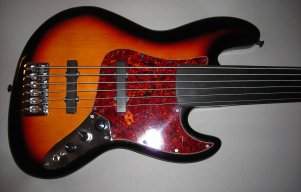
I say
1. P-bass
2. Jazz
1 sounds fatter in the lower mids.
2 has more attack and has a more nasal sound
This is my thinking too. Plus 2. just sounds like my J. On the other hand I don't own a P and have never owned a P bass so I'm not really familiar with the sound. I'm just assuming that a P sounds fatter than my J based on everyone raving about them here.
But then as I recall the last P/J shootout had me guessing the fatter sound was the P and that turned out to be wrong.
That's awesome! Point taken. Just out of curiosity, with the similarity between a soloed neck 'J' and a P-bass, is there a reason you prefer the J?
i do the same thing. the single coil is a little thinner. more snap to it.
i also prefer the look and feel of the J. its a lot easier to get in 5 string.

Can I call foul since the Jazz's neck pickup is soloed?
No. Not everyone who has a bass with two pickups uses them together all the time. One of the points to having two pickups is being able to get more than one sound. I almost never use my bass's pickups together; I usually have either just the bridge pickup on or just the neck pickup on.

Here's an interesting experiment:
Before you reveal the answer, reverse the order and run the clips again. See how many people can hear the difference.
I've been playing various Fender P and J basses for over 40 years. Presently I have a 58 P and a 62 J. I can get the J to sound exactly like the P, but not the other way around.
Before you reveal the answer, reverse the order and run the clips again. See how many people can hear the difference.
I've been playing various Fender P and J basses for over 40 years. Presently I have a 58 P and a 62 J. I can get the J to sound exactly like the P, but not the other way around.


