
Enjoy the benefits of a premium membership!
Upgrade Account
-
TalkBass has been independent since 1998. Add your voice.
Create a free account to reply to discussions, view embedded media, and browse with fewer display ads.
Join free Log in
Want zero display ads or expanded classifieds tools? Compare plans.
You are using an out of date browser. It may not display this or other websites correctly.
You should upgrade or use an alternative browser.
You should upgrade or use an alternative browser.
More options
Who Replied?
thanks for no one answering my question. its a schecter by the way
Oh my. I'm sorry, I just saw this. I apologize on these gentlemen's behalf for attempting to educate you. A bit ridiculous for them to do so, if you ask me. Stand facing the end of your truss rod looking down the end of your neck. Begin vigorously turning the truss rod adjustment nut clockwise. When it gets so tight you think you can't turn it further, take a closed end wrench, slip it over the end of the allen wrench and use it as a "cheater bar" for more leverage. Turn until you feel and hear a "pop". Perfection.
Listen, don't do anything I just said. You received two answers before you made your passive/aggressive comment about not receiving an answer. You then received three more answers before asking "which way" again. As has already been suggested, please take this to someone with more experience. Maybe ask if you can watch or even assist with the adjustments.
And please, learn to accept help when it's given, preferably without being inconsiderate about it.

Don't change Your Truss rod for action buddy.. The Truss Rod is used to reinforce the neck from the string tension and then to stop buzz from certain parts of the neck
Turning your Truss rod Clockwise usually makes your action feel as if its lower because it bends the neck in a specific position to make it feel like the strings are closer and really whats happening is only some of the parts of the neck are closer to the strings.. a.k.a. - usually the middle of the neck upper area..
search this forum for Jerzy Drozd setup guide.. it has the pictures and you will WAKE UP buddy.. and not use your truss rod for action anymore..
so here.. .wake up
Let me google that for you
Pretty sure if the strings are low in summer and high in winter pretty sure the bridge is not the part to adjust.
If you have to ask you should have your locally owned music store tech do it.
I agree but would be ideal if he were to find a good tech who could walk him through the process!
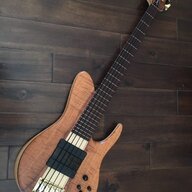
I recently purchased a brand new KSD Proto 605 which I really like. I noticed that the truss rod when turning clockwise decreases tension but the neck lessens relief (flatter). Turning counter clockwise increases tension but increases relief. Luckily I realized this before I screwed up the neck.

Ding, ding, ding. IF you have adjusted relief correctly and IF you have then adjusted your bridge correctly, let's be real--if the action changes noticeably the neck is in need of adjustment.. I have adjusted my bridges exactly once, to get it where I want it. Necks get adjusted several times a year.Pretty sure if the strings are low in summer and high in winter pretty sure the bridge is not the part to adjust.


That looks properly set up.Link Removed
So THAT'S what they mean by "compound radius".Looks like this old folk guitar I have in my basement. The neck is literally a staircase


Pretty sure if the strings are low in summer and high in winter pretty sure the bridge is not the part to adjust.
What?? what does this guy have a truss rod made out of plastic?? and where is he living the north pole and then gigs in Dubai during the summer??
what kind of temperature changes is he going through?? I own an upright well, multiple upright basses so I know how wood is affected.. and this electric bass ain't no huge stick of wood that moves that much..
His neck needs to be adjusted to the exact point there isn't buzz on the open strings when plucked hard and then action set from the saddle to his preferred height.. some will say do this one first or the other..
he doesn't appear to know how to do this though..

What?? what does this guy have a truss rod made out of plastic?? and where is he living the north pole and then gigs in Dubai during the summer??
what kind of temperature changes is he going through?? I own an upright well, multiple upright basses so I know how wood is affected.. and this electric bass ain't no huge stick of wood that moves that much..
Highest summer temperature here is +40℃, lowest winter at night -10℃. Metal reacts faster to temperature changes than plastic...
I use public transportation to get to rehearsals and I had to adjust my truss rod last weak, because action got noticeable higher.
Last edited:

I have a Music Man StingRay 5 where the bridge was perfectly setup and I adjust the truss rod according to the season that would always create the right relief and provide the best action.
Now I have a bass with a two-way truss rod and the same principles don't apply. The blogs I've seen on the Net don't seem to be helping me out where I can't seem to figure out if the threading is reversed, very frustrating. I have already brought it in to a tech that did a great job on it but would love to avoid having to pay someone and waiting each time I need an adjustment.
Now I have a bass with a two-way truss rod and the same principles don't apply. The blogs I've seen on the Net don't seem to be helping me out where I can't seem to figure out if the threading is reversed, very frustrating. I have already brought it in to a tech that did a great job on it but would love to avoid having to pay someone and waiting each time I need an adjustment.

Link Removed
This is actually a feature and not a bug...
This guitar is the "Martin Venison Deluxe".
A skilled bow hunter can sneak this into the woods without making the deer suspicious. Then, just when they are expecting a nice folk song, he loads the e-string up with a carbon arrow and takes down a 12 point buck.
I had to adjust my truss rod last weak,
Try adjusting it strongly next time.

Try adjusting it strongly next time.
Thank you for using an adverb!
Highest summer temperature here is +40℃, lowest winter at night -10℃. Metal reacts faster to temperature changes than plastic...
I use public transportation to get to rehearsals and I had to adjust my truss rod last weak, because action got noticeably higher.
Ok well that's even more reason why you have to buy a bass that you know is stronger for climate reasons then..
I ended up getting an Entire Upright bass made out of Carbon Fiber because I didn't want to deal with any of the problems like that...
now for electric bass - I called up The Makers of my bass, Roscoe... They told me the way the grain is and the type of wood and the reinforcement and I'm sure more factors contribute to how strong your neck is and if it will change drastically due to weather.. but in general I shouldn't have to touch it..
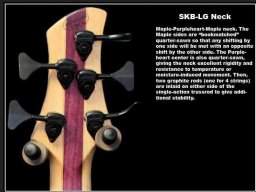
with my bass in particular, it has two graphite rods along with the truss rod and that is probably why I don't mess with my truss rod and don't notice anything ...


