And another potential reason might be that from what I heard, the necks are done by hand so the measurements vary from one to the other. Consequently, you can try 10 different ones and every one of them will have slightly different necks.

Enjoy the benefits of a premium membership!
Upgrade Account
-
TalkBass has been independent since 1998. Add your voice.
Create a free account to reply to discussions, view embedded media, and browse with fewer display ads.
Join free Log in
Want zero display ads or expanded classifieds tools? Compare plans.
You are using an out of date browser. It may not display this or other websites correctly.
You should upgrade or use an alternative browser.
You should upgrade or use an alternative browser.
Why aren't G&L basses more popular?
- Thread starter Zerstorte Zelle
- Start date
- Status
- Not open for further replies.
More options
Who Replied?
This is my take -- and I'm pretty sure I'm right about this ...
1) No Sex Appeal: G&L basses don't have the general popularity as other brands. They don't have high-profile endorsers, they don't have big name players singing their praises and they aren't widely seen at retail. All this combines to make it a brand that flies below the radar.
2) The "Different" Factor (A): The control layout on G&L's is not like anything else out there. Instead of Volume, Blend, BTM -- which everyone is used to, G&L has a whole 'nother thing happening.
Volume, Treble Boost, Bass Boost PLUS toggles for pickup selection, series/parallel, and passive/active/active with Treble boost -- "What is THAT about? How am I supposed to use that? "I can't get any good tones out of it -- it sucks!!"
Of course it doesn't suck -- but you can't just pick it up and play it like you can with most other basses. There is a learning curve that you have to master. While it is (very!) rewarding to those who take the time to do so, most of us down't feel like hassling with it.
3) The Different Factor (B): We have become accustomed to classifying basses in terms of the tones they can cop -- and those come in 4 primary flavors; Jazz, Precision, Stingray, and Modern/Hi-Fi. Just about every bass we talk about, we do so in comparison to those standards.
Well, the G&L doesn't cop ANY of those tones. It comes close but it doesn't duplicate them ... and that's a problem for people. It reminds me of a Lakland 55-01 that way. We spend a lot of time lambasting the 55-01 because it doesn't really sounds like anything else. No, it doesn't -- it sounds like a 55-01! And oh, by the way, a 55-01 works very well in the mix.
Same with the G&L. It may not duplicate those signature tones but the tones it delivers are VERY useful and the bass delivers a very wide range of tones that work very well in a wide variety of genres.
That's my take on the subject. Feel free to throw darts or hearts!
1) No Sex Appeal: G&L basses don't have the general popularity as other brands. They don't have high-profile endorsers, they don't have big name players singing their praises and they aren't widely seen at retail. All this combines to make it a brand that flies below the radar.
2) The "Different" Factor (A): The control layout on G&L's is not like anything else out there. Instead of Volume, Blend, BTM -- which everyone is used to, G&L has a whole 'nother thing happening.
Volume, Treble Boost, Bass Boost PLUS toggles for pickup selection, series/parallel, and passive/active/active with Treble boost -- "What is THAT about? How am I supposed to use that? "I can't get any good tones out of it -- it sucks!!"
Of course it doesn't suck -- but you can't just pick it up and play it like you can with most other basses. There is a learning curve that you have to master. While it is (very!) rewarding to those who take the time to do so, most of us down't feel like hassling with it.
3) The Different Factor (B): We have become accustomed to classifying basses in terms of the tones they can cop -- and those come in 4 primary flavors; Jazz, Precision, Stingray, and Modern/Hi-Fi. Just about every bass we talk about, we do so in comparison to those standards.
Well, the G&L doesn't cop ANY of those tones. It comes close but it doesn't duplicate them ... and that's a problem for people. It reminds me of a Lakland 55-01 that way. We spend a lot of time lambasting the 55-01 because it doesn't really sounds like anything else. No, it doesn't -- it sounds like a 55-01! And oh, by the way, a 55-01 works very well in the mix.
Same with the G&L. It may not duplicate those signature tones but the tones it delivers are VERY useful and the bass delivers a very wide range of tones that work very well in a wide variety of genres.
That's my take on the subject. Feel free to throw darts or hearts!

The G&L side of the story as told in George Fullerton's account is that Music Man canceled all orders with CLF Labs (Leo's R&D & mfg facility) to punish them for not capitulating on certain matters. George and Leo founded G&L so they wouldn't have to lay everyone off and shut down the plant.Are you aware of how he ran Musicman into the ground?
Your point that Leo wasn't a great business man is well taken, however. G&L never turned a profit during Leo's life.
But his genius lay not only with his instrument designs, but with manufacturing processes. The Stratocaster is probably the first ergonomically designed musical instrument. The Stratocasster design also made it possible to have simultaneous processing lines for bodies, necks, and pickguard-mounted electronics, not brought together until final assembly.
This efficiency had its limitations, however. Leo's manufacturing methods and high standards couldn't keep up with the demands of the exploding rock scene. By the time CBS bought Fender, it had a 2-year backlog. Still, Leo's methods managed to crank out a very high number of instruments of exquisite playability and tone, which partially accounts for the high prices of Leo-era Fenders today.

This is my take -- and I'm pretty sure I'm right about this ...
1) No Sex Appeal: G&L basses don't have the general popularity as other brands. They don't have high-profile endorsers, they don't have big name players singing their praises and they aren't widely seen at retail. All this combines to make it a brand that flies below the radar.
2) The "Different" Factor (A): The control layout on D&L's is not like anything else out there. Instead of Volume, Blend, BTM -- which everyone is used to, BTW.
G&L has a whole 'nother thing happening. Volume, Treble Boost, Bass Boost PLUS toggles for pickup selection, series/parallel, and passive/active/active with Treble boost -- "What is THAT about? How am I supposed to use that? "I can't get any good tones out of it -- it sucks!!"
Of course it doesn't suck -- but you can't just pick it up and play it like you can with most other basses. There is a learning curve that you have to master. While it is (very!) rewarding to those who take the time to do so, most of us down't feel like hassling with it.
3) The Different Factor (B): We have become accustomed to classifying basses in terms of the tones they can cop -- and those come in 4 primary flavors; Jazz, Precision, Stingray, and Modern/Hi-Fi. Just about every bass we talk about, we do so in comparison to those standards.
Well, the G&L doesn't cop ANY of those tones. It comes close but it doesn't duplicate them ... and that's a problem for people. It reminds me of a Lakland 55-01 that way. We spend a lot of time lambasting the 55-01 because it doesn't really sounds like anything else. No, it doesn't -- it sounds like a 55-01! And oh, by the way, a 55-01 works very well in the mix.
Same with the G&L. It may not duplicate those signature tones but the tones it delivers are VERY useful and the bass delivers a very wide range of tones that work very well in a wide variety of genres.
That's my take on the subject. Feel free to throw darts or hearts!
Here's not 1, not 2, but three hearts.
 I think its for all the reasons you list why I actually LIKE G&L.
Because they're ugly.
Yeah, ugly's in the eye of the beholder and all that...
I've received an awful lot of positive feedback on the tone AND the looks of this Leo era G&L L-2000


Sorry dude, but those control plates are ugly as sin. Looks like they went out back and found whatever piece of scrap metal that was lying around and just stuck it on there. It doesn't fit in with the rest of the bass. They were ugly when they were on the original Stingray guitars, and they are almost as ugly on the early G&L basses. Thankfully they went to the rear mounted controls.

Sorry dude, but those control plates are ugly as sin. Looks like they went out back and found whatever piece of scrap metal that was lying around and just stuck it on there. It doesn't fit in with the rest of the bass. They were ugly when they were on the original Stingray guitars, and they are almost as ugly on the early G&L basses. Thankfully they went to the rear mounted controls.
Well that's just like, your opinion, man.
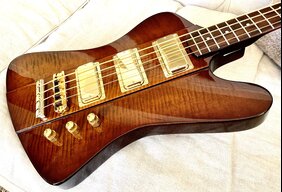
I had a beautiful blue burst G&L 2500 Tribute with a maple neck that I really wanted to love but alas it just wasn't for me. I ended up trading it in on a Stingray 5 string.
The G&L looked and felt fantastic, but the controls were not intuitive and the pickups were entirely too hot. I have dozens of basses and the G&L is the only one that would consistantly clip my amp out with only modest levels of gain. Tried lowering the pups and stuff but finally decided it had to go. I made the trade over a year ago and don't miss it yet. Good sounding bass, kinda brite (maybe because of the maple neck and FB), lots of switching options (maybe too many), but not a lot of usable sounds due to the high gain/output pickups. YMMV.
The G&L looked and felt fantastic, but the controls were not intuitive and the pickups were entirely too hot. I have dozens of basses and the G&L is the only one that would consistantly clip my amp out with only modest levels of gain. Tried lowering the pups and stuff but finally decided it had to go. I made the trade over a year ago and don't miss it yet. Good sounding bass, kinda brite (maybe because of the maple neck and FB), lots of switching options (maybe too many), but not a lot of usable sounds due to the high gain/output pickups. YMMV.

...it's the headstock, pure & simple!...an uglier one doesn't exist on the planet, lol...
If you're talking about the G&L four string I will have to strongly disagree. There are a boatload of headstock designs stuck on 'Fenderish' basses that are 'inappropriately shaped'. As for the G&L five string headstock...you may have a point. I don't have the strength to argue that one.
 IMHO, of course.
 M. M.
I agree about the hot pickups. I love my Tribute L2500, but I use the passive settings almost exclusively. The active output is ridiculous. It does sound great in passive though.
ETA: Maybe I should just remove the battery.
ETA: Maybe I should just remove the battery.
Yeah, ugly's in the eye of the beholder and all that...
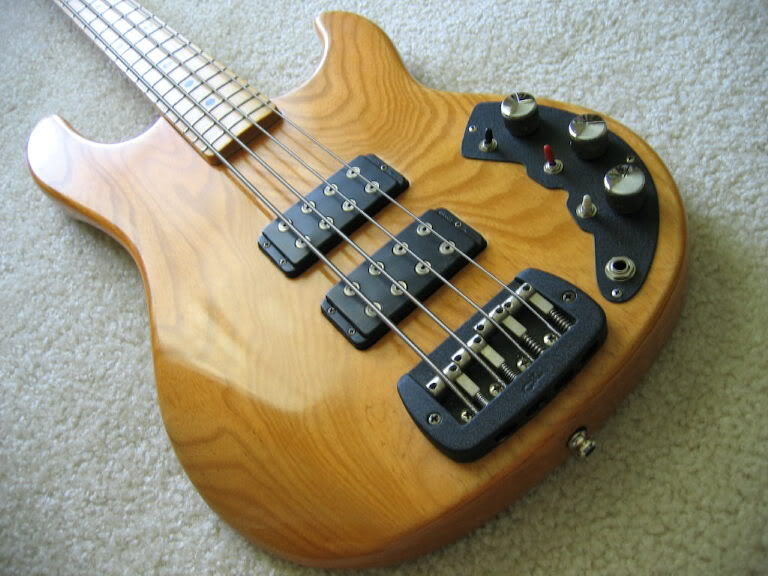
I've received an awful lot of positive feedback on the tone AND the looks of this Leo era G&L L-2000
There's only one control plate uglier than that one:
There's only one control plate uglier than that one:
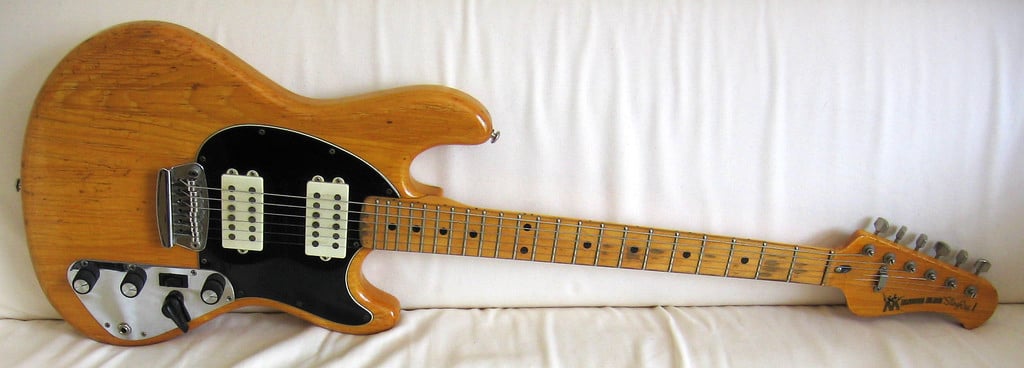
I see that and raise you a Marcus Miller Jazz


What's the "OMG mode?"
This...
http://www.bassesbyleo.com/passive_l_series.html
Not sure if I could explain it, but when you flip the switch, you say..."OMG"...

Does anyone else LOVE the post-lawsuit headstock? I do!
+1.
I really love the three G&L basses that I own. An SB-2, ASAT and an old El Toro. They all bring something completely different to the table. In my opinion the SB2 is THE P bass tone I have been after with every Fender P I have tried. Full, aggressive, with just the right amount of mids.
It took me a while to get around to G&L, but since I discovered what gems they are, I am quite happy to be an owner. And, truly, I am glad they are not more popular. I can't explain why, but, I always pull for an underdog.
I love G&Ls also but, strangely enough, always end up selling them. I just sold my L-1000 yesterday. And now, I think I'm missing it already. Strange stuff...The issue was stated earlier. I don't think I like the pickups! But I love everything else about them and I am now thinking about buying a JB or JB-2 with Alnico pups in it. In fact, I'm SURE I'm gonna buy one or the other. THAT should quell my GAS for a moment.
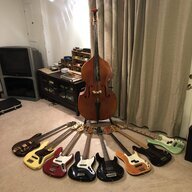
Kinda feel like G&L is the Mercury to Fender's Ford. Maybe, just maybe not enough marketing to make the product stand out, and not enough differentiation from Fenders for many players to seek out. Not that there aren't some great features on G&L basses (like lots of great Mercury cars over the years), and *I* see lots of differences, but perhaps the general bass playing public does not. To many, it might be the "almost a Fender" brand???
Maybe.
It always seems to come back to marketing for me, on the G&L issue.
Maybe.
It always seems to come back to marketing for me, on the G&L issue.

Several years ago I picked up a very early L2000E. Not in the greatest shape paintwise but a monster in the mix. By the time I'd found it I was already using fives as main basses and a five string version of the L2000 would've been great.
As many will remember, most early five strings were basically converted fours as far as neck width... I guess they didn't want to scare anyone. For a player like my self who hates tight string spacing that's a deal breaker. I need to get between and under the strings when I want to. I dug my L2000E so much I contacted G&L asking if they'd consider doing a wider spaced five. I explained that's why a lot of players don't like what they were currently producing in five strings. I was told they didn't see the need for it and besides, they sell enough basses as it is. That kind of genius is why G&L remains off my radar.

If I'd gotten a wide spaced G&L five I might still be playing it to this day. Oh well. Many people need to see other people playing gear to get interested in it and I guess G&L never really figured that out bass-wise. IMO IME if you get the right person playing the instrument esthetic issues can largely disappear.

As many will remember, most early five strings were basically converted fours as far as neck width... I guess they didn't want to scare anyone. For a player like my self who hates tight string spacing that's a deal breaker. I need to get between and under the strings when I want to. I dug my L2000E so much I contacted G&L asking if they'd consider doing a wider spaced five. I explained that's why a lot of players don't like what they were currently producing in five strings. I was told they didn't see the need for it and besides, they sell enough basses as it is. That kind of genius is why G&L remains off my radar.
If I'd gotten a wide spaced G&L five I might still be playing it to this day. Oh well. Many people need to see other people playing gear to get interested in it and I guess G&L never really figured that out bass-wise. IMO IME if you get the right person playing the instrument esthetic issues can largely disappear.

Well that's just like, your opinion, man.
Excellent post / avatar combo here.
My first and only experience with G&L's is the L2500 I owned for two years. I really dig the string spacing (and had my Stambaugh's made to match) but the neck was just a little too chunky. Something that feels more like a Stingray5 would be perfect for me.
The other frustrating thing was that I felt like I was always fighting the electronics. I know lots of people like them, but I am certain that I would like a more traditional active preamp setup in there, ESPECIALLY with the ability to split each pickup to single coils.
Otherwise, I really dig how they're kind of the simple, unknown underdogs of the bass world, and I've thought many times about grabbing another one, but the first thing I'd have to do is yank the preamp and replace it with an OBP2 or something.
Also, it'd be nice if they offered a few more custom options.
My second bass back in the day was an '82 L-2000 that I custom ordered. What a great sounding and playing bass. It had a natural finish ash body and an ebony fretless board. It had tones to die for. I always dug the body shape and the headstock shape (original style). It weighed about 9 lbs. The only negative...the gap between the neck and the body on the upper horn side was big enough to drive a truck through. Nowadays, I would have refused to take delivery. Back then...I was young.
Someone in an earlier post had mentioned The Bass Exchange/Amp Shop in Sherman Oaks CA as having some G&L's. About six and a half years ago I went in there to buy an MTD Kingston 5. They had a few. I was in their little demo room playing one for about five minutes when the sales dude asked me to leave the room. He had another customer who wanted to try out an expensive boutique bass. Maybe he was a big name player, too. No problem, mate. I purchased my Kingston elsewhere and have never set foot in that store since. My advice would be to grab the most expensive G&L they have. You might get to spend some quality time in 'the room'.
M. M.
Someone in an earlier post had mentioned The Bass Exchange/Amp Shop in Sherman Oaks CA as having some G&L's. About six and a half years ago I went in there to buy an MTD Kingston 5. They had a few. I was in their little demo room playing one for about five minutes when the sales dude asked me to leave the room. He had another customer who wanted to try out an expensive boutique bass. Maybe he was a big name player, too. No problem, mate. I purchased my Kingston elsewhere and have never set foot in that store since. My advice would be to grab the most expensive G&L they have. You might get to spend some quality time in 'the room'.
M. M.
Well if I were the store owner I'd rather listen to a G&L being played too. Hehe! Just kidding.
Seriously, that was pretty rude of the owner.
Seriously, that was pretty rude of the owner.
- Status
- Not open for further replies.


