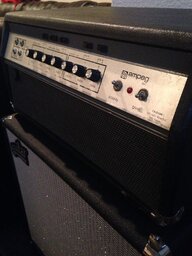
Wasnt the V9 also a guitar cab
I heard the same...
V9 (SVT with reverb?) was designed as a 300 watt tube guitar amplifier with the V9 9x10" cab as intended enclosure...


the horror!

someone correct me if i'm wrong...

TalkBass has been independent since 1998. Add your voice.
Create a free account to reply to discussions, view embedded media, and browse with fewer display ads.
Join free Log in
Want zero display ads or expanded classifieds tools? Compare plans.
Wasnt the V9 also a guitar cab
In the 1960s 50 watts was a large driver. The only way Ampeg could get enough power handling for the SVT head was to use eight drivers. Why a sealed box? Because they didn't know any better. Almost all bass cabs were sealed then, as the Theile/Small design parameters for ducted ports didn't exist yet. With today's drivers and technology the 8x10 is an anachronism, but as long as people buy them they'll make them.Chris Breese said:WHY?? WHY??? WHY ISN'T THE 8X10 PORTED?
billfitzmaurice said:Why a sealed box? Because they didn't know any better. Almost all bass cabs were sealed then, as the Theile/Small design parameters for ducted ports didn't exist yet.
billfitzmaurice said:In the 1960s 50 watts was a large driver. The only way Ampeg could get enough power handling for the SVT head was to use eight drivers. Why a sealed box? Because they didn't know any better. Almost all bass cabs were sealed then, as the Theile/Small design parameters for ducted ports didn't exist yet. With today's drivers and technology the 8x10 is an anachronism, but as long as people buy them they'll make them.


billfitzmaurice said:With today's drivers and technology the 8x10 is an anachronism, but as long as people buy them they'll make them.
Fuzzbass said:Jim Bergantino, who knows how to build a high fidelity speaker cabinet, designed improved versions of the sealed box: he showed the love to us bassists who like the vintage "lo fi" sound ("lo fi" in comparison to his HT series cabinets, anyway).


Not quite. While bass reflex was certainly known prior to T/S, what was not was how the various parameters that defined the operation of drivers interacted with the cabinet. For that matter, aside from a few rudimentary parameters such as fs, there was very little quantization of how a driver actually functioned. Building a reflex cab was also pretty much a seat of the pants venture as well. Before T/S the standard method of building a reflex box was to make the port the same size as the driver, with no duct, and tune the box to the same frequency as fs via the box size, which usually meant a very large box. An Altec A7 is a good example. Sealed boxes were preferred for bass instrument cabs not because they were better but because it was the only way one could have the box small enough to be portable while containing the necessary number of drivers to handle the power. After T/S defined the relationships between driver and cabinet, and most especially the ducted port, it allowed reflex cabinets to be tuned to function optimally with a particular driver while reducing the size of the box to manageable proportions.Jerrold Tiers said:Ported did not have to wait for A.N. Thiele to "invent" it. The design used to be called "bass reflex", and goes back a long way...
What Thiele did present was the concept of "alignments", viewing the speaker as a filter which could be implemented various ways. That 'regularized" design of ported cabs, but was not necessarily "The" enabling technology for them.
Obviously. I am.WOW! No offense, I am not an engineer
And what I do for a living is design speakers, quite successfully so. I don't manufacture them because I choose not to, and frankly, I don't need to.'those who can, do
billfitzmaurice said:Not quite. While bass reflex was certainly known prior to T/S, what was not was how the various parameters that defined the operation of drivers interacted with the cabinet. For that matter, aside from a few rudimentary parameters such as fs, there was very little quantization of how a driver actually functioned. Building a reflex cab was also pretty much a seat of the pants venture as well. Before T/S the standard method of building a reflex box was to make the port the same size as the driver, with no duct, and tune the box to the same frequency as fs via the box size, which usually meant a very large box. An Altec A7 is a good example. Sealed boxes were preferred for bass instrument cabs not because they were better but because it was the only way one could have the box small enough to be portable while containing the necessary number of drivers to handle the power. After T/S defined the relationships between driver and cabinet, and most especially the ducted port, it allowed reflex cabinets to be tuned to function optimally with a particular driver while reducing the size of the box to manageable proportions.
Obviously. I am.
And what I do for a living is design speakers, quite successfully so. I don't manufacture them because I choose not to, and frankly, I don't need to.
metron said:Dude bring it down to a simmer. Your posts are over the top. Its just speakers.
While successful reflex boxes did exist, they were arrived at by trial and error, as there was no way to accurately predict the performance of any particular driver/box combination. The main obstacle to small reflex boxes was the lack of ducts. You can make a small reflex box and tune it low by using a very small port, but with any appreciable power you'll get port noise; that's why large ports were preferred, but large ports demanded large boxes. Reflex was revolutionized when it was realized that a moderately sized port with a duct would allow a small box that could be tuned low, and do so without port noise. This came hand in hand with the quantization of driver parameters, allowing one to accurately predict how a driver/box combination would work.metron said:Bill I had thought after I posted that it may be the case that the B-15 and other reflex speakers of the era were designed not necessarily using the equations and parameters similar to what you say. Was it just a guess and check kind of thing in those days?
BigMikeW said:Let's see...
BIG CLAIMS no proof
BIG TALK no proof
more BIG CLAIMS
"I don't build stuff, you do it based on my plans for $14.95. Act now and I will double the order and throw in these fancy kitchen knives"
Bill's claims remind me far too much of the AccuSwitch situation. IMO, if you are going to boast about what you can do AND are actively selling a product, you had better damn well prove it.
Read what I said again. I didn't bash anything, just stated the facts. Prior to T/S ducted port cabs weren't done because the techology that made it possible to easily design them didn't exist. That applied to all cabinet designers, not just those at Ampeg. As for the 8x10 concept being an anachronism, it is what it is, 1968 technology. That doesn't make it bad, just old. So is a '68 GTO. There are worse rides.seaKamp said:I don't agree with the Ampeg bashing, or sealed cab bashing ...:

billfitzmaurice said:Read what I said again. I didn't bash anything, just stated the facts.

billfitzmaurice said:While successful reflex boxes did exist, they were arrived at by trial and error, as there was no way to accurately predict the performance of any particular driver/box combination. The main obstacle to small reflex boxes was the lack of ducts. You can make a small reflex box and tune it low by using a very small port, but with any appreciable power you'll get port noise; that's why large ports were preferred, but large ports demanded large boxes. Reflex was revolutionized when it was realized that a moderately sized port with a duct would allow a small box that could be tuned low, and do so without port noise. This came hand in hand with the quantization of driver parameters, allowing one to accurately predict how a driver/box combination would work.
BigMikeW said:Let's see...
BIG CLAIMS no proof
BIG TALK no proof
more BIG CLAIMS
"I don't build stuff, you do it based on my plans for $14.95. Act now and I will double the order and throw in these fancy kitchen knives"
Bill's claims remind me far too much of the AccuSwitch situation. IMO, if you are going to boast about what you can do AND are actively selling a product, you had better damn well prove it.