

Enjoy the benefits of a premium membership!
Upgrade Account
-
TalkBass has been independent since 1998. Add your voice.
Create a free account to reply to discussions, view embedded media, and browse with fewer display ads.
Join free Log in
Want zero display ads or expanded classifieds tools? Compare plans.
You are using an out of date browser. It may not display this or other websites correctly.
You should upgrade or use an alternative browser.
You should upgrade or use an alternative browser.
Why play a four string?
- Thread starter joel406
- Start date
More options
Who Replied?
To summarize the high points...
"I've been playing with 5 strings for years now. What the snape is wrong with you urql heads still playing 4?"
"I tried 5 but Jaco rolled over in his grave so hard that LA got hit by a 5.3 earthquake. You 5 string bituminous poquans."
"You ignorant waffle cones, any REAL bassist uses 6!"
"16 and a half." (smirks)
"I've been playing with 5 strings for years now. What the snape is wrong with you urql heads still playing 4?"
"I tried 5 but Jaco rolled over in his grave so hard that LA got hit by a 5.3 earthquake. You 5 string bituminous poquans."
"You ignorant waffle cones, any REAL bassist uses 6!"
"16 and a half." (smirks)

I have two 4-strings, three 5-strings and one 6-string bass. I prefer 5-string basses, but 4's and 6ers have their place.

I don't know, but ask Marcus Miller, Geddy Lee, Darryl Jones, Pino Palladino, Victor Wooten, Sting, Will Lee and every other bass player who's still playing 4 strings. They might have some insight.
I actually play a 5. Don't use the b string often but a few of our songs require something below e. It's nice to have it and can't be bothered changing axes for a few songs. If you dont ever use the b string then there is nothing wrong with playing a 4. I find that having it I use it. Kinda like bourbon. Don't need it, but if it's there.......

I don’t own a 5 but am considering one. From what I’ve discovered so far...
- pros who do theatre gigs say they need 5s because a lot of the music is written for 5s even though some prefer 4s.
- famous older bass players probably didn’t have 5s and they are writing the bass lines so can’t go below E. If you’re writing the song you write for the instrument you have.
- most people like having the extra D and Eb. Lots of songs are in Eb (Stevie Wonder etc). The B can be too deep.
- the open E on string 4 doesn’t sound the same as the E at fret 5 on string 5. Lots of people prefer the tone of the open E.
- with a 5 you can play lots of songs from fret 5 so move from low to higher string rather than up and down the fretboard. Some people find this convenient but some say if makes you lazy. It also makes it difficult to play a 4 again once you rely on the 5th string, especially if you remember patterns.
- the smaller string spacing on a 5 can make slap harder but makes finger style easier. Can have 17-19 spacing and some bridges are adjustable.
- the 5 neck is wider so may have to adjust your technique.
- muting the B string may require technique adjustments such as floating thumb. A lot of work if you rarely need the B string.
- Detuner on a 4 could catch you out as the fingering changes.
- Tune a 4 to BEAD (same strings) or could buy a set of 5 strings and use the lowest 4? Presume you’d have to adjust the truss rod. Could cause fingering issues.
So far I’m replacing notes below E with octaves or other substitutes. Apparently the ear will hear a low note even if you play one of the octaves if it’s expecting it.
My fear is that if I get a 5 I’ll re-finger certain songs so I can no longer use the 4 and I don’t want to swap basses during a set or have to sell my 4 strings. Dilemma!!!
- pros who do theatre gigs say they need 5s because a lot of the music is written for 5s even though some prefer 4s.
- famous older bass players probably didn’t have 5s and they are writing the bass lines so can’t go below E. If you’re writing the song you write for the instrument you have.
- most people like having the extra D and Eb. Lots of songs are in Eb (Stevie Wonder etc). The B can be too deep.
- the open E on string 4 doesn’t sound the same as the E at fret 5 on string 5. Lots of people prefer the tone of the open E.
- with a 5 you can play lots of songs from fret 5 so move from low to higher string rather than up and down the fretboard. Some people find this convenient but some say if makes you lazy. It also makes it difficult to play a 4 again once you rely on the 5th string, especially if you remember patterns.
- the smaller string spacing on a 5 can make slap harder but makes finger style easier. Can have 17-19 spacing and some bridges are adjustable.
- the 5 neck is wider so may have to adjust your technique.
- muting the B string may require technique adjustments such as floating thumb. A lot of work if you rarely need the B string.
- Detuner on a 4 could catch you out as the fingering changes.
- Tune a 4 to BEAD (same strings) or could buy a set of 5 strings and use the lowest 4? Presume you’d have to adjust the truss rod. Could cause fingering issues.
So far I’m replacing notes below E with octaves or other substitutes. Apparently the ear will hear a low note even if you play one of the octaves if it’s expecting it.
My fear is that if I get a 5 I’ll re-finger certain songs so I can no longer use the 4 and I don’t want to swap basses during a set or have to sell my 4 strings. Dilemma!!!
Last edited:
Here’s a quote from Will Lee from his website...
“I can be seen playing my Sadowsky 4-string basses on TV, in the studio & live. Behind the scene (and sometimes on the scene), I play a variety of basses. For instance, my Yamaha 5-string has become an extension of my soul (never thought it would happen with a 5!)”
“I can be seen playing my Sadowsky 4-string basses on TV, in the studio & live. Behind the scene (and sometimes on the scene), I play a variety of basses. For instance, my Yamaha 5-string has become an extension of my soul (never thought it would happen with a 5!)”

well... sometimes, just one string is more than enough, and sometimes, 6 might not be ...


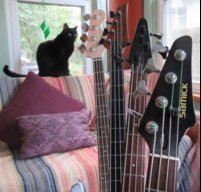
Well, I have a 5 and a collection of 4s. I agree with all your comments above except for worrying about having to sell your 4 strings. So far, not a big deal to go from one to the other, and my last several bass purchases have been 4s. When I grab the wider 5 string neck, my hand sort of knows to adjust. Maybe it helps that I have almost no talent or skill?I don’t own a 5 but am considering one. From what I’ve discovered so far...
- pros who do theatre gigs say they need 5s because a lot of the music is written for 5s even though some prefer 4s.
- famous older bass players probably didn’t have 5s and they are writing the bass lines so can’t go below E. If you’re writing the song you write for the instrument you have.
- most people like having the extra D and Eb. Lots of songs are in Eb (Stevie Wonder etc). The B can be too deep.
- the open E on string 4 doesn’t sound the same as the E at fret 5 on string 5. Lots of people prefer the tone of the open E.
- with a 5 you can play lots of songs from fret 5 so move from low to higher string rather than up and down the fretboard. Some people find this convenient but some say if makes you lazy. It also makes it difficult to play a 4 again once you rely on the 5th string, especially if you remember patterns.
- the smaller string spacing on a 5 can make slap harder but makes finger style easier. Can have 17-19 spacing and some bridges are adjustable.
- the 5 neck is wider so may have to adjust your technique.
- muting the B string may require technique adjustments such as floating thumb. A lot of work if you rarely need the B string.
- Detuner on a 4 could catch you out as the fingering changes.
- Tune a 4 to BEAD (same strings) or could buy a set of 5 strings and use the lowest 4? Presume you’d have to adjust the truss rod. Could cause fingering issues.
So far I’m replacing notes below E with octaves or other substitutes. Apparently the ear will hear a low note even if you play one of the octaves if it’s expecting it.
My fear is that if I get a 5 I’ll re-finger certain songs so I can no longer use the 4 and I don’t want to swap basses during a set or have to sell my 4 strings. Dilemma!!!
Its not unheard of for guitar and bass to de-tune a half step to give a thicker fatter sound, or maybe you are playing with a horn section, there is no rule anywhere that I know of that says just because its in Eb on the record you cant transpose it back up to E or down to D if you prefer. Dont go out and buy a ERB just because some tunes are in flat keys.
now, I recently picked up another 5 having not used one in quite some time, I enjoy the heck out of it, but I still transpose to regular keys instead of playing it in a flat key just because I'm able......I could, but screw it.
now, I recently picked up another 5 having not used one in quite some time, I enjoy the heck out of it, but I still transpose to regular keys instead of playing it in a flat key just because I'm able......I could, but screw it.


I’ll play whichever suits the song/arrangement/whatever the people hiring me want me to play. Currently my main squeeze is a Guild Starfire 2, but yeah, it’s all good

Define "Normal music"I bought and played a five string (Yamaha BB735A DCS) for a year or so. It now sits and gathers dust as I've discontinued its use.
Just not a requirement in normal music...........


but every note below D is just big bunch of lost energy.
You need to play through a better PA. In most clubs, or through a bass amp, I agree with you, but an ampless gig through a real PA will change your mind.
Define "Normal music"
Long before the bass guitar was invented, there was classical music; those guys were often playing basses with C (or sometimes B) extensions on them. "Normal music" has been calling for notes below E for at least a century. We might want to think of the 4 string bass guitar tuned to E and above as a temporary aberration, due to the technical limitations of early amplifiers and loudspeakers.
Oh, and tubas go lower that that. Also, contrabassoons, which are very useful, should you ever want a lawn mower sound in your band.
Last edited:
Erm, the question was posed to @quickfix, and I guess there are probably as many definitions of "normal" music as there are posters on this thread. Most double bass players I know (granted, a small group) use the exact same tuning as a 4 string bass guitar. The amount of classical basses with extensions are about 10% of all the double basses I've seen, so I think they are the exception, not the norm.Long before the bass guitar was invented, there was classical music; those guys were often playing basses with C (or sometimes B) extensions on them. "Normal music" has been calling for notes below E for at least a century. We might want to think of the 4 string bass guitar tuned to E and above as a temporary aberration, due to the technical limitations of early amplifiers and loudspeakers.
Oh, and tubas go lower that that. Also, contrabassoons, which are very useful, should you ever want a lawn mower sound in your band.
As an alternate idea, we may think of a 4 string bass guitar tuned to E as an easily approached tool for making music, just as much as a 6 string guitar tuned E to E is. Frequently used, and easy to learn due to the overwhelming amount of instruction and written music specifically played on these instruments.
Those who want to play a different range of notes can play on instruments that allow for such explorations. They are looking for a different experience, and that's great.

Because they never made a Peavey T-50
There was a proto. First guy that tried it strapped it on, the floor gave way, and he wound up in the basement. After that, the project was cancelled for obvious reasons.


