• TalkBass has been independent since 1998. Add your voice.
    Create a free account to reply to discussions, view embedded media, and browse with fewer display ads.
    Join freeLog in
    Want zero display ads or expanded classifieds tools? Compare plans.

Double Bass Wolf Note Eliminators

[QUOTE="gerry grable, post: 19832155,

Just got back from a band rehearsal.
The gerry-rigged eliminators didn't do the trick. Back to the drawing boards.
The guitar player suggested something called a "notch-filter." Never heard of them. Does anyone know if they'd work on Wolf tones?
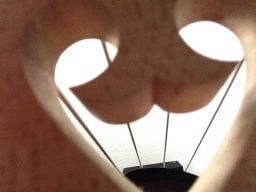
 
except for the A and Ab on the G and D strings where I get a hollow thump sound with little sustain.
I'd start with moving the soundpost to a variety of positions to see if the response gets better or worse (bowing usually magnifies the wolf...) - the fact that it occurs on the same notes on different strings points me to the instrument's set up, esp. the soundpost.
Try these same pitches ("A and Ab") on the A string, (at the Harmonic, First Partial), bowing Fortissimo - I'll bet it occurs there, as well.
You might also try installing a genuine wolf-tone eliminator, or two. (see below). Try installing it at different positions on the after-length. Again, bowing helps hear (and sometimes even "see"!) the wolf-tone. The string vibration will look slightly different than "normal", non-wolfy, vibrations.
Or, perhaps re-calculating/re-installing the after-length & tailpiece position.
(A notch-filter won't do much good, IMO. If you try to enhance those 2 notes, you'll probably wind up over-emphasizing adjacent notes...)
Thanks, and Good Luck.

photo(290).JPG
 
  • Like
Reactions: gerry grable
I'm not sure my issue is a true wolf note, but here's my story. A while ago, I realized that I haven't played amplified in a while, so I pulled the pezio off my after lengths. I was grooving on how open the tone sounded with an un-cluttered bridge, but kept hearing something that was not right. On examination, I realized that the D-string after length was vibrating whenever I played the open D (arco).

I posted on TB about this, and most suggestions were to wrap something around the after lengths, like a scarf.

Rather than a scarf, I placed a wolf note eliminator (like the one pictured above) on the D after length, and the sympathetic vibration went away, but the bass sounded less open than without the weight.

So I took a short length of cord and tied it on the D after length. Sympathetic vibration is gone, and open tone remains. My next experiment is to see how much of the cord I can trim off before the sympathetic vibration starts ago.

FWIW. I'd be interested if anyone else has played the game of trying to find the minimum adjustment necessary to eliminate such a problem.

DSC_0072.jpg
 
  • Like
Reactions: gerry grable
I'd start with moving the soundpost to a variety of positions to see if the response gets better or worse (bowing usually magnifies the wolf...) - the fact that it occurs on the same notes on different strings points me to the instrument's set up, esp. the soundpost.
Try these same pitches ("A and Ab") on the A string, (at the Harmonic, First Partial), bowing Fortissimo - I'll bet it occurs there, as well.
You might also try installing a genuine wolf-tone eliminator, or two. (see below). Try installing it at different positions on the after-length. Again, bowing helps hear (and sometimes even "see"!) the wolf-tone. The string vibration will look slightly different than "normal", non-wolfy, vibrations.
Or, perhaps re-calculating/re-installing the after-length & tailpiece position.
(A notch-filter won't do much good, IMO. If you try to enhance those 2 notes, you'll probably wind up over-emphasizing adjacent notes...)
Thanks, and Good Luck.

View attachment 1085521

Don,
I decided to try your suggestions and check for movements. On checking, I discovered that my bridge had slipped out of position. I centered it and adjusted it to the string length that my luthier, Shanks Strings had it set up to: 42 3/8 from bottom of nut to front of the bridge. (I didn't want to get into moving the sound post at this time, since I don't have the tools and am not as brave (dumb) as I was in the olden days.) It played great and feels great, but with the amp the wolf was still there. I continued looking for a cause. I removed my bow quiver, no change, but then I remembered that someone here on TB said she used a rubber ball between the tail piece and the top of the bass and it worked well. I didn't have a ball, so I found some thick sponge foam and stuffed it under the tail piece over the ebony saddle and the wolf was gone. But I noticed a loss in the general the resonance of the bass. Checking further, I notice a very lively ringing when I knock on the tail piece. It's very sensitive, maybe too sensitive?
I'm now wondering if I should go back to the rigid solid wire that was originally on the bass. I changed it to braided cable years ago at the suggestions of many knowledgeable members on TB, and it sounded fine for years until recently. I wonder if there could be some kind of change it the Gage Realist I use. I had the general impression that they either worked or didn't. This one still works.
Well, I guess I'll try the foam trick and see how it works out. Resonance isn't a huge concern when trying to goose big band horns.
Also I have a couple of different sized tail pieces that I could try if I really get adventurous.
Thanks for the advice.
 
  • Like
Reactions: Don Kasper