SLO has sold... Just looking for one more sale to fund the Oracle.

TalkBass has been independent since 1998. Add your voice.
Create a free account to reply to discussions, view embedded media, and browse with fewer display ads.
Join free Log in
Want zero display ads or expanded classifieds tools? Compare plans.
You honestly won't regret it....and @Arkham Sound is a pleasure to deal withSLO has sold... Just looking for one more sale to fund the Oracle.
From all the input I have gotten, I don't think I will regret it either. I'll have to rearrange some things on the board, but should have plenty of room to spare. Now to decide what I want to use as a cab sim, or if I even need one with it.You honestly won't regret it....and @Arkham Sound is a pleasure to deal with


The only applicable thing the RNDI manual says about the Thru jack is in a diagram:I think I did read something about that somewhere, maybe in the manual, but that's not a situation I normally encounter.


When the BeatBuddy is in stereo is there any actual "stereo" aspect to it or is it just dual mono?The only applicable thing the RNDI manual says about the Thru jack is in a diagram:
1/4" Thru
Parallel 1/4" Port
used to send signal
to the amp or speaker
They give more detail if you use the speaker setting but nothing else about the instrument setting.
The Rupert Neeve website does not go into detail about it either.
My guess is that the RNDI is splitting its power to send a signal to the amp as well as the XLR out.
The funny thing is, I would expect the active RNDI to have less volume drop than the passive JDI but that is not the case.
I may contact Rupert Neeve tech support to verify that this DI is working correctly. That is my main concern here.
In the meantime, think I will either buy a JHS Buffered Splitter and split the signal to my amp with it instead of using the Thru jack or the RNDI or I will use the JDI for my bass and put the RNDI on my BeatBuddy.
I guess now that I have two DI's, I could run the BeatBuddy in stereo to my soundboard using XLR connections (I have done this before with 1/4" cables). Always something to play with.
I picked up the RNDI as I needed a second DI to have the option of running my BeatBuddy and my bass to a soundboard (home or church). Since I had a passive DI, I thought I would try an active one to boost my active bass signal to the soundboard. RNDI does that more than my JDI (as I would expect) and I will try that the next time I am at church.
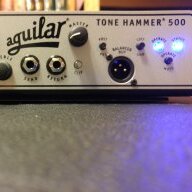
If that is not enough boost, I will take my Tone Hammer 500 head to church for the DI and just put a tuner pedal in front of it and skip the pedal board. I have plenty of gain from the TH500 to make the WL happy (I just have to make sure all of those knobs on the TH500 don't shift in transit and make my bass sound horrible - which has happened before and I did not catch it until after the first service).

A 110V splitter cable takes care of power to the Oracle for me. One end to Oracle, one end to Cioks DC7.
Power Cord Splitter, 5 15P to C13, 6 ft, 10A, 125V, 18 AWG | Tripp Lite
I was thinking the same. The Roscoe P sounds great alone, but there's no denying how much better it is with the LA-1A. I will always have that combo. My active basses sound great as they are, but I think having some compression really helps us all hear better - especially in our IEM's - and I like that the B string is tamed down a bit so I don't have to worry about it being overpowering. I hate to have 2 (probably equally expensive as I am now spoiled by the LA-1A) compressors on a board but would an Empress or Cali be better for my active Bart Roscoes?
I like the color and tone I get with my passive P from the LA-1A. Just not sure I want that with the active Roscoe's. Still experimenting. Not sure I want a 2nd $600 compressor either. I go from no pedals to boutique in a week.
I know someone with a Cali76 for sale.

Don't rule out the CaliCB if you decide to pursue another compressor.
I compared them here: https://www.compressorpedalreviews.com/post/cali76-tx-vs-compact-bass-compressor-review
So I don't mean to highjack the compression talk but I'm currently torn between the HX Stomp and the Headrush GigBoard....can anyone chime in if they've had experience with either?

I want to say that I previously ran both a right and left outputs of the BeatBuddy to my sound board which was connected to studio monitors and I want to say that there was some additional right channel action going on (not much, but a little). I think that some of the cymbals sound on some beats may have gone over to the right channel and maybe some other effects. I am not sure as it has been a long time ago that I did it. I plan on trying it with dual DI soon and see how it sounds.When the BeatBuddy is in stereo is there any actual "stereo" aspect to it or is it just dual mono?
I suppose I could just use the headphone jack, that would presumably showcase whatever stereo capabilities are in there.I want to say that I previously ran both a right and left outputs of the BeatBuddy to my sound board which was connected to studio monitors and I want to say that there was some additional right channel action going on (not much, but a little). I think that some of the cymbals sound on some beats may have gone over to the right channel and maybe some other effects. I am not sure as it has been a long time ago that I did it. I plan on trying it with dual DI soon and see how it sounds.
The manual does say that playing into a stereo system sounds best:
"However, like all audio, the better the
sound system it is plugged into, the
better the BeatBuddy will sound. The
BeatBuddy sounds best when played
through a high quality full range stereo
sound system. A PA system or a home
stereo system is ideal (you can plug
the BeatBuddy's headphones port into
the Aux input on your home stereo or
guitar amplifier, if it has one)."
I bet you could find more about it on the Singular Sound forums.
How are you powering your Rolls? From their site, they list it as 9-15 volts. I may pick one up. Was it a problem to mount it?Off the current topic of discussion, but I haven't shown my current board setup in a while. I've swapped a lot of things out since the last time I posted it. The only things that aren't new are the Darkglass AO, Grand Orbiter, and the Straight Ahead amp.
There's a lot going on under the board as far as power goes. My power supply has a 115v AC out and I am using it to connect the 12v adapter for the SLO, and the 18v for the Cali76 CB.
The Saturnworks pedal is for the effects loop that contains the AO, GO, and OctaBass - left switch is standard on/off, right switch is momentary hold on/release off.
I also added a power switch so that when I'm set up at home I don't have to keep plugging and unplugging the cord.
I swapped in the Rolls PM55P over the PM50se since it has a limiter. I was getting tired of having my ears blown out from pops or feedback. I think it works? I wish it was as small as the 50, but it is what it is.
View attachment 3765522
I thought the headphone amp in the BeatBuddy was a little noisy, but you could get an idea about how it sounds. I am not sure you will hear a difference on all beats (but I could be wrong). The noise could just be the power in my space. I am powering it from a Voodoo Labs Mondo though. I have been spoiled by feeding the BeatBuddy into my Tasty Blender and not having any additional noise.I suppose I could just use the headphone jack, that would presumably showcase whatever stereo capabilities are in there.
How are you powering your Rolls? From their site, they list it as 9-15 volts. I may pick one up. Was it a problem to mount it?