• TalkBass has been independent since 1998. Add your voice.
    Create a free account to reply to discussions, view embedded media, and browse with fewer display ads.
    Join freeLog in
    Want zero display ads or expanded classifieds tools? Compare plans.

Zoom Owners' Club!

In my quest for the perfect tone, I remembered I have an old Zoom B3 pedal that I had forgotten I owned. Suggestions to get a nice warm sound out of our church in house sound system? It is dull and flat. I like the sound I get at home with my Carvin Micro bass amp (2x10).
My all time favorite little combo is in the B3 as Monotone based on the Polytone MiniBrute III, nice punch with the perfect amount of mids.
 
  • Like
Reactions: pecBass
Generally, Zoom has done a good job with linear evolution. I.e., the sound/fx quality, features and build-quality keep improving through each generation of models. There are some examples where some depth/tweakability have taken a hit-- particularly the number of parameters that you can adjust on a given module, or as with the B2 Four & MS-60B+ the cabs get hard-wired to the amp (though the MS-60B+ at least allows you to turn the cab off).
 
Generally, Zoom has done a good job with linear evolution. I.e., the sound/fx quality, features and build-quality keep improving through each generation of models. There are some examples where some depth/tweakability have taken a hit-- particularly the number of parameters that you can adjust on a given module, or as with the B2 Four & MS-60B+ the cabs get hard-wired to the amp (though the MS-60B+ at least allows you to turn the cab off).
This is likely due to the experience and feedback from consumers, many want as simple as possible solutions, too many options gives most brain freeze with too many choices, especially on the fly or live. Then again us geeks want more options as we love to tinker and explore. I can see both sides on the cab issue as many amps characteristics rely on a particular combination with OEM speaker, and most wouldn't want to try the other possibilities. Personally I really like the sound of a sealed 15" and like to use several amps with that speaker like Bassman, Marshall, Acoustic and GK. I only wish they included a Peavey model 😎 as those were the amps I primarily used.
 
  • Like
Reactions: mikewalker
This is likely due to the experience and feedback from consumers, many want as simple as possible solutions, too many options gives most brain freeze with too many choices, especially on the fly or live. Then again us geeks want more options as we love to tinker and explore. I can see both sides on the cab issue as many amps characteristics rely on a particular combination with OEM speaker, and most wouldn't want to try the other possibilities. Personally I really like the sound of a sealed 15" and like to use several amps with that speaker like Bassman, Marshall, Acoustic and GK. I only wish they included a Peavey model 😎 as those were the amps I primarily used.

Yea, it's kind of a weird paradox.

If a user doesn't want option-paralysis; they can just use factory presets-- or enjoy the default values that are loaded when the module is chosen. Zoom also can put the main controls on the first page, and people can just pretend that pages 2-4 don't exist.

As far as the amp-to-cab hardwiring; I suppose that can be forgiven as they have created this special layered IR process.

Most fx designers assume that every single one of us is in love with some particular nostalgic sound from some specific set of brands/amps. I'm sure I'm not alone that I honestly don't care what brand or model of amp it is. I just want it to sound nice with my bass. For me, I don't care much about "color" or "character", but I want it to feel well-balanced, and have good (FULL) dynamic range. When I want color & character, I'd prefer to get that from some combination of drive, EQ, compressor-- and none of those need to come from the amp. YMMV

Fractal is cool because they sometimes make these hybrids that combine the best qualities from different amps for their own "FAS" variants. But Fractal offers very little to bass players, and offers next to nothing for those wanting a good solid state sim.

But to the original point, there is absolutely no down-side to giving users control over all the necessary parameters to make the effects do what we want. But I suppose if more control & complexity is what people want, they can get a Fractal, or maybe some number of SA pedals.
 
Last edited:
Really wish the MS+ series supported using midi page turners to select patches like the old MS pedals do. It's such a useful feature that makes the MS pedal so much more useable on stage. IDK if Zoom just didn't think people used that or if they were afraid that making the MS+ more usable would cut into the sales of the more expensive B2-Four and B6. But without that feature, I just can't give up my old MS-60B.
 
  • Like
Reactions: champbassist
I have a Zoom MS-60B and I am trying to find out what the splitter actually do ... My impression from a few experiments and the description on the effects list is that the Hi and Lo signal are just added and sent to next effect (or output). Meaning that it somehow is nothing more than a 2 band tone control with a changeable crossover frequency.

What can be obtained by the Splitter that cannot be obtained with the multiband Equalizer?
 
Last edited:
IIRC, Splitter functions like a two-band high/low shelf with an adjustable x-over. You can turn either band down to zero (off), so it functions like a low-pass filter or high pass filter. If I understand it correctly, it is a dumb name because It does not split in any meaningful way.

If they called it a 2-band shelf, that might be less misleading.
 
Last edited:
Thanks @stubbsonic The signal chain seems 100% one-dimensional (serial), then, so frequency-band specific effect needs at least two pedals and external wiring. Like input via an Y link to two MS60-B pedals (each handling its own frequency band) and then combining the outputs afterwards. I dont think such multi band processing is in the new 60+ either. Think it over I suppose the signal processing capabilities are not suffficient to provide such functions. and one way to add capabilities is of course to add more pedals :)
 
I guess in a way, the Splitter is useful as a specific kind of EQ-- especially for bass. Sometimes you want something that takes down the low-end even-handedly without making the sub lows completely disappear. A high-pass is right sometimes, but a shelf is nice when you want taming without killing. So a low shelf where you can set the frequency is useful.
 
  • Like
Reactions: mikewalker and tpa
I've had the Zoom B1 FOUR for a while now, and I haven't had to tweak, add or remove anything, and I'm using about 8 stock settings, as is.

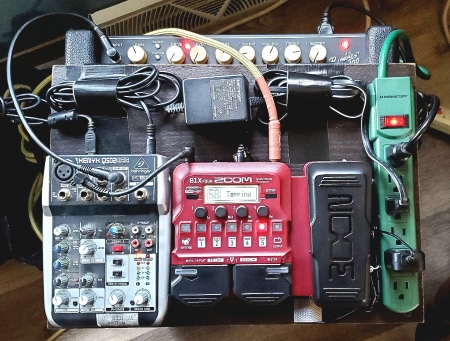
I have it setup so the chain is Bass > Zoom B1FOUR > Xenyx mixer.

From there, it's Xenyx mixer Main Out (or USB) to either Headphones/Amp/Laptop or PA for recording, practice or gigs. With everything mounted to one board, I either have it sitting in a homemade endtable/rack or velcroed to the top of my combo. And since neither my Xenyx or Zoom have on/off switches it's nice to just use the on/off switch on a small mounted power strip.

I'm really digging the Zoom B1 FOUR. I love the drum tracks, tuner, and looping. It's opened a lot of tonal choices and creativity in my writing with my 6 string bass. I think it's a great all-in-one unit.

Velcroed to top of Rumble 100 (V3) combo...

pedalboard-web-amp.jpg


Or in my living room endtable "rack" for practice/recording...

Effects-Mixer-endtable.jpg
 
I've had the Zoom B1 FOUR for a while now, and I haven't had to tweak, add or remove anything, and I'm using about 8 stock settings, as is.

I have it setup so the chain is Bass > Zoom B1FOUR > Xenyx mixer.

From there, it's Xenyx mixer Main Out (or USB) to either Headphones/Amp/Laptop or PA for recording, practice or gigs. With everything mounted to one board, I either have it sitting in a homemade endtable/rack or velcroed to the top of my combo. And since neither my Xenyx or Zoom have on/off switches it's nice to just use the on/off switch on a small mounted power strip.

I'm really digging the Zoom B1 FOUR. I love the drum tracks, tuner, and looping. It's opened a lot of tonal choices and creativity in my writing with my 6 string bass. I think it's a great all-in-one unit.

Velcroed to top of Rumble 100 (V3) combo...

pedalboard-web-amp.jpg


Or in my living room endtable "rack" for practice/recording...

Effects-Mixer-endtable.jpg
Some of the new gen sounds are usable but I still feel the need to tweak to get just what I want from different sounds, it took me years to get the sounds on my old B2/B2.1u just the way I needed and they still make me smile.
 
Some of the new gen sounds are usable but I still feel the need to tweak to get just what I want from different sounds, it took me years to get the sounds on my old B2/B2.1u just the way I needed and they still make me smile.
Most of the tweaking (for me) is in the EQ'ing as some are too bright, or not enough...and my bass offers enough tonal control to add/subtract to the overall sound.

I think the only "tweaking" I did was with the volume of each output from the selected patch.
 
Hello zoom experts,
I am very new to effects and especially multi-effects pedals. Recently a G3 x came into my life. I’m wondering how best to use this for bass. I’m assuming EQ, compression, chorus, reverb, echo (still learning the difference) and fuzz/OD/ distortion will generally work the same as if this was a bass specific pedal, but I’m hoping someone has some experience with settings or patches (for G3’x) that work well on bass, and could point me in the right direction. Many thanks in advance.
Andy
 
Congrats on the G3X!

Given that you're new to multi-effects; you'll have so much fun just exploring different fx & amps, and seeing what different parameters do to change the sound.

I think the most "effective" modules for bass will probably be the modulation effects like Chorus, Tremolo, Flanger, Phaser, and others. However, just be aware of how much they affect your low end. Hopefully using the wet/dry mix, you can make sure there is enough dry signal to keep your low-end frequencies intact.

When it comes to overdrive, distortion, fuzz; there are no wrong answers -- or no right answers ;) It's such a matter of personal taste. I don't use those kinds of effects for bass very often; but for me, I usually try to make it break up more when I'm playing louder, and I try to use whatever available controls there are to roll off the high end to make it a bit darker.

The envelope filters and synth stuff may or may not respond well to bass, but by all means get in there. That's some real fun.

As compressors go, the G3 is of an age/generation where Zoom's compressors just aren't fast enough to be useful for bass (IMHO). They are especially too slow for slap bass. By all means, you should still have a play with them, you'll get a good feel for smashing the sound, it's just that you won't really learn much about the real ones by playing with these fake ones, because they just aren't snappy (responding quickly to hard attacks) in any meaningful way. Later Zoom units; B2 Four & MS-60B+ have improved this greatly.

The reverbs and delays in the G3 are pretty good, and you can use them to create a big ambient wash-- which is satisfying and fun.

On a final note, depending on the kinds of gigs you get, if you are trying to create an appropriate sound for a particular genre of music, then you'll have to be a bit careful about your choices and settings. If you're just hanging out and trying stuff in jams or at home, then go nuts. You really can create your own kind of signature sounds with that box. However, I must caution you, now that you have drunk from that well, your thirst shall never be slaked. Your hunger will grow and soon you will have a second multi-effect...
 
Last edited:
Congrats on the G3X!

Given that you're new to multi-effects; you'll have so much fun just exploring different fx & amps, and seeing what different parameters do to change the sound.

I think the most "effective" modules for bass will probably be the modulation effects like Chorus, Tremolo, Flanger, Phaser, and others. However, just be aware of how much they affect your low end. Hopefully using the wet/dry mix, you can make sure there is enough dry signal to keep your low-end frequencies intact.

When it comes to overdrive, distortion, fuzz; there are no wrong answers -- or no right answers ;) It's such a matter of personal taste. I don't use those kinds of effects for bass very often; but for me, I usually try to make it break up more when I'm playing louder, and I try to use whatever available controls there are to roll off the high end to make it a bit darker.

The envelope filters and synth stuff may or may not respond well to bass, but by all means get in there. That's some real fun.

As compressors go, the G3 is of an age/generation where Zoom's compressors just aren't fast enough to be useful for bass (IMHO). They are especially too slow for slap bass. By all means, you should still have a play with them, you'll get a good feel for smashing the sound, it's just that you won't really learn much about the real ones by playing with these fake ones, because they just aren't snappy (responding quickly to hard attacks) in any meaningful way. Later Zoom units; B2 Four & MS-60B+ have improved this greatly.

The reverbs and delays in the G3 are pretty good, and you can use them to create a big ambient wash-- which is satisfying and fun.

On a final note, depending on the kinds of gigs you get, if you are trying to create an appropriate sound for a particular genre of music, then you'll have to be a bit careful about your choices and settings. If you're just hanging out and trying stuff in jams or at home, then go nuts. You really can create your own kind of signature sounds with that box. However, I must caution you, now that you have drunk from that well, your thirst shall never be slaked. Your hunger will grow and soon you will have a second multi-effect...
Thank you @stubbsonic, I can definitely see how it can be addictive: "if I can just decrease frequency X and boost Y, then add some reverb, or maybe echo, or tremolo!...." It seems like a great little unit for the $ and for experimenting, plus the looper.
Do you know of any websites that give explanations of the various effects along with some sound samples? Edited to answer my own question: StudyBass.com !! Andrew has a whole section on bass effects with sound clips and fantastic explanations. I had forgotten how great that site is.
 
Last edited:
  • Like
Reactions: stubbsonic
Hello zoom experts,
I am very new to effects and especially multi-effects pedals. Recently a G3 x came into my life. I’m wondering how best to use this for bass. I’m assuming EQ, compression, chorus, reverb, echo (still learning the difference) and fuzz/OD/ distortion will generally work the same as if this was a bass specific pedal, but I’m hoping someone has some experience with settings or patches (for G3’x) that work well on bass, and could point me in the right direction. Many thanks in advance.
Andy
I have the cheaper version G1x from that era of zoom and still use it all the time as guitar voiced effects can still be very useful for creating textures for bass although I mainly use it with guitar, piccolo and steel guitar. For a while I was running a stereo set up with the neck pickup going to a B2.1u and the bridge going to the G1X into a pair of small amps giving me lots of possibilities, oh the energy I once had. One drawback with a guitar voiced multi is there is often not the chance to blend a clean or dry sound with the effect which is very helpful to keep lows, punch and note clarity but with careful use you can still get usable tones.
My method was to create a basic sound patch that was pleasing and then add to that as desired adding modulation, envelopes, pitch shifters plus reverb and delay to fit a particular song or sound.
 
  • Like
Reactions: stubbsonic