• TalkBass has been independent since 1998. Add your voice.
    Create a free account to reply to discussions, view embedded media, and browse with fewer display ads.
    Join freeLog in
    Want zero display ads or expanded classifieds tools? Compare plans.

1965 Fender Jazz Nut Issue (With Pictures)

I kinda feel the same, as you can't really undo gluing. So that is why I'm looking for some more tips/tricks. I'm seriously considering using paper but what would work more long term similar to paper?

I don't want to really remove the nut it looks very old and fragile. I'd honestly rather just play it the way it is but like I said, the strings are beginning to eat the headstock a little bit.

Take it to a well regarded professional. Don’t use a 1965 Jazz Bass as your guinea pig to learn basic guitar servicing.

Wood veneer sample books are a good source of wood shim stock for guitar repairs.
 
You don't have to worry about color matching if you use CA as a filler. You won't see it, it will be under the string.
You place a strip of packing tape on each side of the nut, to retain the CA til it hardens. You're filling the bottom of the nut slot, just enough to allow you to file a new slot to your preferred depth. Pull off the tape and file away. When you restring, you'll only see original nut, not the bottom of the slot, under the string.

As mentioned by others, get a couple cheap plastic nuts to practice on. When you feel confident, take on the vintage piece.
 
I've been playing it for a few years now and I wanted it to play its very best so...
Other than that it is original and I don't want to replace the nut or anything like that.
Do you want to play the bass or freeze it in time? What you’ve posted so far says that its appearance is more important than its playing quality. Decide for yourself what’s important.
 
I've used superglue without the bone dust without issue. I wonder if the bone dust is really only needed for much thinner guitar strings?
Anyways, I just squirt a little super glue onto a piece of paper, and then 'paint' only the string slots using a pin as a brush
 
Lots of tips. Simplest is just to put a small piece of paper (folded as needed) under the string in the nut slot. For something a little more permanent and substantial, you can mix a little bone sanding dust with superglue. Put it in the slot, then when dry, use a string to “file” the slot back to the desired depth. I’ve done both and both worked fine.
I’ve done this, but I used a business card. It’s a little thicker heavier card stock than paper and you don’t have have to fold it several times. Also, I believe you can artificially age a bone nut using something to dye it, but I can’t remember the details right now. But if you search for it I’m sure it will pop up.
 
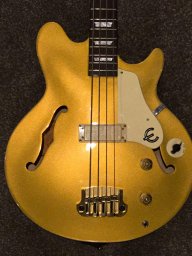
My dad pretty much gave me his 1965 Fender jazz that he has owned for the past 50 years or so. I've been playing it for a few years now and I wanted it to play its very best so I set it up the other day, adjusted the truss rod, string height, intonation etc. All according to the proper specifications provided by Fender. The bass plays way better, and it already played great!

The only issue I am having now is some fret buzz coming from the first fret when I play open strings. I checked the nut and according to the few tests people recommend, the nut slots are too deep, especially the G string.

I took a closer look and I think for certain the nut slots are too deep. I would attribute this to being played for half a century or so:

View attachment 4102318

View attachment 4102319


Now the bass is all original for the most part. My dad had a clear coat put on the body, over top of the original paint years ago as he said the paint was coming off everywhere when he played. Other than that it is original and I don't want to replace the nut or anything like that.

Side note: The height adjustment screws on the bridge would loosen up after playing a gig and it would be a mess. Someone on this forum recommended using clear nail polish to lock the screws after they have been adjusted. That was phenomenal advice and they don't move a bit. Others recommended replacing the bridge and keeping the original tucked away safe in the case. I didn't want to do that though, I wanted the bass to look the same as always. In this situation with the nut, I don't want to replace it or have to modify it much. I want the bass to remain looking original.

With that being said, I'm looking for any tips or tricks that can help keep this bass original yet playable with respect to the nut issue I'm having. I've thought of sticking something in the nut slots to raise the strings a bit but that seems a little half assed. Maybe not, depending on the material?

Please let me know if you have heard or known of a trick to fix too deep of nut slots. Worst case I will just leave it alone, the bass plays great and it sounds phenomenal plugged in.

Thank you very much and bellow there will be some pictures of the bass. Who doesn't like a thread with pictures.

Here is the same bass in different decades:

Late 60's?:

View attachment 4102325

Early 70s's?:

View attachment 4102321

1980s?:

View attachment 4102322

Here is the bass now:

View attachment 4102323


I greatly appreciate any advice regarding the nut, and in return, I hope this thread is a little bit entertaining.

- Sonny

Just asking, did you install new strings, and if so, are they the same gauge as the old ones. If the nuts slots were cut too deep, the buzzing would have been there from day one, unless somebody tried to modify it.
 
As for your son, maybe the direct approach will deter him. It just so happened in my case it sort of organically worked out but maybe you can inspire him some way indirectly. Your '65 is beautiful and I would feel the exact same way as you. I'd much rather give it to someone who will cherish it than give it to a family member who has absolutely no idea how special it is. I don't think a non musician can even fathom how special these instruments are, especially if they have a long family history.
I'm not pressuring my son to play - I hope the desire to play comes without pressure from me. He's got a room in our house full of basses, bass amps, upright and EUBs, guitars, guitar amps, a drum set, a PA, banjos, etc etc etc. Maybe since musical stuff is not beyond his immediate reach its less desirable. Or maybe seeing his Dad play music makes it less cool!
 
  • Like
Reactions: SonnyMorrow
+1 to first trying small pieces of paper in the nut slots. Parchment paper (the stuff used for cooking) has a tone that'll match the nut color halfway well. You might even need a double layer; it's pretty thin. See how that works. I'd do that first.

If that cures the buzzing, you can take an X-acto knife and trim the paper so it's not noticeable.
 
  • Like
Reactions: SonnyMorrow
I've used paper to eliminate buzzing at the first fret as a temporary fix for nut slots that are too deep. I've then repaired the nut slots using the CA/baking soda method and my set of nut files with excellent results making sure to file a bit of fall away into the slot for a good witness point at the fingerboard.
 
Last edited:
  • Like
Reactions: SonnyMorrow
Listen to the baking soda and superglue guy. i learned that trick many years ago from Rendel Wahl, setup man at Gibson in Kalamazoo and Heretige Guitars. Put a small pinch of baking soda in the slot and put a drop of superglue on the baking soda. Let it dry then take a round jeweler's file and recut the slot. Yes it can be undone with jeweler's files (usually cheap at Harbor Freight or other discount tool stores). If you should need it on a black nut, it takes color well from a Sharpie. This will last and if done carefully and keep it in the slot, you'll never see it.
 
Take the bass to a good guitar tech and have a new bone nut made and save the original for nostalgic reasons.

This. While there are many good options here that are acceptable even to collectors, your attachment to the instrument tells me that you ultimately be dissatisfied with anything that might alter the appearance of the nut (which is definitely just a “wear” item, like strings).
 
  • Like
Reactions: SonnyMorrow
[This invalid link has been removed]

One option from the master repairman Dan Erlewine, or as stated, have a qualified tech replace the nut with a new one, and save the original. All instruments will eventually need replacement parts if they are played, no matter how much we want to keep them original.
 
Last edited: