Enjoy the benefits of a premium membership!
Upgrade Account
-
TalkBass has been independent since 1998. Add your voice.
Create a free account to reply to discussions, view embedded media, and browse with fewer display ads.
Join free Log in
Want zero display ads or expanded classifieds tools? Compare plans.
You are using an out of date browser. It may not display this or other websites correctly.
You should upgrade or use an alternative browser.
You should upgrade or use an alternative browser.
More options
Who Replied?
yes, we will have to agree to disagree. Which is perfectly normal and fineWe’re gonna have to agree to disagree on this one. Yes there are more physical landmarks on a double bass, but it’s entirely possible to play electric bass and shift accurately without looking by using muscle memory by using the same exercises that you learn the same thing with double bass. Also, your simplification of finger theories is erroneous. I freely move between the classic upright simandl 1-2-3+4 method, the one finger per fret method, and the Rabbath style pivoting on electric bass. My original statement, slightly expanded, was that as a result of playing electric bass for 25 years and upright bass for 20 years, and jumping between the two often on different songs in the same set, the difference an inch or two in scale makes for me, and only me, but possibly others, is imperceptible. My hands and muscle memory have learned to automagically adjust.

Just to explain my experience on this, and what I've found to be my requirements for playing accurately and consistently:
I have been sight reading music on various instruments since I was a little kid, and on topic... electric bass since 1983.
On electric bass there are plenty of times when I need to glance at the neck if I need to nail the performance every time, whether fretted or fretless. I also can play an entire night without ever looking at my left hand, but it's taking a chance, depending on the music of course.
This is an engineering thing that is most dramatic on the electric bass. The neck on the bass is very long before the body join, moreso on the basses I play (24 fret with easy upper fret access). Without the cues of the fingerboard rising up on the neck (so you can feel depth change easily as you move up the neck on upright) and of the neck changing in any easily felt way other than very gradually widening and the frets getting closer together (if you are playing fretted bass), you are left with the only measurement of feel being your left arm's position (wrist angle, elbow bend, shoulder hang, and distance between frets), which changes depending on how your instrument hangs on a strap (length of the upper bout, for example), on whether you are sitting or standing, on the scale length, on the distance of the bridge from the edge of the body (and therefore how far extended the neck is to get to the nut for the scale length).
I play without looking most of the time, but there are times when I need to look unless I'm just going to take a chance. I'm not talking about going up 1 or 2 positions, but for doing big shifts and fast complex parts with significant shifting. I always look in those cases, unless I absolutely can't. I can do it without, but it's possible to play it wrong if I do that.


I agree.I think people get too caught up on scale lengths, fretboard radius and nut width etc.
You can’t really tell if you’re going to like a bass until you play it.
I was really surprised when I got my hands on a Yamaha Attitude that has a 1-11/16" width nut, which is way wider than the 1-1/2" width that I'm used to.
The depth of the Yamaha is shallower than I expected it to be and it turns out to be very fast and comfortable for my short finger hands.
Most Precision Bass necks with the 1-5/8" nut or Fender/Squier necks with a 1.65" nut feel big and slow....so the wide flat Yamaha somehow works where a regular P Bass neck does not....go figure.

drumvsbass
Commercial User
- Aug 20, 2011
- 1,981
- 4,324
- Disclosures
- I work for Long and McQuade Musical Instruments Canada in Sales.
I just said this 10 times in a row and now a genie is the room and won't leave.
All yours buddaayyyyy.... *disappears to the sound of the old Apple 'wild eep' and the smell of Nag Champa....*
http://www.tnlc.com/eep/sfx/wildeep!.wav
Last edited:

I can immediately tell, and am surprised that people can't. Even though I have huge hands, I've never been able to meld with a 35". It just feels unnatural to me.

It feels quite different to me, but then after playing a Fender Jazz with a 7.25" radius since 1966, a 9.5" radius feels way to flat. Besides that, I would propose that the tension can also vary by the strings you use. My current 5-string is only 34", but it was inexpensive ($229 or so) back in 2009, sounds decent and has a slim, not fat, neck which I like. I can put up with the wide necks. but not the fat necks, My Jazz basses have all have the Slim 60's C-shape neck with 7.25" radius.Going from 34 to 35 inches adds… 6 percent more tension (the Physics is very straightforward). Yes, it’s more, but I wouldn’t call it a lot.

Does anyone know if all of the Carvin XB76 series have 34" scale length? Most of the 6ers are listed as 34" from Carvin. Maybe that's so the high C sounds as equally good as the low B?Agree!!! The B does sound better with 35" and longer scale. But, I have noticed that a B string with the tapered end at the bridge sounds pretty darn good on a 34" scale too.
I have a Carvin XB75, 35.25 scale with TI Flats and the B string sounds soooooo delicious!

I’m pretty sure I could tell the difference playing them. I might be able hear the difference while playing in an ensemble. I seriously doubt scale would make a difference in my choice between two instruments. In the end, they are both going to sound like a EB to everybody else.In all my years of selling basses, this happens most consistently:
I post a 35" scale bass. I get a comment saying, "If this bass was 34-inch scale, I'd be all over it." A little while later, I sell a 34" scale bass and get the comment, " Man! If this was 35-inch scale, we'd be talking."
I own both. I play both... in 4-string and 5-string. Scale-length has never crossed my mind when switching from a 34" to a 35". I've never noticed any need to adjust. For me, scale length isn't even in my top-10 of things I look for in a bass.
Can anyone REALLY tell the difference between 34" scale and 35" scale? If so, what's the deal? Does it affect your playing? Is it all about how the low-B sounds?
I don't get it. Enlighten me.
(don't get me started on multi-scale... lol)


Speaking only from my experience, I've never tried a 35" five string that was an obvious improvement over 34". Feel is relative to me and not much of a concern and I'd prefer the far wider range of string choices for the 34" basses.
I made my peace with whatever the B-string does or doesn't feel like, I just play it and forget about it.
But . . . I've yet to try a Dingwall and I'd like to see and hear how it works.
I made my peace with whatever the B-string does or doesn't feel like, I just play it and forget about it.
But . . . I've yet to try a Dingwall and I'd like to see and hear how it works.

Well...
When I decided to start my "Bass Herd", I decided that they would all be 34" scale - or shorter; all 4-stringed; and - of course - all left handed. 35" scale - or longer - basses were never on my radar, mainly because:
1. 35" or longer basses all seem to have more than 4 strings. In the 50+ years I've been playing, I have never needed more than 4 strings, and having more wouldn't make playing what I play one iota easier.
2. My stubby troglodyte paws have never managed to work on a 5-string bass neck - regardless of scale length. They're always too wide, or if they aren't? The strings are too close together. And, pretty much all 35" scale basses I've had in my hands - like the lefty Dingwall Combustion I messed with at Sweetwater a few days ago? No way in Hell could I ever play that thing. It started out too wide to get my hand around - and got worse from there. Pretty nice bass, tho... And;
3. Does anyone even make a 35" scale 4-string bass? Much less a left handed one?
So, the answer to your question - for me - is; Hell yes, I can tell the difference. I can play a 34" 4-string bass with, at worst, minor difficulty with some bass's neck contours. Every 35" scale bass I've ever had in my hands? Absolutely no way...
When I decided to start my "Bass Herd", I decided that they would all be 34" scale - or shorter; all 4-stringed; and - of course - all left handed. 35" scale - or longer - basses were never on my radar, mainly because:
1. 35" or longer basses all seem to have more than 4 strings. In the 50+ years I've been playing, I have never needed more than 4 strings, and having more wouldn't make playing what I play one iota easier.
2. My stubby troglodyte paws have never managed to work on a 5-string bass neck - regardless of scale length. They're always too wide, or if they aren't? The strings are too close together. And, pretty much all 35" scale basses I've had in my hands - like the lefty Dingwall Combustion I messed with at Sweetwater a few days ago? No way in Hell could I ever play that thing. It started out too wide to get my hand around - and got worse from there. Pretty nice bass, tho... And;
3. Does anyone even make a 35" scale 4-string bass? Much less a left handed one?
So, the answer to your question - for me - is; Hell yes, I can tell the difference. I can play a 34" 4-string bass with, at worst, minor difficulty with some bass's neck contours. Every 35" scale bass I've ever had in my hands? Absolutely no way...
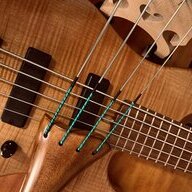
In my experience, with all other factors equal: I can feel the slight difference in resistance under my right hand; my left hand needs a modest adjustment for spacing; with the same B string gauge, the clarity of the lowest notes makes it easier to discern the pitch.
I own 34” and 35” scale basses and enjoy them both!
I own 34” and 35” scale basses and enjoy them both!



Are all lakland’s 35”?I prefer 33" and 34" basses. I sold my Laklands and Roscoes because i just didn't like the feel of 35"...I do feel a slight difference when switching between 33" and 34" but I love them both.
The second "5" in "55-" is for a 35" scale. They have made "54-94"s which are 34 inch scale. I believe all "44-" basses (4 string models) are 34" scale.Are all lakland’s 35”?

Thanks for the explanation.The second "5" in "55-" is for a 35" scale. They have made "54-94"s which are 34 inch scale. I believe all "44-" basses (4 string models) are 34" scale.
I was only referring to the 5 string models, my bad. Nowadays they are all 35”?
I always thought lakland’s sound amazing but 35” is a big turn off for me.
If you talk to the US shop they will definitely make a 34" scale for you. If you're looking at skyline models, all 55-02s are going to be 35" scale.Thanks for the explanation.
I was only referring to the 5 string models, my bad. Nowadays they are all 35”?
I always thought lakland’s sound amazing but 35” is a big turn off for me.

When folks discuss the benefits of 35 vs 34 B they typically refer to the sound of the open B. Well at least in video reviews.
But one of the appeals of a 5 string is being able to play down around the low E in the upper positions. So way less shifting positions.
So question is how does the 35 compare to the 34 when playing between the 5th and 12th frets ? Does it really make a difference as the different in fret spacing up there is really rather minimal.
But I guess string tension is still different.
But one of the appeals of a 5 string is being able to play down around the low E in the upper positions. So way less shifting positions.
So question is how does the 35 compare to the 34 when playing between the 5th and 12th frets ? Does it really make a difference as the different in fret spacing up there is really rather minimal.
But I guess string tension is still different.