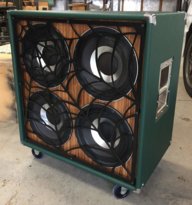
Although, what most people don't realize, is that's actually really loud. Like, it's really more than you need.
Yes, thats why i fear roasting the cabs

TalkBass has been independent since 1998. Add your voice.
Create a free account to reply to discussions, view embedded media, and browse with fewer display ads.
Join free Log in
Want zero display ads or expanded classifieds tools? Compare plans.
Although, what most people don't realize, is that's actually really loud. Like, it's really more than you need.
I would use two exact same 110s.
Do you also see the potential of any tuning problems with the exact same model?
Ok nice, soIf the cabs match, they will be tuned exactly the same.
Ok nice, so
2 110s from the exact same type and
2 112s from the exact same type should not face any of these problems then
Not necessarily. It doesn't matter that the 10s and 12s are from the same brand (unless that brand specifically designed those speakers to work well together).
It's better to just keep with the same set of cabinet all together. So if you plan to use a GK 110, us 4 gk110s. Or if you like how the GK 112 sounds, use 4 GK 112s (replace GK with whatever brand you are into).
okay, so you wouldnt mix 10s and 12s?
I wouldn't purposefully go out of my way to do so without first trying them to see if I liked how they sound. That's just based on much of what I've read on here from people who are much more knowledgable on the subject (including people who design bass cabs like Andy at Mesa Boogie).
Putting 10s and 12s or any other mismatched combination of speaker sizes could result in phase issues. That being said, there are certain brands that have specifically designed their different cabs to work well together. The Subway 210 and Subway 115 from Mesa Boogie are examples of that from what I've read from many users here on TB.
Although, what most people don't realize, is that's actually really loud. Like, it's really more than you need.
I see, the only reason i would mix 10s and 12s would be for broader frequency response. But as 10s and 12s are not far from each other, phasing issues could easily compromise the positive aspects.
Maybe i should ask the manufacturer if their 10s and 12s work together
I see, the only reason i would mix 10s and 12s would be for broader frequency response. But as 10s and 12s are not far from each other, phasing issues could easily compromise the positive aspects.
Maybe i should ask the manufacturer if their 10s and 12s work together

Exactly.If they are using the term peak in the normal way: 1000W peak = 500W RMS.
View attachment 4355762
To convert VRMS to Vpk multiply by sq rt of 2 which equals ~1.414 The inverse of sq rt of 2 is ~0.707. So to convert Vpk to VRMS, multiply by ~0.707. Notice in the image above, VRMS is 0.707 of the Vpk
View attachment 4355763
Lets solve Vpk for 1000Wpk at 8 ohms. I'll use ~ to indicate rounded figures. I'll use unrounded numbers in my calculator.
Vpk=sq rt(PpkZ)In other words if you apply ~89.44Vpk to 8 ohms, the load will dissipate 1,000Wpk.
Vpk=sq rt(1,000x8)=~89.44Vpk
Now we will convert to Vpk to VRMS by multiplying by ~0.707
89.44x0.707=~63.25VRMSNow we will figure the Power RMS with ~63.25VRMS at 8 ohms.
PRMS=(VRMS^2)/ZThis shows 1000Wpk=500WRMS.
PRMS=(~63.25^2)/8=500WRMS
AFAIK, most companies use RMS power ratings and would call this a 500W amp.
If they are using the term peak in the normal way: 1000W peak = 500W RMS.
View attachment 4355762
To convert VRMS to Vpk multiply by sq rt of 2 which equals ~1.414 The inverse of sq rt of 2 is ~0.707. So to convert Vpk to VRMS, multiply by ~0.707. Notice in the image above, VRMS is 0.707 of the Vpk
View attachment 4355763
Lets solve Vpk for 1000Wpk at 8 ohms. I'll use ~ to indicate rounded figures. I'll use unrounded numbers in my calculator.
Vpk=sq rt(PpkZ)In other words if you apply ~89.44Vpk to 8 ohms, the load will dissipate 1,000Wpk.
Vpk=sq rt(1,000x8)=~89.44Vpk
Now we will convert to Vpk to VRMS by multiplying by ~0.707
89.44x0.707=~63.25VRMSNow we will figure the Power RMS with ~63.25VRMS at 8 ohms.
PRMS=(VRMS^2)/ZThis shows 1000Wpk=500WRMS.
PRMS=(~63.25^2)/8=500WRMS
AFAIK, most companies use RMS power ratings and would call this a 500W amp.

What the bass?!
I need some time to look thru this
Thanks for sharing your knowledge





If you've never played through two 12's, it's likely all you'll need. Put the money you'd spend on the 10's into two top notch 12's.