Yes. You can just send them to me. I'm happy to relieve your burden.Now I have to dump my 5 string basses and get the right ones?

TalkBass has been independent since 1998. Add your voice.
Create a free account to reply to discussions, view embedded media, and browse with fewer display ads.
Join free Log in
Want zero display ads or expanded classifieds tools? Compare plans.
Yes. You can just send them to me. I'm happy to relieve your burden.Now I have to dump my 5 string basses and get the right ones?

Disagree I had a 35” and hated it.
5 string bass scales should be a choice!


I studied the Physics of Musical instruments in college, and this is absolutely the right answer. String sets for basses are typically designed with an arithmetic progression in string diameter - 45-65-85-105. This results in uneven tension. When extended to a 5th string, this thinking flat out fails. I like really light tension - 40-55-70-95 on a 4 string. A well matched B string for that set is a 130. If you’re playing a 105E, a 140 is what you need. The 120 or 125 in the set you bought is just a bad choice.
35 inch scale is a band aid for the fact that string companies don’t make matched sets - it helps the floppy B somewhat, but makes the other strings tighter as well. With well designed string sets, none of this would be necessary.
I buy single strings to get a well matched B string. It works very well on a 34 inch scale. With the right strings, a 34 inch scale bass is better for a 5 string - shorter necks are, by definition, stiffer. That difference is small, but it is there.

I was going to let this thread go, 'cause there are a lot of opinions & mine is just another.
That is, until I saw micguy. I said "woah, it's science!".
No, seriously - I'm interested now.
I have 34s, mostly 4-strings.
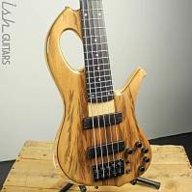
My go-to bass, when I have to be able to do any style or any crazy key at the drop of a hat, is a Read Custom 34" scale 5-string.
- Alder body covered with an exotic wood sandwich
- Maple neck, and purpleheart lam., ebony board. Single truss rod - two-way (?).
- Good electronics: Agular OBP-3, Lane Poor soapbars.
When I had it built, I said "34". 35 was the rage for 5-strings at the time. Maybe I thought I'd have trouble going back & forth all the time. I bet I could though....
Strings are usually gauges 40-60-80-100-125, or 45-65-85-105-125. Sadowsky or DR. Most often nickel.
I fight the "B" like crazy. It's too "floppy", sounds different or lacks definition as I travel up the neck.
I have to put on the brakes on my plucking hand, and change up technique on the B.
So, if I like light or light/medium, probably nickel strings - what do I need?
Who sells single B strings and where can I get them?
Rock on, micguy!
Since I buy online it's hard to look at a string and know. If you will seguest a string brand I will buy and see if that fixes the problem.It occurs to me that it could be the type of string you're using for your low B. Some manufacturers use a 3 wrap string to get it to gage and some use a 4 wrap string. That will change the tension, the flexibility, the mass, and the tone. You might try using a different brand of strings.
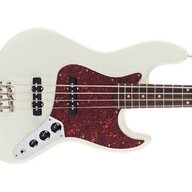
Take a look at the Schecter Elite 5, I just purchased one several months back and love the feel and the tone.I have absolutely no use for a B string, However, I find myself greatly DESIRING one. I am casually researching five strings. From what I can determine by reading a few threads on Talkbass string gauge and construction can mitigate scale length. That said, when I do finally get a fiver it will probably ether be a Yamaha BB or an Ibanez SR.
https://kaliummusic.com/shop/strings/electric-bass/stainless-steel/singles-stainless-steel/I was going to let this thread go, 'cause there are a lot of opinions & mine is just another.
That is, until I saw micguy. I said "woah, it's science!".
No, seriously - I'm interested now.
I have 34s, mostly 4-strings.
My go-to bass, when I have to be able to do any style or any crazy key at the drop of a hat, is a Read Custom 34" scale 5-string.
- Alder body covered with an exotic wood sandwich
- Maple neck, and purpleheart lam., ebony board. Single truss rod - two-way (?).
- Good electronics: Agular OBP-3, Lane Poor soapbars.
When I had it built, I said "34". 35 was the rage for 5-strings at the time. Maybe I thought I'd have trouble going back & forth all the time. I bet I could though....
Strings are usually gauges 40-60-80-100-125, or 45-65-85-105-125. Sadowsky or DR. Most often nickel.
I fight the "B" like crazy. It's too "floppy", sounds different or lacks definition as I travel up the neck.
I have to put on the brakes on my plucking hand, and change up technique on the B.
So, if I like light or light/medium, probably nickel strings - what do I need?
Who sells single B strings and where can I get them?
Rock on, micguy!
Very interesting solution!I love this bass ... it is a 5 string bass at 32" ... I love the low B and I use light scale strings 125 95 75 60 40. It has 3 pickups wired V-V-V-T. The only problem with the low B is I use long scale strings and the wrong part of the string enters the tuner and breaks, so I made an extender at the bridge to stop that.
View attachment 4492957
View attachment 4492962
There is another reason: inharmonicity of strings. Physicists develop bass string theory and String inharmonicity vs material
Italian harpsichord makers needing to shorten the instruments to fit, learned in the 1600's that too thick a string will not vibrate freely and even though may have similar tension, will not have the overtones or sustain necessary to match, and the overtones can go sharp. This is one reason B strings in commercially available sets are lesser diameter than equal tension figures might indicate otherwise as to how large a diameter a B string should be. Piano tuners also work with this, actually progressively flattening the fundamentals of the lowest octaves so the overtones will be in tune with the middle of the piano, and sharpening the treble pitches for other bioacoustic reasons as well as the inharmonicity of the solid strings as they get shorter.
Yes, I have been using custom singles to get a more balanced tension, usually with 45-60-80-105 GHS Progressives on my Rickenbacker 4002 (yes, "2," not "1" or "3") since the early 90's, and more recently the D'A XL170BT plus a 130 B string on my Ibby gig bass for these very reasons.
Bottom line: depending on the construction, set up, and choice of strings, any 5-string bass of any scale can sound good, even superlative, so long as the player is aware of the inherent compromises and limitation inherent in having a 5th B string on a bass.

Tension yes string type no. A good built 5 has good string tension no matter the string that’s all I’m saying.We completely disagree. String tension is a string problem. Have a nice day.
Tension yes string type no. A good built 5 has good string tension no matter the string that’s all I’m saying.
Yea we all know you like to throw your title around...have a nice day.The Equation that you use (I’m an Acoustical Physicist) to calculate string tension includes the length of the string, it’s linear density, and the frequency you want to tune it to. There are literally no parameters of the thing it’s attached to that change the tension of the string.
25928761[/URL], member: 79074"]Yea we all know you like to throw your title around...have a nice day.
https://kaliummusic.com/shop/strings/electric-bass/stainless-steel/singles-stainless-steel/
[Invalid or Expired Link Removed]
145 Stainless Wound Bass Single String
Invalid Link Removed