• TalkBass has been independent since 1998. Add your voice.
    Create a free account to reply to discussions, view embedded media, and browse with fewer display ads.
    Join freeLog in
    Want zero display ads or expanded classifieds tools? Compare plans.

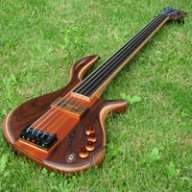
5 string fan fretted 36"-34" all in Wenge

I have played raw-wood necked basses for years, not all woods are good for this of course, but wenge, ebony, pau ferro, goncalo alves, padauk and a few more are perfectly OK to play raw. Maybe you sweat from your forearms when playing - I don't, but I sweat from my hands quite a lot when playing during the hot summer. Sometimes the neck wood is soaking wet with sweat when playing. What I do after playing is to rub the neck with one of these pads (don't know what they are called in English) and the neck is like new again. Actually better because after playing / rubbing several times the neck get's an almost gloss and very smooth finish to it. These raw necks are the best feeling necks I've ever played...

Here are some pics of my raw necked basses. They have both been played for years. Nothing is uneven, dirty or whatever... (Of course a clean white paper towel and some denatured alcohol will make the paper dirty if I wipe it. It will also get dirty if I wipe the new pieces of wood I just bought for upcoming builds, or if I wipe any other piece of wood for that matter).

Let's not take this further, we will take the thread off topic... We have different experiences and different opinions and I guess that is fine..!? I was just making the OP aware, that a finish is not needed for wenge and personally I would never do an oil finish on that amazing bass, it kills the gorgeous look - IMHO. But if one wants are darker look - oil finishes are fine. We all agree on that.

View attachment 450834 View attachment 450835 View attachment 450836

Yeah, and here's the raw wenge neck on my first build. It's very shiny up close and very smooth and very comfortable and slick to use. It also gets pretty manky after playing, and I worry about moisture uptake. So I take the time to keep it clean, but I do the same to my finished necks.

http://i223.photobucket.com/albums/dd60/hardmark/guitarwork/001/back_1.jpg

And here's the wenge back of a guitar I finished with tung oil.
http://i223.photobucket.com/albums/dd60/hardmark/guitarwork/002/done_3.jpg

The lighting is not great, but I assure you that you can still see the chocolaty contrast even with tung oil finish on it.
 
I have played raw-wood necked basses for years, not all woods are good for this of course, but wenge, ebony, pau ferro, goncalo alves, padauk and a few more are perfectly OK to play raw. Maybe you sweat from your forearms when playing - I don't, but I sweat from my hands quite a lot when playing during the hot summer. Sometimes the neck wood is soaking wet with sweat when playing. What I do after playing is to rub the neck with one of these pads (don't know what they are called in English) and the neck is like new again. Actually better because after playing / rubbing several times the neck get's an almost gloss and very smooth finish to it. These raw necks are the best feeling necks I've ever played...

Here are some pics of my raw necked basses. They have both been played for years. Nothing is uneven, dirty or whatever... (Of course a clean white paper towel and some denatured alcohol will make the paper dirty if I wipe it. It will also get dirty if I wipe the new pieces of wood I just bought for upcoming builds, or if I wipe any other piece of wood for that matter).

Let's not take this further, we will take the thread off topic... We have different experiences and different opinions and I guess that is fine..!? I was just making the OP aware, that a finish is not needed for wenge and personally I would never do an oil finish on that amazing bass, it kills the gorgeous look - IMHO. But if one wants are darker look - oil finishes are fine. We all agree on that.

View attachment 450834 View attachment 450835 View attachment 450836

Is that a solid macassar ebony neck? That thing is beautiful, but how much does it weigh?
 
Yes, it's a solid macassar ebony neck from Warmoth, and with a fretboard made from the same lump of wood... It's the most amazing neck I have ever seen, and silky smooth to play.

It's 1,3kg's, that is 170g more than the solid Pau Ferro neck I had on the bass before (I found this beauty second hand). So it's heavy and there is a little bit more neck dive than with the pau ferro neck, but it's not bad. With the ultralite tuners I have on it now it's fine, but it came with boat-anchor Shallers and with those it was to heavy and too much neck dive. Here a few pics (with the original Shaller tuners).

Sorry for the off topic Matteo, but I'm sure you will like to look at this beast also :cool:

neck-main.jpg neck-rear.jpg
 
Thanks Matteo... It's stunning and Warmoth makes amazing necks..! It's installed in my P bass and for sound my comparison is the pau ferro neck with pau ferro fretboard I had on it before. The macassar ebony neck is a little more forward in the midrange, and I hear myself better in the mix when playing the bass now with this neck, than I did before with the pau ferro. It's not night and day differences, but there are differences.
 
Yes, it's a solid macassar ebony neck from Warmoth, and with a fretboard made from the same lump of wood... It's the most amazing neck I have ever seen, and silky smooth to play.

It's 1,3kg's, that is 170g more than the solid Pau Ferro neck I had on the bass before (I found this beauty second hand). So it's heavy and there is a little bit more neck dive than with the pau ferro neck, but it's not bad. With the ultralite tuners I have on it now it's fine, but it came with boat-anchor Shallers and with those it was to heavy and too much neck dive. Here a few pics (with the original Shaller tuners).

Sorry for the off topic Matteo, but I'm sure you will like to look at this beast also :cool:

View attachment 451007 View attachment 451008

Mac ebony is the most beautiful wood in the world IMHO, I gladly put up with a little neck dive for that look on the right bass. I would guess that that neck was pretty expensive. I bet that the blank was in the range of $150 in rough lumber. Mac Ebony goes for about $90 a board foot at my supplier.
 
Hello in Italy :-)

I could use a bit of help and advise - please.

When I look at the way you have made the set-neck it's very much the same as I'm going to do. I'm curious about your measurements: I know you have a one piece neck, but if it was a neck blank + fingerboard, how thick would the neck blank be? And how thick would the fingerboard be? How thick is the heel block? And how many degrees do you angle the neck with the heel block?

I would much appreciate if you will share your measurements, thanks..! And regarding angling the necks... Some seems to think it's not needed, others think it's very important. What is your take on this?


This is the "heel block", a wedge to tilt the neck backwards
IMG_0066_zpse2fc8c80.jpg


I glued the wedge on the neck and routed an "huge" neck pocket. It was a little tight, so I used the scraper to fix it.
IMG_0070_zps793d02d5.jpg
 
When I look at the way you have made the set-neck it's very much the same as I'm going to do. I'm curious about your measurements: I know you have a one piece neck, but if it was a neck blank + fingerboard, how thick would the neck blank be? And how thick would the fingerboard be? How thick is the heel block? And how many degrees do you angle the neck with the heel block?

I would much appreciate if you will share your measurements, thanks..! And regarding angling the necks... Some seems to think it's not needed, others think it's very important. What is your take on this?

IMG_0066_zpse2fc8c80.jpg


Hi Morten!

So many question to answer without my CAD!
About angling the neck: I think it's usefull for long/super long scale basses, because your left hand is closer to your body. But truely i use it because Carl Thompson do the same! You can find lot of his videos of Carl talking about it. And also because i LOVE the way it looks when it's carved!

About the measurement: it's very hard to tell you a "real" measure, too many variables... scale, number of frets, length of the neck pocket...
The neck blanck has a 0.5° angle, the heel block has 1° angle. An angle with 1.5° could appear a very small thing, but it isn't, in almost all the basses i built i had to put a 3-4mm baseplate under the bridge to compensate this angle.

My suggestion is to do a sectional drawing of the bass: use a thick fingerboard, 7-8mm, and (with the desired thickness at the nut) you can draw the neck with a 0.5° angle. Under the neck you can draw the heel block, about 1mm to 5mm, or 1mm to 6mm for a deep set neck. The bottom line of the heel, is the "direction" of the body. The top line of body will be placed in the line between the neck and the end of the fingerboard, with the same direction of the heel's bottom line.

I hope I was clear!
 
Thanks Matteo!

Yes, the explanation with the angle + long scale makes sense to get the neck closer to the body. This also explains your use of a block under the bridge to lift it up. I noticed that on your CT tribute build. I'm building regular 34" scale 4 string basses (call me boring ;-)) so I don't need the angle, but it can still ge a cool feature to make.

Having never build a bass before I'm looking for measurements :) The best I have now is my Warmoth bass that has a 15mm deep neck pocket, a 19mm thick neck blank and a 7,5 mm thick fingerboard. I know this works, so I guess I can just use those dimensions...
 
You can put a 2/3mm heel block with 0° angle if you want, just for the look. But take care to leave enough wood under the neck pocket!

BTW a boring 34" bass is long scale bass! 32" medium, 30" short, 35/36" super long or extra long scale ;)

Having never build a bass before I'm looking for measurements :) The best I have now is my Warmoth bass that has a 15mm deep neck pocket, a 19mm thick neck blank and a 7,5 mm thick fingerboard. I know this works, so I guess I can just use those dimensions...

Your neck should be a "standard contour" neck
Invalid Link Removed

This measures should be ok, but what about the neck pocket? Will you route to the PU like the prometeus?
 
Good idea with the heel block and no angle. I will do that - and of course only if/when there is enough wood under the pocket. Thanks, great idea :)

Yes, the Warmoth neck I use to get the measurements from is a standard contour Warmoth neck, a P bass neck actually, I like the chunkier P bass necks better than the narrow and slim J bass style necks. And Yes, the pocked will be routed to the pick up like in the Prometeus and like your wenge monster. It will be a glued set-neck.
 
Yes, it's a solid macassar ebony neck from Warmoth, and with a fretboard made from the same lump of wood... It's the most amazing neck I have ever seen, and silky smooth to play.

It's 1,3kg's, that is 170g more than the solid Pau Ferro neck I had on the bass before (I found this beauty second hand). So it's heavy and there is a little bit more neck dive than with the pau ferro neck, but it's not bad. With the ultralite tuners I have on it now it's fine, but it came with boat-anchor Shallers and with those it was to heavy and too much neck dive. Here a few pics (with the original Shaller tuners).

Sorry for the off topic Matteo, but I'm sure you will like to look at this beast also :cool:

View attachment 451007 View attachment 451008

That neck is incredible!