That is awesome! Great look and the sound clip sounds great! Can't want to see and hear the completely finished product!

Enjoy the benefits of a premium membership!
Upgrade Account
-
TalkBass has been independent since 1998. Add your voice.
Create a free account to reply to discussions, view embedded media, and browse with fewer display ads.
Join free Log in
Want zero display ads or expanded classifieds tools? Compare plans.
You are using an out of date browser. It may not display this or other websites correctly.
You should upgrade or use an alternative browser.
You should upgrade or use an alternative browser.
5 string fretless showcase: Habanero V
- Thread starter adam.beauchene
- Start date
More options
Who Replied?Stick_Player
Inactive
- Nov 13, 2009
- 4,149
- 937
- Disclosures
- Endorser: Plants vs. Zombies Pea Shooters


Drake Custom
Commercial User
- Aug 24, 2010
- 440
- 1,083
- Disclosures
- Builder/Owner:Drake Custom Bass Guitars
Digging the build. I was not sure if I would like the body shape but now that I see it in the playing position, I stand corrected. I can see that the shape flows nicely. Beautiful work! That neck is my favorite from all of the builds and that pickup is the coolest thing I have seen in a long time.

OK... moving this post to my OWN thread... sorry big B!
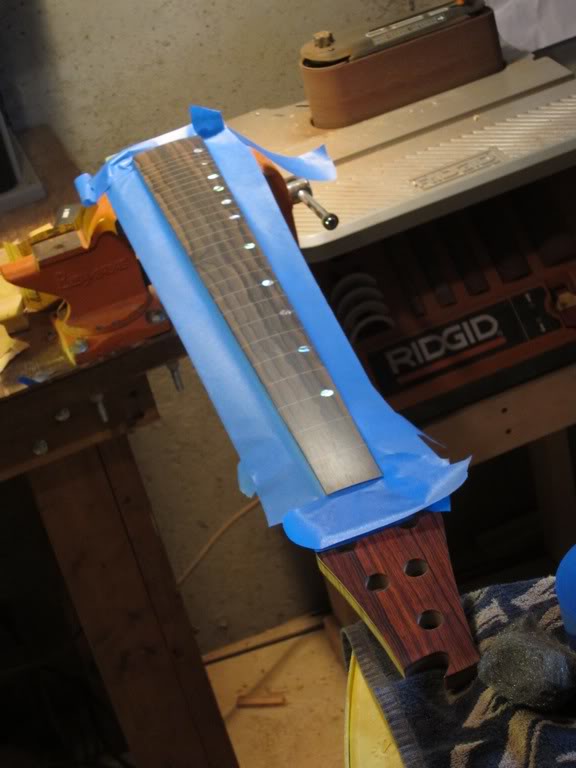
Took the FB down to 320, then steel wool, then taped off:
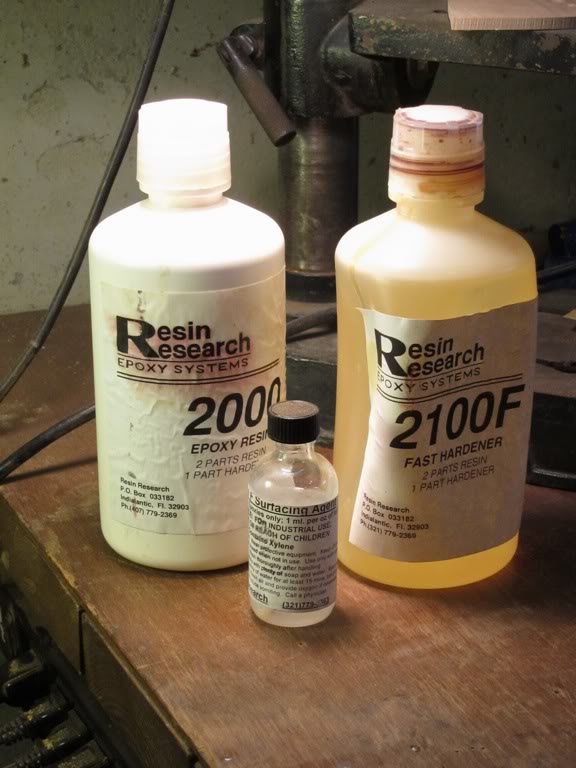
Mixed up some epoxy. My shop was about 50 degrees F today so I had to warm up the epoxy and the neck a little with lamps and a heat gun.
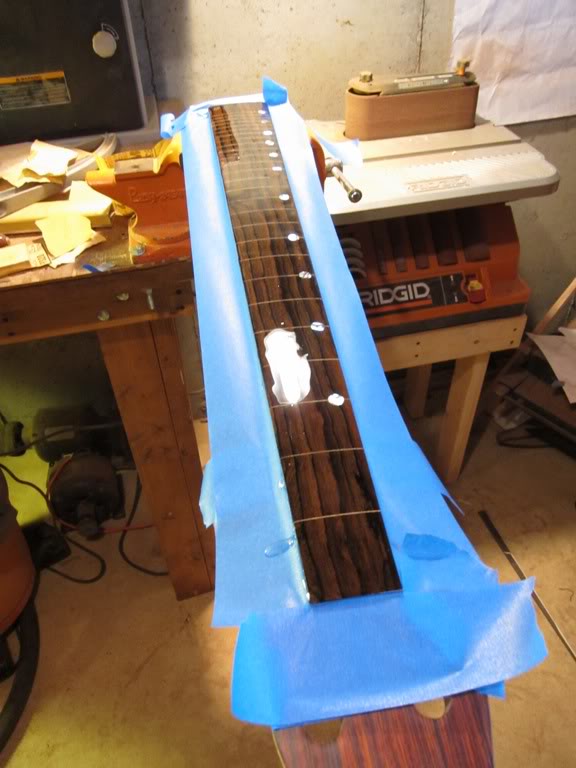
Then poured on the sauce, spread it carefully with a foam brush, and put it my nice warm laundry room to cure for the day.
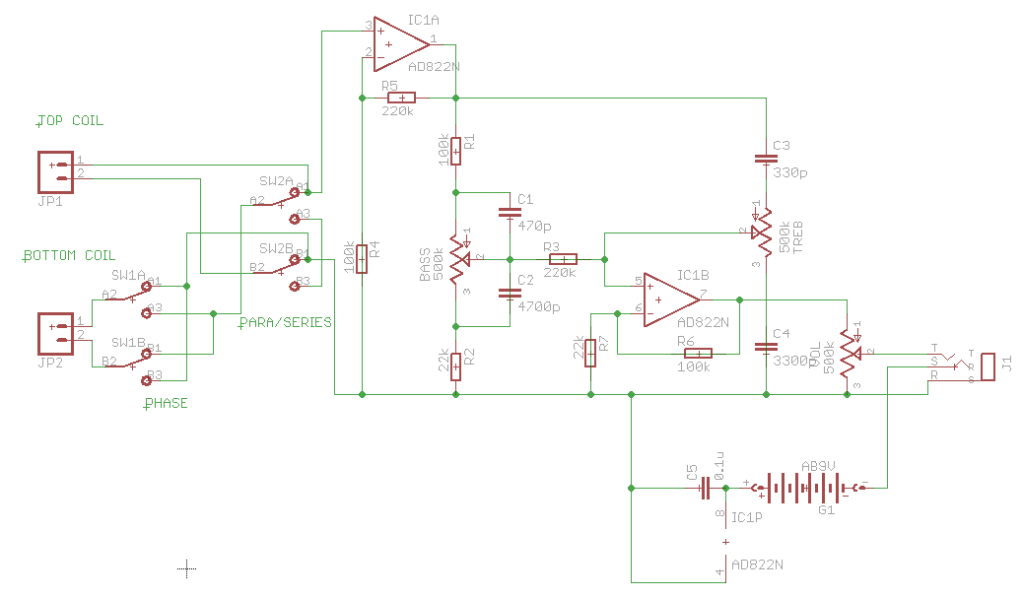
Meanwhile, I kept working on the active preamp. I'm using the same tone stack values, but it will be buffered from the pickup and again from the volume control using an Anolog Devices AD822 2-channel opamp. The pickup buffer will be gain 2, and the volume buffer gain 5.
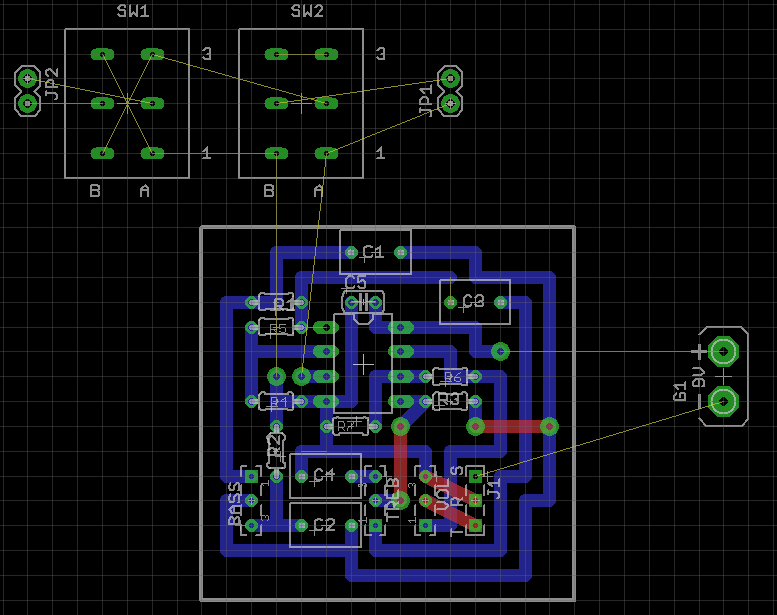
Started soldering tonight, hopefully some good news tomorrow!
Took the FB down to 320, then steel wool, then taped off:
Mixed up some epoxy. My shop was about 50 degrees F today so I had to warm up the epoxy and the neck a little with lamps and a heat gun.
Then poured on the sauce, spread it carefully with a foam brush, and put it my nice warm laundry room to cure for the day.
Meanwhile, I kept working on the active preamp. I'm using the same tone stack values, but it will be buffered from the pickup and again from the volume control using an Anolog Devices AD822 2-channel opamp. The pickup buffer will be gain 2, and the volume buffer gain 5.
Started soldering tonight, hopefully some good news tomorrow!
Looking real good, but I don't understand any of the electronics stuff you just posted
lowsound
lowsound
Looking real good, but I don't understand any of the electronics stuff you just posted
lowsound
It's cool, I barely understand it either
Soldered up, gotta scrub off the rosin and test it out!

Taylor Livingston
Commercial User
I'm a big fan of your builds! Wonderful work.
I had a few thoughts/questions about your electronics, hopefully that's ok.
Generally you want a series capacitor between the output of the second opamp and your volume control. 1uf to 10uf is probably a good value.
Otherwise you're sending the signal with a DC offset to the volume control. Since the volume knob would then be dividing not only your AC instrument signal, but the DC voltage, you'll get scratchy pot control, and potentially asymmetrical clipping at whatever you plug the bass into, because the signal will be offset towards the voltage rails, rather than centered around 0v. There are also other potential dangers if you plug into an amp that has DC leakage.
You can also double the values of R6 and R7 to lower current consumption and get a little more battery life.
The one thing I'm pretty confused about is that you have no voltage reference to bias the audio signal to ~4.5v. The way you have it, your audio is swinging around 0v, but because your opamps are run on a single-sided supply, they can only swing between 0v-9v. That means that the negative half of your waveform will be clipped off. I haven't used the AD822, but looking at the datasheet I don't see anything about self-biasing, but perhaps I'm missing some important detail here.
I had a few thoughts/questions about your electronics, hopefully that's ok.
Generally you want a series capacitor between the output of the second opamp and your volume control. 1uf to 10uf is probably a good value.
Otherwise you're sending the signal with a DC offset to the volume control. Since the volume knob would then be dividing not only your AC instrument signal, but the DC voltage, you'll get scratchy pot control, and potentially asymmetrical clipping at whatever you plug the bass into, because the signal will be offset towards the voltage rails, rather than centered around 0v. There are also other potential dangers if you plug into an amp that has DC leakage.
You can also double the values of R6 and R7 to lower current consumption and get a little more battery life.
The one thing I'm pretty confused about is that you have no voltage reference to bias the audio signal to ~4.5v. The way you have it, your audio is swinging around 0v, but because your opamps are run on a single-sided supply, they can only swing between 0v-9v. That means that the negative half of your waveform will be clipped off. I haven't used the AD822, but looking at the datasheet I don't see anything about self-biasing, but perhaps I'm missing some important detail here.
I'm a big fan of your builds! Wonderful work.
I had a few thoughts/questions about your electronics, hopefully that's ok.
Generally you want a series capacitor between the output of the second opamp and your volume control. 1uf to 10uf is probably a good value.
Otherwise you're sending the signal with a DC offset to the volume control. Since the volume knob would then be dividing not only your AC instrument signal, but the DC voltage, you'll get scratchy pot control, and potentially asymmetrical clipping at whatever you plug the bass into, because the signal will be offset towards the voltage rails, rather than centered around 0v. There are also other potential dangers if you plug into an amp that has DC leakage.
You can also double the values of R6 and R7 to lower current consumption and get a little more battery life.
The one thing I'm pretty confused about is that you have no voltage reference to bias the audio signal to ~4.5v. The way you have it, your audio is swinging around 0v, but because your opamps are run on a single-sided supply, they can only swing between 0v-9v. That means that the negative half of your waveform will be clipped off. I haven't used the AD822, but looking at the datasheet I don't see anything about self-biasing, but perhaps I'm missing some important detail here.
Thanks Taylor, that's the kind of input I was hoping to get! I don't hang out much in electronics forums.
I thought about the problem of not having a decoupling cap on the output last night while I was putting this together, thought I'd check for any DC output before I plugged it into anything expensive, and go back and add one if I needed it....probably a good idea to add now, in case there is some sort of drift that occurs over time that I don't yet know about.
Thanks for the tip on increasing r6 and r7 to lower quiescent current, all I knew is that it was the ratio of the two that mattered, I didn't think about the effect the absolute values would have.
As far as a single ended supply, just keeping it simple to try and get output. I've seen some examples out there running single-ended, and some with V- and V+, I know that I'm losing half of the opamp's potential output, do you think I'm risking damaging anything? My plan is if this works, I'll design a third version with a rail splitter and a regulator.
Thanks a lot for the advice! My knowledge of woodworking is marginal at best, but it is much deeper than my knowledge of electronics, which in turn is much deeper than my understanding of bass playing

Taylor Livingston
Commercial User
It's not about losing output, but if you don't bias your signal to the center of the supply, the negative half of your signal will be completely clipped off. So you'll have constant distortion.
You don't need to mess with a regulator, just do what everybody does in 9v electronics, shown in the attachment.
Just make a voltage divider out of equal value resistors. 100k is chosen here again to lower current draw - potentially you could lower these to closer to 10k and get a more stable reference voltage, but that's splitting hairs.
A v. divider with equal value resistors divides by 2, so at the junction of those 2 resistors we have 4.5v. That will be our "Vref", reference voltage. Now, in front of your opamp inputs put a series cap, 100n is good, and attach a 1m resistor to the non-inverting (+) input, going to Vref.
What this does is bias the audio so that it swings around 4.5v, the center of our single-sided 9v supply. Now your audio can swing positive and negative (relative to our vref) without being clipped, and it only costs a couple of passive parts.
Glad I could contribute a little something. I'm in awe of the work you and others do in the LC, and my woodworking projects are extremely primitive, so I generally have nothing to add here but "ooh" and "ahhh".
You don't need to mess with a regulator, just do what everybody does in 9v electronics, shown in the attachment.
Just make a voltage divider out of equal value resistors. 100k is chosen here again to lower current draw - potentially you could lower these to closer to 10k and get a more stable reference voltage, but that's splitting hairs.
A v. divider with equal value resistors divides by 2, so at the junction of those 2 resistors we have 4.5v. That will be our "Vref", reference voltage. Now, in front of your opamp inputs put a series cap, 100n is good, and attach a 1m resistor to the non-inverting (+) input, going to Vref.
What this does is bias the audio so that it swings around 4.5v, the center of our single-sided 9v supply. Now your audio can swing positive and negative (relative to our vref) without being clipped, and it only costs a couple of passive parts.
Glad I could contribute a little something. I'm in awe of the work you and others do in the LC, and my woodworking projects are extremely primitive, so I generally have nothing to add here but "ooh" and "ahhh".
Attachments

It's not about losing output, but if you don't bias your signal to the center of the supply, the negative half of your signal will be completely clipped off. So you'll have constant distortion.
You don't need to mess with a regulator, just do what everybody does in 9v electronics, shown in the attachment.
Just make a voltage divider out of equal value resistors. 100k is chosen here again to lower current draw - potentially you could lower these to closer to 10k and get a more stable reference voltage, but that's splitting hairs.
A v. divider with equal value resistors divides by 2, so at the junction of those 2 resistors we have 4.5v. That will be our "Vref", reference voltage. Now, in front of your opamp inputs put a series cap, 100n is good, and attach a 1m resistor to the non-inverting (+) input, going to Vref.
What this does is bias the audio so that it swings around 4.5v, the center of our single-sided 9v supply. Now your audio can swing positive and negative (relative to our vref) without being clipped, and it only costs a couple of passive parts.
Glad I could contribute a little something. I'm in awe of the work you and others do in the LC, and my woodworking projects are extremely primitive, so I generally have nothing to add here but "ooh" and "ahhh".
Thanks again for the lesson! That seems so simple now that you've explained it. For now I'll put a cap on this one and it'll be my single-sideband growler pre, until I do up another one with a voltage divider. I'm getting pretty quick with the perf board nowadays
I checked out your website, I am likewise in awe. I love those pedals, esp. that xerograph.
Omnipharious said:Wow, I need to learn electronics.
Seriously. I'd love to be able to build a preamp like this. I'm still wiring everything passive.
Seriously. I'd love to be able to build a preamp like this. I'm still wiring everything passive.
I want to get into being a serious luthier like you guys, and so far, I've rewired a p-bass, and converted an acoustic guitar with p-bass pickups, and gotten it slightly wrong both times

Omnipharious said:I want to get into being a serious luthier like you guys, and so far, I've rewired a p-bass, and converted an acoustic guitar with p-bass pickups, and gotten it slightly wrong both times
I've only been at it for just over a year, and less than that with the proper tools. Making that investment was the best decision I've made.
Electronics were never my strong suit. As I progress into active basses, I definitely see myself using ready-made preamps whenever possible. For now though, I've gotten pretty good at wiring passive setups, and I actually prefer passive anyway. I guess I'm showing my age!!
I've only been at it for just over a year, and less than that with the proper tools. Making that investment was the best decision I've made.
Electronics were never my strong suit. As I progress into active basses, I definitely see myself using ready-made preamps whenever possible. For now though, I've gotten pretty good at wiring passive setups, and I actually prefer passive anyway. I guess I'm showing my age!!
Well, I've seen the builds you've put up; you could take the pickups out and they'd still be some truly awesome basses.
I will (at the very least) be going to school for woodworking, and some sort of electronics work.
Thanks guys, I'm just learning, too. I didn't get into bass building until 2007. This desire to understand and build an active preamp is pretty recent, and built upon what I've learned while building a couple of headphone amps in the last year...and despite the cool looking schematics I've posted, I still don't have something that works yet., so you're seeing learning in real time. I'm grateful for the people who have been helping me out, both in this thread and via pm's.
Then poured on the sauce, spread it carefully with a foam brush, and put it my nice warm laundry room to cure for the day.
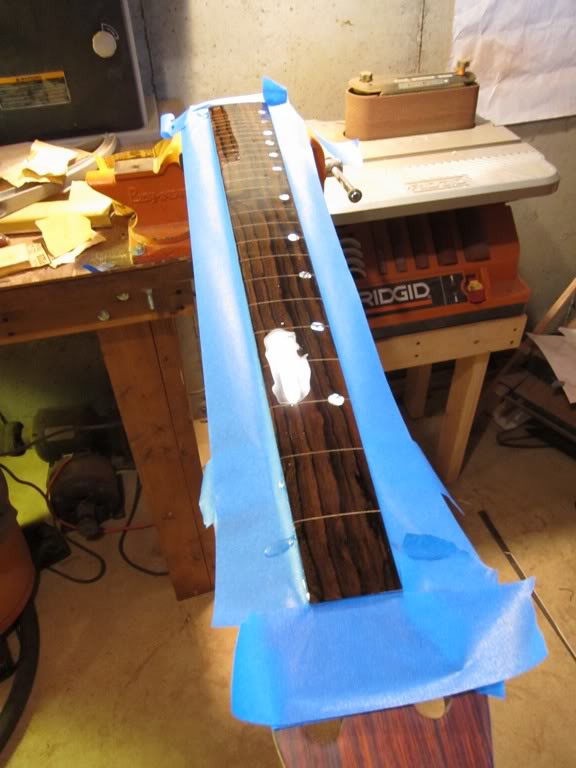
How many coats of epoxy are you planning on? I've been looking back through some of the how-to articles and it seems like there are a few different ways to go with it. Will you re-sand with a radius block then polish, add more to build up a thicker layer, etc? In addition to the preamp, I'm looking forward to seeing more about this part, too!
How many coats of epoxy are you planning on? I've been looking back through some of the how-to articles and it seems like there are a few different ways to go with it. Will you re-sand with a radius block then polish, add more to build up a thicker layer, etc? In addition to the preamp, I'm looking forward to seeing more about this part, too!
2 coats. First coat as seen above- quite thick, around 1mm. I radiused that with my 12" stewmac block, taking it down to about .5mm with 220, 320, then 00 steel wool. The second coat is curing now, it is very thin, maybe 1/3 of the first coat. I'll level that with 320, then steel wool, then polish. [DEL]Pics later.[/DEL] Here's a crappy phone pic of the leveling, I used the block in a circular motion to try and get it level without blowing through to the wood...although I did a tiny bit at the butt end on the B string side, no biggie.
So I plugged in the opamp last night, checked for DC offset and quiescent current draw, both looked good, so I plugged it into my external DAC and listened through my laptop.... ew. Sounds nasty, and weird things happen when turn the volume knob. Gotta double check my routing. Took Taylor Livingston's advice and added a Vref:
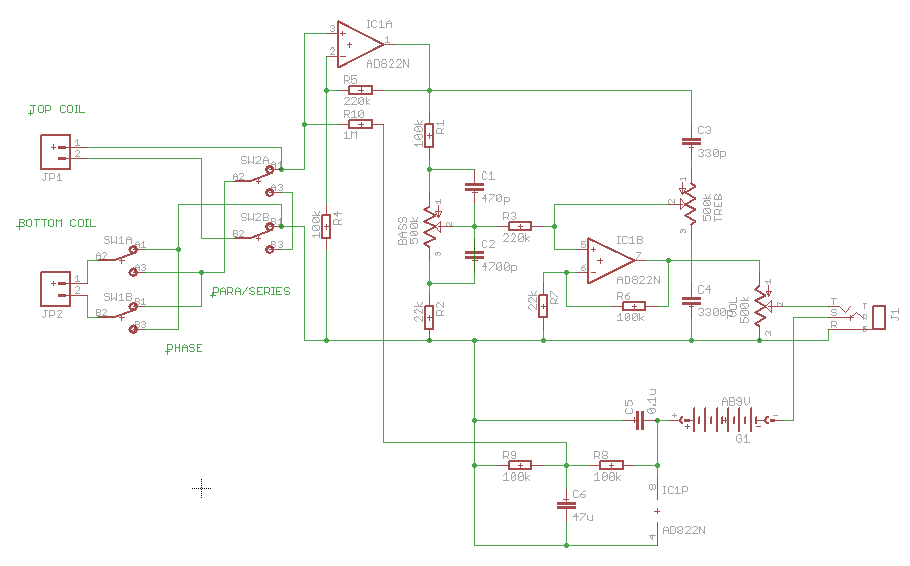
I don't understand how it's a Vref of 4.5v if it's being seen through a 1M resistor, but I'll push the 'I believe' button for now...maybe someone will chime in? Anyway, might build this one later this week. This preamp is gonna end up costing me way more than if I just bought one, but saving money is a really bad reason to want to learn to build basses in the first place.
I don't understand how it's a Vref of 4.5v if it's being seen through a 1M resistor, but I'll push the 'I believe' button for now...maybe someone will chime in? Anyway, might build this one later this week. This preamp is gonna end up costing me way more than if I just bought one, but saving money is a really bad reason to want to learn to build basses in the first place.

Musiclogic
Commercial User
- Aug 6, 2005
- 6,505
- 75
- 60
- Disclosures
- Owner/Builder: HJC Customs USA, The Cool Lute, C G O
So I plugged in the opamp last night, checked for DC offset and quiescent current draw, both looked good, so I plugged it into my external DAC and listened through my laptop.... ew. Sounds nasty, and weird things happen when turn the volume knob. Gotta double check my routing. Took Taylor Livingston's advice and added a Vref:
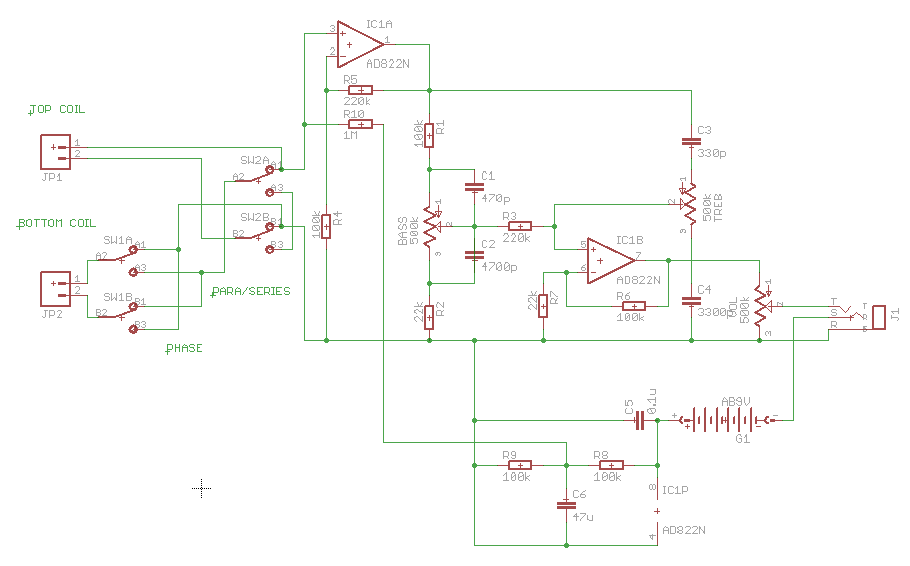
I don't understand how it's a Vref of 4.5v if it's being seen through a 1M resistor, but I'll push the 'I believe' button for now...maybe someone will chime in? Anyway, might build this one later this week. This preamp is gonna end up costing me way more than if I just bought one, but saving money is a really bad reason to want to learn to build basses in the first place.
It seems I relayed a similar experience with cost to you Adam(my 062 based pre
 )....LOL but it is a great deal of fun. Remember, even the best parts(shupe) can bleed more than rated, get a new pack, and then try tinkering with the resistance to groom it to your needs. Remember, electronics is about try and retry, and Ohms Law is the basis for all electronic life...LOL


