• TalkBass has been independent since 1998. Add your voice.
    Create a free account to reply to discussions, view embedded media, and browse with fewer display ads.
    Join freeLog in
    Want zero display ads or expanded classifieds tools? Compare plans.

$67 Glarry P-Bass

Yep. The P still sounds thin and hollow, probably because its made out of plywood rather than basswood if I were to guess. I thought new pickups and strings would make a difference but I still hate the tone. I like the jazz a bit better but these won't get much playing time like I thought they would. I still want a P and a J.
Check these two posts out sometime.
Exquisite Bass. How are they compared to Glarry Bass ? No. 255
Exquisite Bass. How are they compared to Glarry Bass ? No. 260
turned out pretty nice for @EatS1stBassist
 
Familiar Looking Headstock Shape on this Stagg P-300...no?

s-l1600.jpg


and this Cort

s-l1600.jpg
 
Last edited:
  • Like
Reactions: fretter
Also, free shipping? C'mon! I've shipped enough guitars to know that it would almost cost the $74 just to ship one as an average Joe. They may as well be free, but you pay for shipping!
Just a note:
They shipped mine exactly like this:
upload_2019-7-9_21-38-54.jpeg

It could have gotten nasty real fast.
Still, shipping does have a cost though.
 
Well, I have cured my neck dive and when loosely hung at my neck, the guitar will want to very gently level to the horizon if I move around fairly hard. Otherwise it stays put.

This is a 4x3x1/4 inch steel plate. For the test I had to grind the plate to a shine where the double side foam adhesive tape (3M brand) goes on the plate. Now it sticks well enough for a test. Shine the entire back of the plate and it will stick and it will probably never come off without intention.

Ok now I have always had a dull spot with weak sustain at C 2nd dot on G string. The neck vibrates strongly on the G string with a peak on C. I do not know if the plate on the foam could be exaggerate the resonance, but since my neck dive has been cured I am strongly focused on that dull spot LOL.
from experiences on other mechanical systems I may need to screw the plate on so it can't vibrate. On the foam it is free to vibrate at "higher" frequencies such as the G string range.
I'll be taking the plate off to round the edges, paint it black, and if needed drill it for screw mounting. The plate as is does not contact the artist's body.

After it's removed I will be able to see if the plate aggravates the resonance or I simply became hyper-focused on the problem now that the neck dive is no longer on my mind. LOL again

0711190431.jpg
0711190431a.jpg
0711190440.jpg
 
Yes, an idea to change the resonance of the neck. But adding weight is going to somewhat affect balance.
I forgot to mention changing the truss rod tension in my previous post, probably the most effect.

I tried the strap weight but it was clumsy swinging around and can beat on the guitar body.
 
Ohh I forgot to look up what a fat finger is , looks like it might make it go away, oh please make it go away.
Nothing else has worked. I did tightly clamp the body balance weight and found it to not be the cause.
I'll make a diy fat finger and see what happens. If it works I will need to buy the Fender Fat finger because it will be much more pro looking than a diy crapper. I had thought of that before I even got the Glarry.

As for the neck thickness it's really not a factor and I do find it sort of comfy. Another want is to try some flat strings for these bright JB pups which have a problem with string squeak. Lifting up the finger straight up before moving technique helps and a little Finger Ease is a big help but there is still a lot of squeak.

I looked at the original strings under magnification and they look more like spiral scroll saw blades than guitar strings and they had cut into the frets in a couple of weeks. The Fender strings under magnification are MUCH smoother.
 
Funny though, I can't recall of any songs I play that use any sustained low C on the G string. The same pitch on the D string is slightly dull but nothing like the G string.

I forgot to mention I tried a Fender Player JB that comes with flat wounds and the bright JB coils make them almost bright as nickel wound rounds. If that says anything impressive the reader must be playing on some purdy dirdy steel round wounds LOL.

Oh duh I also forgot to mention earlier today firmly pressing the headstock against some wood furniture did significantly cure the resonance.
 
Here is a person with a Fender Bass at the G string 6th fret, mine is at the 5th. And the weak thin tone with rapid decay is identical. He got medium improvement.
I also get temporary relief with my BP90 and some of the preset tones with enhanced sustain.

 
Last edited:
Here is a person with a Fender Bass at the G string 6th fret, mine is at the 5th. And the weak thin tone with rapid decay is identical. He got medium improvement.
I also get temporary relief with my BP90 and some of the preset tones with enhanced sustain.


I've viewed and listened. To begin with, that is far from the worst "dead spot" I have heard and in my opinion is not a truly representative sample. Two, IMO the ff is in the wrong place for maximum effect; it should be at three o'clock just above the nut (or at least that should be the default starting position for a Fender-style headstock). Three, any fat)finger that can be slipped on and off with just one hand is nowhere near clamped down on the headstock to have much effect.

A do-it-yourself fat)finger is called a c-clamp.
 
I used a small pipe cutter, removed the circular blade then slipped thin planks of wood in each jaw for a closer approximation to the Fatfinger, only used it in one spot with some help. I'll retry and move it but clamping is limited by the kludge nature of my temporary apparatus.
 
I checked out many 34" basses at GC and found about all of them have noticeable dark and bright frets on the G string. And at the 5th or 6th fret G string, C. I also notice not many songs I like have much accent on that C note area for some reason.

Here's a nice song to play bass to.

 
Last edited:
Another consideration since we are not happy with just one guitar, try to get them with different natural resonance points so you have a guitar good for different songs that do not use any or short notes in the bad zone.
In the past I was suspicious of these things, reverse engineered some products I thought were flakes or crooked rigs then found them to apparently be a best compromise of options.
I tried a Mustang bass, short scale and it had a dull spot at the 11th fret G string, way up from the 34" scales of all brands I tried.
 
Is she saying that strings with a different sort of core can cure that problem ?
Or maybe the nut. I'm thinking a nut with 3 holes for 1 or 1.5mm screws would lock it down good. The screw holes would need to be staggered in the direction of nut to bridge.

Afterthought, probably the nut because he saved her life when she was all the way down, and turned her life around.
 
Last edited:
My two basses that have no dead spots have 40-95 strings. Hmmm. Since nothing else is working I'll give it a try. Looks like the lower tension strings would change the resonance characteristics of the neck and have less power to move the neck in vibration.
I just put a set of 7250 45-105's on it with spectacular results in tone and especially volume.
I have never tried unwinding strings then re-using them later. Do they ring just as well after being pulled off and set back in the package then re-installed ?
 
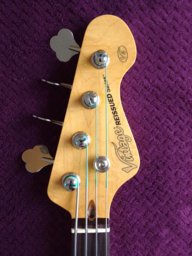
After much testing and on my last try before giving up I found a significant improvement. The string hat for the D and G string looks to be in the wrong place. It is almost even from the nut as the A string tuner, only slightly diagonal. On the other Glarry basses I looked at, the string hat is way down next to the swan of the logo , about even with the shark fin part of the head stock. Instead of clamping the Fatfinger on the headstock, I used it to pull the D and G strings down a bit at the shark fin tip location and the note plucks MUCH better and no weird harmonics and it now has long sustain. I looked up the tree hat location after trying that and then found that mine appears to be improperly located at the L in Glarry instead at the shark fin location. I suppose I'm going to have to move the string hat there to say for sure.
 
The fix was not by pulling the strings down to a sharper angle from the nut. Verified by installing a string bar across the whole nut width an inch out from the nut and no fix, the problem came back. So I removed the bar and went back to the Fatfinger and I have found a nice location that makes the dead C note almost as good as the rest but a very slight dampening. With the amp on I get some help from feedback. Plucking an octave lower C along with it greatly sustains the note.
See the bar up above the nut ? I do not see any common name for it, I just call it a string guide bar.

yamaha-trbx174ew-nt.jpg
 
The fix was not by pulling the strings down to a sharper angle from the nut. Verified by installing a string bar across the whole nut width an inch out from the nut and no fix, the problem came back. So I removed the bar and went back to the Fatfinger and I have found a nice location that makes the dead C note almost as good as the rest but a very slight dampening. With the amp on I get some help from feedback. Plucking an octave lower C along with it greatly sustains the note.
See the bar up above the nut ? I do not see any common name for it, I just call it a string guide bar.

View attachment 3511072
another thing to try is to loosen the bolts on the back of the neck and then retighten. Some TB-ers have had good results with this.