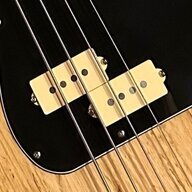
The biggest advantage of the split P must surely be the ability to raise or lower the poles under each string to produce a more even output. An immediate advantage with its introduction.
Smart point that I hadn't thought of..

TalkBass has been independent since 1998. Add your voice.
Create a free account to reply to discussions, view embedded media, and browse with fewer display ads.
Join free Log in
Want zero display ads or expanded classifieds tools? Compare plans.
The biggest advantage of the split P must surely be the ability to raise or lower the poles under each string to produce a more even output. An immediate advantage with its introduction.
Smart point that I hadn't thought of..

VHS versus Betamax. We all know how that turned out for Sony.I find it interesting that we tend to collectively think the p-bass was preferred by engineers et al because it "fits perfectly in the mix". I have a different perspective. The p-bass was the first mass-marketed electric bass. As such, it was the most ubiquitous. Bassists appreciated the portability and started showing up at sessions with them. Studios followed suit. The most obvious new tool for the job. EB-0's, Rics, etc. were not yet on the radar. I rather suspect the actual sequence of events was more along the lines of "here's this new gadget, the engineer has to figure out how to make it fit in the mix". P-basses were ubiquitous (early jazz recordings often list "Fender Bass" on the album credits, in part because when a player joined the local union, that was the way the union distinguished upright bass from electric bass). P-basses vs. other electric basses is like Microsoft vs. Apple. Apple fans insist it's a better system and it may well be, but Windows was first. Far more people know how to navigate it and it therefore continues to dominate. Never was a question of which is better, just which was first to gain widespread acceptance. IMHO>
BBB

(SNIP) I find it interesting that we tend to collectively think the p-bass was preferred by engineers et al because it "fits perfectly in the mix". ... (/SNIP)
But lack of shielding noise is one thing--that inherent hum from the single coils not being equal volume is another. Might be something else going on w that bass.I play Jazz basses 90% of the time fyi.
The thing that made me wonder about this was playing my passive jazz with single cools this morning and hearing all that hum noise (I need to shield this bass).
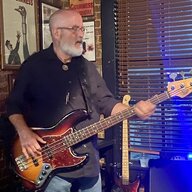
Touching the strings doesn't make 60 cycle hum go away.Anyone who has played a J bass with single coil pickups knows what happens if the blend of the pups isn't even, or if your fingers aren't making contact with the strings and acting as a ground...60 cycle hum.

Someone must get a Fender Reggie Hamilton or a Blacktop Jazz into your hands!BL in my main band sometimes tells me he prefers my P-bass. I like it too.
But he compliments my playing more when I stick with the J.

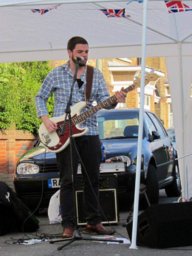
In the United States perhaps, but elsewhere? I wouldn't bet on that. We know John Paul Jones and Herbie Flowers played Js as session musicians in the UK, and that's because they played on music that became well known in North America. Information about what they were playing anyplace else is lacking. And that was the case with session musicians. Bassists in bands played all sorts of stuff, like the Gibson and Epiphone semi hollows that were popular with UK bands circa 1964.
Later Leo F conceded that the reverse P configuration would produce a still more even sound. Lee Sklar is the best example I can suggest.
Is the hum a narrow frequency bandwidth? Perhaps engineers were able to reduce it significantly with eq without detracting from the bass tracks.
Yup... of course. Wilton Felder (and many others) played those single-coil Ps for decades. But the hum-bucking P bass could also be induced to hum, just not from the same noise source. I wasn't referring to those - I was talking about initial modern split-coil version.
I don't think it was until the 90s that the large majority of producers started to laud the fact that you can EQ a P Bass to fit into most mixes. This is by benefit of the fact that the Ps give you a lot of mids, so no matter what you have to cut to make room from keys, brass, sax, whatever, there was still plenty of mids to sit the bass in the mix wherever you want. I think from there, a lot of us retconned the history to assume that producers in the 60s felt the same way, but I doubt they did.
Rather than spending time to convince a bass player to run their neck pickup solo or just work with them, it's easier to just hand them a bass and say "use this" as a kind of teaching moment. Basically, if your bass, and the way you prefer to run it provides any kind of impediment to a usable tone, it's far faster for them to make you play another bass than to spend any time with you to help you get a tone they need out of YOUR bass.

Most of the sessions I did with my P (Yamaha BB5000) were direct in - sitting in the control room. Which made me want a pair of Westlake 2 /15's with JBL horns, as a bass amp..Related anecdote- a producer/engineer I've worked with a few times who's been professionally active on the international scene since the early 80s began swearing by Rhode Island Guild acoustic guitars in the early 00s after realising that the easiest/least bad sounding AG recordings they'd done were with Guilds. As of 2015 he said he would only let guitarists do a few takes with their guitars and then have them redo them with his Guilds, and would always at their request scrap the Their Guitar takes.
I imagine most of the Studio Wants A P posters of the past quarter century of TB dealt with producers and engineers who'd already by the 90s suffered through over a decade of amazing Alembics, Wals, Steinbergers, Pedullas, Modulus, Zons, Spectors, etc all owned by players whose ear for whole-band tone was far less developed than they thought… and suffered through re-listening to their work and were embarrassed by the playback of all their 80s work except the few they did fast & loose with a cheap 10-20 year old totally out of fashion round edged low tech surfer/R&B/punk bass.
———
I find the pushback against the P amusing. A slotted screw needs to be turned, but so many of us went and got ourselves all riled up for advanced modern Torx & Robertson drivers and bought those while refusing to buy a flathead screwdriver and resolve to buy every other tool you'd need to make a Torx fit a plain slot.
Been there. Did the dynamics processing and three or more stages of EQ thing.
Regardless of the chicken-egg thing of P-Hit Recordings- after several decades we know that salt melts snow & slush, we know that water hydrates, we know that some people are scared of clowns, and we know that the east way to professionally record amateur musicians' bass parts is with their bassist using a P with minimal/no effects.
I find it interesting that we tend to collectively think the p-bass was preferred by engineers et al because it "fits perfectly in the mix". I have a different perspective. The p-bass was the first mass-marketed electric bass. As such, it was the most ubiquitous.

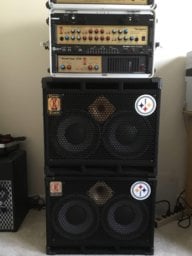
BL in my main band sometimes tells me he prefers my P-bass. I like it too.
But he compliments my playing more when I stick with the J.
That just about sums up what I think might be happening here.