It often does when the bridge isn't grounded properly.Touching the strings doesn't make 60 cycle hum go away.

TalkBass has been independent since 1998. Add your voice.
Create a free account to reply to discussions, view embedded media, and browse with fewer display ads.
Join free Log in
Want zero display ads or expanded classifieds tools? Compare plans.
It often does when the bridge isn't grounded properly.Touching the strings doesn't make 60 cycle hum go away.
I think there's greater variety in how different Jazzes sound, than you find with P's. For example I have 2--one is pretty scooped sounding with everything dimed, to the point of the mids pretty much disappearing in a dense mix. Another has quite defined punchy mids with everything dimed and "sits in the mix" great that way, all up and down the range of the instrument--very even and consistent(and it's a 70's PU configuration too). As I say earlier it's the tightest most mid-focused setting on that bass. I dare say it could be mistaken for a P in some mixes (unless you pluck right over the bridge pickup).I've never had any problems using J-basses for recording. I mean, in a controlled recording environment it should be possible to deal with hum.
I still prefer P-basses for recording though. Because.... wait for it...
They "sit" better in the mix. Yep!
At least with the kind of music I generally play.
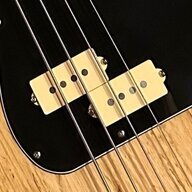
It's all about the position of the pickup. The position of the pickup on a traditional P-bass gives me the perfect balance of fat lows, a nice "heft" in the lower mids and a crisp upper mid presence.
With the pickup closer to the bridge it gets too thin/nasal/middy sounding for me.
Blending pickups? Too scooped/clanky/phased out for me.
Pickup closer to the neck? I can work with that, but in a dense mix it often needs a bit of eq.
But a classic P-bass... Pretty much plug'n'play, even if all you've got is a clean DI.
The elctric bass was not invented in the 1950sSomething I was wondering about...
After the invention of the electric bass in 1950's (P Bass) and the Jazz Bass in 1960, it is no secret that P Basses became the standard for studio recordings and while plenty of Jazz basses made their way onto albums in the 60's & 70's, there is one aspect of the P-Bass pertaining specifically to studio recordings that I don't think I have ever heard discussed.
Conversations typically center around how a P Bass sits in the mix, however, anyone who has worked with a producer in a studio environment has to wonder if there may have been an additional reason to prefer a P in a studio environment, especially in the 60's and 70's.
Anyone who has played a J bass with single coil pickups knows what happens if the blend of the pups isn't even, or if your fingers aren't making contact with the strings and acting as a ground...60 cycle hum. Now shielding can mitigate this to great effect, and I am not sure when cats first started to shield their basses, but shielding isn't 100% full proof.
Back to producers; in my experience, no detail is too damn small for them to care about! They live in a world of minutia and microscopic sonic details...
Which brings me to my point.
To what degree did the much quieter split P pickup play a role in the P Bass being so heavily utilized in the recording studio world of the 1960's and 70's? And to what degree did getting everyones ears used to that sound early on influence it as a preference for all these years?
It seems the same aversion to 60 cycle hum could have been a factor in live performances as well no?
View attachment 5351180
Never noticed a difference between indoor and out personally, even when I've run FOH(been a while though)--P's just do the P thang in my experience (keeping in mind the different variables overall of outdoor vs indoor, different rooms, etc).@LowendG do you find the same as some others that p's are well suited to outdoors sound and J's slot well indoors?

Something I was wondering about...
After the invention of the electric bass in 1950's (P Bass) and the Jazz Bass in 1960, it is no secret that P Basses became the standard for studio recordings and while plenty of Jazz basses made their way onto albums in the 60's & 70's, there is one aspect of the P-Bass pertaining specifically to studio recordings that I don't think I have ever heard discussed.
Conversations typically center around how a P Bass sits in the mix, however, anyone who has worked with a producer in a studio environment has to wonder if there may have been an additional reason to prefer a P in a studio environment, especially in the 60's and 70's.
Anyone who has played a J bass with single coil pickups knows what happens if the blend of the pups isn't even, or if your fingers aren't making contact with the strings and acting as a ground...60 cycle hum. Now shielding can mitigate this to great effect, and I am not sure when cats first started to shield their basses, but shielding isn't 100% full proof.
Back to producers; in my experience, no detail is too damn small for them to care about! They live in a world of minutia and microscopic sonic details...
Which brings me to my point.
To what degree did the much quieter split P pickup play a role in the P Bass being so heavily utilized in the recording studio world of the 1960's and 70's? And to what degree did getting everyones ears used to that sound early on influence it as a preference for all these years?
It seems the same aversion to 60 cycle hum could have been a factor in live performances as well no?
View attachment 5351180
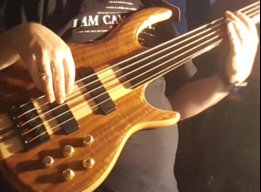

Call it genius or call it dumb luck, but Leo's Precision Bass just sits easily in a mix in ways that basses with bridge pickups usually don't. It's the EASY button for engineers. Even more so if the Precision Bass has flatwounds. That configuration is just very hard to beat when there are bigger fish to fry (vocals, cymbals..).Something I was wondering about...
After the invention of the electric bass in 1950's (P Bass) and the Jazz Bass in 1960, it is no secret that P Basses became the standard for studio recordings and while plenty of Jazz basses made their way onto albums in the 60's & 70's, there is one aspect of the P-Bass pertaining specifically to studio recordings that I don't think I have ever heard discussed.
Conversations typically center around how a P Bass sits in the mix, however, anyone who has worked with a producer in a studio environment has to wonder if there may have been an additional reason to prefer a P in a studio environment, especially in the 60's and 70's.
Anyone who has played a J bass with single coil pickups knows what happens if the blend of the pups isn't even, or if your fingers aren't making contact with the strings and acting as a ground...60 cycle hum. Now shielding can mitigate this to great effect, and I am not sure when cats first started to shield their basses, but shielding isn't 100% full proof.
Back to producers; in my experience, no detail is too damn small for them to care about! They live in a world of minutia and microscopic sonic details...
Which brings me to my point.
To what degree did the much quieter split P pickup play a role in the P Bass being so heavily utilized in the recording studio world of the 1960's and 70's? And to what degree did getting everyones ears used to that sound early on influence it as a preference for all these years?
It seems the same aversion to 60 cycle hum could have been a factor in live performances as well no?
View attachment 5351180


The elctric bass was not invented in the 1950s
Still...the electric bass was not invented in the 1950s.There were a few things around before the P bass, but in such small numbers that they were oddities. The P bass was the start of the electric bass as a "normal" instrument.
Still...the electric bass was not invented in the 1950s.