• TalkBass has been independent since 1998. Add your voice.
    Create a free account to reply to discussions, view embedded media, and browse with fewer display ads.
    Join freeLog in
    Want zero display ads or expanded classifieds tools? Compare plans.

Achieving valve tone with solid state plus..?

Personally I prefer a valve preamp with a solid state power > solid state > all valve for bass. Power tubes do things to the signal that work great on guitars but I don't care for much on bass. Even though its a bass guitar, it doesn't mean its the same as a guitar.
 
For all I know, some people like the OP’s guitarist can in fact detect an instant, non-adjustable deficiency in anything lacking tubes, but I have my doubts.

There are soooo many parameters you can adjust in something like a Helix that I suspect quick replies of “just get a tube amp” to be knee-jerk reactions. Confirmation bias. Anti-modeler/pro-tube amp confirmation bias does have a characteristic ring to it, and I hear it in this thread.

Maybe more to the point, the OP seems to have space, budget and transport limitations that strongly favor working with what he/she already has. Since that listed gear includes a hugely flexible front end, a powerful back end, and limited cab size/weight/displacement, maybe the focus should be more on “how can I approach a sound like _____ in a _____ playing situation with a Helix, 1,000-watt Peavey head and 2 x 10
Cab?”

To answer something like that, the focus probably needs to shift off of “achieving a valve tone with solid-state gear,” because what seems to be getting lumped in with a preconception of “valve tone” is physical cab/driver displacement, dirt, compression and EQ. With a Helix, or any number of other modelers, attaining a whole range of dirt, compression and EQ possibilities should be do-able with tweaking, and listening in a given band mix. Screw how valve-y it sounds or not...how does it fit the mix?

The cab will still be a limitation, but if that’s all that’s available because you drive a Miata or have to carry it up and down 9 flights of stairs and the service elevator is broken...what can you do with what you’ve got?

Probably need more info on how loud it needs to be, what it’s supposed to keep up with in performance, whether it’s getting some PA assistance or is the sole source of bass reproduction. That will help determine how much can be expected and what limitations need to be accepted.

Thank you for understanding a bit better. Sadly, I no longer have a Miata, but I don't wish to have a house full of gear that I can barely transport.

I think it was also as you say, confirmation bias. I don't think he can tell the difference personally, but that doesn't mean I don't want a valve amp at all. It's just not realistic for me.

Maybe if I can work out how, I'll upload some sound clips of my playing at some point.

I don't quite understand. Why would you run the send to the helix. You should Just plug the bass into the Helix and the helix into the effects return.

Because I don't want the Peavey preamp...I'm simulating amps in the Helix. I realise that I could be doing it all wrong, but I tried using the Helix basically as an effects pedal, but it sounded crap when I simulated amps with it.

Personally I prefer a valve preamp with a solid state power > solid state > all valve for bass. Power tubes do things to the signal that work great on guitars but I don't care for much on bass. Even though its a bass guitar, it doesn't mean its the same as a guitar.

Interesting...that's what I'm likely to end up with at this rate!
 
Since we don’t even know what you mean by “tube sound” it’s hard to know what you’re aiming for. My guess is if you stuck a box with a glowing tube in it on top of the amp, your guitarist will see the difference immediately. He’ll see it even more clearly if you stick an Ampeg badge on it. You don’t need to muddle your tone by putting it in the signal chain, just make sure the glowing tube is visible.

That said, two issues rise to the top for me. A 210 cab is going to be limited in terms of oomph, so moving to a bigger cab might give your guitarist the tickle down below that he may be craving.

The second is how do you feel about your current tone? Does it sit well in the mix of the band? Or is the guitarist being a tube snob rather than a musician taking into account the overall sound? If you can honestly say that you like your tone and that it serves the music well, then I think you should tell him that he needs to replace his speakers with greenbacks or Celestion whatever the heck speaker guitar players geek out over, because his guitar tone doesn’t quite have the mojo of a “real” guitar amp.
And to your point, I wonder if the audience would ever know if he's playing through tube amp or solid state amp. Would they even care? Do they even think about this stuff while they're partying to the groove?
 
  • Like
Reactions: Aqualung60
I suspect the biggest culprit in terms of lack of "strenght" from your rig is the 210 cabinet. That said, tons of players use nothing more in their signal chain than some sort of preamp- many, if not most of which are not tube (valve)- plugged straight into a PA system and achieve a great tone. If you're happy with the tone of your setup at lower volumes, you might be better off investing a great DI and let the PA do the heavy lifting.

Although- at the risk of revealing my own personal confirmation bias- if the tube sound is the sound you hear in your head, just get a tube amp. Like someone suggested above, go rent one. If you end up loving and it is just the confirmation bias talking... so what!??!!?! If it makes you happy to play, it's worth it. I dreamed for years about owning an old SVT and it took me well into adulthood and about 20 years of playing before I got one. And guess what... It's my holy grail amp. I've never heard better bass tone. I sold all my SWR gear, my Eden gear, my Ashdown gear. It's all I ever use for an electric gig. It weighs about 100lbs but I never complain about hoisting it onto the matching 810 because I can not wait to fire it up and plug in.

An alternate (and maybe slightly insulting) view might be to look at your technique and approach and see if you can get more strength that way. I've heard many players sit in on other peoples rigs and produce vastly different tones. I had a humbling moment while visiting a friend who worked at Carvin. I was trying out one of their new bass amps (a 210 combo, coincidentally) and wasn't thrilled with the tone. When my buddy asked me what I thought, my response was "It's pretty good, but I really had to tweak the eq a ton to get a tone I like." His response was "No offense dude, but Bunny Brunel was here last week and he just plugged straight in and sounded amazing." Oof... point taken. We all know deep down that most of our tone is in our fingers. It's not the bass, nor the amp.

But THAT said, don't listen to the guitarist. If you like what you're hearing and it inspires you to make music, that's all you need.

Good luck with your tone quest!
-b
 
@dirtychinchilla ...

Ha! You actually did have a Miata. Hopefully not also the stairs and broken service elevator situation.

It might be worth trying, if you haven’t already, using the Peavey’s preamp and putting the Helix in the FX loop, but selecting different things in the Helix. In this scenario you might benefit from the Peavey’s clean preamp and flexibility of having physical tone controls right there in easy reach, and use the Helix to add some layers of mild compression or limiting and mild dirt after the preamp. And maybe mild EQ later in the signal path. Noise gate as needed. With some experimentation you might find something that way that approaches a big clean tube amp just beginning to give it up, with easier/quicker access to basic tone-shaping adjustments on the fly, and achieve it at levels that are not asking too much of a 2 x 10 cab. And you’ll still be getting non-redundant benefit from your investment in the Helix; it’ll still
Be covering a number of functions in a fairly compact unit and therefore be “pulling its weight.” And the things you’d
Be asking it to do would require less gig tweaking in menus, once you had it sorted. The stuff you needed to access while under a time crunch would be right there on the front of the Peavey head: basic gain and EQ.

I don’t mean to disparage the approach of using the Helix as the front end, into the Peavey’s FX return...surely there are lots of useful possibilities that way. But in my experience a couple of gain knobs and a graphic EQ on the front—as found on a lot of Peavey stuff over the years—coupled to a preamp that pretty much wants to stay clean, can be a pretty powerful tool once you get your head around what the frequency bands do and how the gain levels interact. It just takes tweaking and listening, and using your ears rather than your eyes to adjust that graphic.

If you find that the 2 x 10 is too much of a limiting factor, at least you’ll have isolated a clearer goal in your tone quest. You can fight that battle on a different day, so to speak.

As far as getting the cab’s sound up to your ears without losing the bass coupling effect of it being on the floor: Have you tried standing it vertical on one narrow end? Or leaving it on the floor but tipping it back to be aimed at your head?
Or placing it facing out in a corner or at least near a wall? Those things can reinforce lows.
 
Last edited:
  • Like
Reactions: Moosehead1966
Because I don't want the Peavey preamp...I'm simulating amps in the Helix. I realise that I could be doing it all wrong, but I tried using the Helix basically as an effects pedal, but it sounded crap when I simulated amps with it.

I think what @FunkHead is saying is that plugging the effects send into the helix is redundant. You are bypassing the Peavey preamp already by going bass > Helix > Peavey effects return. No need to plug the helix into the effects send. If he is saying that then he is correct.
 
  • Like
Reactions: 4 Out of 5
I think your Helix will do all tricks by itself to whatever tone is pleased and there is no need for any kind of other pedals. The difficulty is to structure tone correctly with all Helix options: compression, eq, dual path signal, overdrive, compression again, [your favorite block] etc :). If you really are missing something I would replace the cab or add another one. My evaluation about SVT tone is partly in correctly equed preamp, compressing powerful power amp and the big cab that makes you feel the power. You have the power (Peavey 1000W) and preamp with endless options (Helix) but you are missing the punch of 8x10. Even playing lower volume you can hear the difference of 2x10 and 8x10.

Edit: You already got the tone you like but missing the powerful feeling in rehearsal room? Then the more cab is the best bet. And check also that you are not over eq your tone for round bedroom sound. Live situation needs much more raw sound to act correctly. That's what valve amp does naturally when giving more gas. Helix doesn't.

I agree with what you said about the “Fridge” cab. Having used and use other tube heads, including the SVT, Hiwatt, Marshall, and Eden, a lot of the magic of the SVT came from the fridge, not the amp itself. JMO.
 
My guess is if you stuck a box with a glowing tube in it on top of the amp, your guitarist will see the difference immediately. He’ll see it even more clearly if you stick an Ampeg badge on it. You don’t need to muddle your tone by putting it in the signal chain, just make sure the glowing tube is visible.
Absolutely. Sometimes we hear with our eyes.

That said, here's a suggestion for said box with glowing tubes that actually doubles as a pretty decent compressor. :D

IMG_2657.jpg

Once your guitar player sees those 3 glowing tubes, you'll sound just like a tube amp. And you're in luck, because these guys are in the UK. :thumbsup:

Seriously, this will impart some tube characteristics into your tone in terms of compression. It doesn't really alter the sound of the GK it's sitting on, but I do like what it does for the overall tone. It's always on.
 
You have a helix? You don't need anything else. It models all of this stuff perfectly. Like, literally perfectly. You def want your cab and amp to be as neutral as possible, or at the very least to not impart big changes to the tone that you can't compensate for within the helix.

I've recorded all the bass parts on my bands upcoming album of covers just with my helix.

Here's a snip of one of the songs we're covering in our album. Check out the bass tone. That's JUST the helix (plus studio production of course afterwards, but only subtle stuff for mixing).

Post info | SndUp

So if you have any weakness in the sound, it's from something after the helix, or from patches in the helix that aren't actually doing what you want, exactly.

For me, it's shocking how much drive I have in my sound to end up hearing it only when the bass is soloed and only when you play up higher, for example in the clip of me playing here where there's a brief fill I do followed by regular bass range stuff, and you can hear the tube drive everywhere but you really notice it on the higher fill with double stops.

I do cab simulation and effects and everything in the helix. My output is direct to the board, or if I'm using amps then I use a power pa floor monitor or studio monitor which is somewhat "flat response"... not particularly flat but much flatter and more hifi than most normal bass cabs are. I filter out the high end in the helix, so if going through a speaker cab you want a bit of horn or tweeter in it, not much, but just enough.
 
Last edited:
He thinks it would have a lot more strength if I was actually using a valve amp.

For guitar there are some strong arguments for going with valves/tubes. I don’t think that necessarily translates out for electric bass.

If by “strength” he means more girth there are several factors beyond just the amp that are at play when it comes to bass. First is the bass itself. A PB is not going to have the same sonic footprint as a sidewinder loaded TBird for example. PBs are somewhat clean and midrange oriented. If your guitarist is thinking in terms of a humbucker sound a PB won’t deliver that. You can make it bassier or louder. But it won’t have the sonic complexity (some call it mud) that a humbucker or sidewinder equipped bass will without adding a pedal that’ll provide additional harmonic information to your signal chain.

On the amp side, the two things a tube amp will give you are: some mild and very musical compression, and a very sight delay in initial response (i.e. attack) to a note being played. This lag rounds off the edge of note attack and gives you that “smooth” tube quality people talk about. Both are a function of the power stage in your amp and the main reason why simply putting a 12AX7 or similar tube in the preamp stage usually won’t be enough, by itself, get you that tube vibe.

It is possible, however, to design solid-state circuitry that can come pretty close to the sonic characteristics of an all tube amp. MOSFET transistors used to be the goto technology for getting a tubelike tone out of a solid-state amp. I don’t know if they’re still what get used today. But electronics developments have not stood still over the last half century. So regardless of what they’re currently using, getting close to the tube sound isn’t a impossibility with newer technology. It won’t be exact. But at normal listening volumes (or especially stage volume levels) I seriously doubt anybody could honestly show they can hear a difference.

Mesa and a couple of other manufacturers do a great job of capturing a decent amount of that classic tube sound for much less money compared to the price of an all glass head. So that’s one thing to possibly look into.

But before doing that I’d suggest trying a compressor that adds some color to your core tone first. The Ovnifx Smoothie, Mad Professor Forest Green, and Doc Lloyd Photon Death Ray compressors can all add some significant strength to your sound while preserving your dynamics when used properly. Well worth investigating before you buy a new amp.
 
Last edited:
I agree with what you said about the “Fridge” cab. Having used and use other tube heads, including the SVT, Hiwatt, Marshall, and Eden, a lot of the magic of the SVT came from the fridge, not the amp itself. JMO.
Absolutely agree. I think it's the cabs that make a real difference. A 2x10 just runs out of oomph at some point. At least a 4x10, or a 4x10 + 1x15 would be great!
 
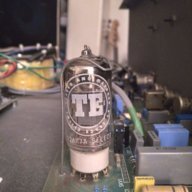
Having said all that, I built a valve pre-amp pedal which he hasn't heard much of. I think I could put that before or after my Helix (probably after???) to give it some genuine valve grit. Just wondering what you guys think of that? Would that be a reasonable compromise and would the resulting sound actually add that grit? I'm not sure what effect putting all that through my power amp would actually have.

Obviously the guitarist doesn't control my tone, but he did set me thinking - getting a valve tone has always been a goal of mine, but I've just not had the funds. I also need to rebuild the pre-amp because it constantly overheats, so I'll take the opportunity to improve the whole thing when I do.

A valve pre can be good, but i've heard that the "tube magic" happens within the power amp tube.

Anyway, Helix is powerful and seems to get better with every update, so have you tried to use the "Amp" models (assuming you're using "pre-amp" models) and adjust bias/sag/biasX/hum/ripple parameters?
If you haven't already, check out some Jason Saddites' video where he explaines what those parameter do (if I understand well, they all interact to give a more realistic tube power amp section emulation and feel, but I can't swear to it).
 
  • Like
Reactions: Ethereal Thorn
Agreed. But putting the Helix in the Effects loop is simply changing the order and still using the Peavey Pre.

If the send is going into the Helix and the return is coming from the Helix, this is correct.

As far as I can understand, I am bypassing the Peavey pre-amp with my set up. Perhaps my terminology is not quite correct - it's in a send return loop, and all the controls on the amp are inactive aside from the volume.

Are you using the send part of the loop or only the return?

Only when you plug bass > Helix > Effects return. If you Use Bass > Peavey Front input and then effect send > Helix > Effects return, then you are still using Peavey Preamp.

This appears to be where the confusion comes from.

I don't quite understand. Why would you run the send to the helix. You should Just plug the bass into the Helix and the helix into the effects return.

Because I don't want the Peavey preamp...I'm simulating amps in the Helix. I realise that I could be doing it all wrong, but I tried using the Helix basically as an effects pedal, but it sounded crap when I simulated amps with it.
It's not an effects pedal, it's a complete solution. To bypass the amp's preamp, your bass will plug into the Helix input, and the output of the Helix will plug into the effects return of the amp. Turn off the speaker sim module since you already have speaker voicing from your amp's cabinet.
 
Getting a proper, good valve tone off of the HX is easy. Anyone who says they can hear the difference on stage has their head so far up where the sun don't shine they couldn't tell hear the difference between flats and rounds.
Well this threads title is misleading. It references tone but the op says he’s lacking power basically. Then he says he built a tube preamp and want to add a pedal. Then he states he’s a 1 pedal guy. It’s also not clear how he’s using the effects send into the Helix.
It’s just a weird thread...
 
  • Like
Reactions: M0ses
Well this threads title is misleading. It references tone but the op says he’s lacking power basically. Then he says he built a tube preamp and want to add a pedal. Then he states he’s a 1 pedal guy. It’s also not clear how he’s using the effects send into the Helix.
It’s just a weird thread...

I've just had a lot of feedback and it's hard for me, without the experience of a variety of different setups, to sift through what makes sense. I didn't say I was lacking power, someone(s) else did. I have tube preamp and would rather not have to use it as I would much rather just run one pedal, but I could probably stretch to two!

I have check out how I'm running the Helix and I had the return connected, but I didn't need it. I had no idea that was the case, so I have disconnected it and now am simply outputting from the Helix, with input to the Helix also.
 
My favourite bassists are Tim Commerford and Geddy Lee. Their tones make me cream my pants, and I think there are some strong similarities. So I aim to have my clean tone a lot like Geddy's, and dirty a lot like Tim's. I can achieve most of that quite easily

Theres a guy who used to post here a lot, name of Tim Starace @Gefilter1001 who plugs a Rick or Jazz into that Geddy SansAmp pedal and that’s the ballgame right there. Look no further. No tubes involved. I’m sure the Helix, with some work, can get you there.