Hey, I have a question that maybe doesn't need its own thread now that y'all are right here. I have owned two active basses. But it's my inclination to run them with their active EQ settings flat. Like, religiously. I do not move them, ever. So my question is: Is there any benefit to having an active bass if you never use the EQ? Does it give higher signal strength even if you leave it all flat? And what's the benefit of higher signal strength anyway?
Why am I better off with my Fender Jazz being active rather than passive? If I am...
It makes a difference if the flatpoint on the eq is an outcome of the sum of the parts, if the pickups are low impedance with a weak output / makes it necessary. The output need not be higher. The eq if flat at center is one thing , but often the detents are not flat.
The pre may be transparent or heavily colored. Shrug.
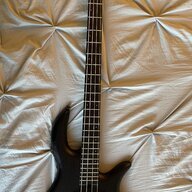
The Cort GB75JH pictured below had a serviceable 2 band pre but the bass sounded scooped, indistinct wooly lows with brittle highs--
Converted all passive.
Updated pups: SD QP neck Aguilar DCB-M5.
VVTB (Vol+Vol+[passive treb / bass cut] )
With the right pots with a taper and a value you like the tone of, with the pickups (250/ 500k Lin vs log etc)
(I selected 500k LIN-Volume/ 500k Audio tone / 1Meg rev log bass cut)
If pickups are multicoil , tapping, mixing coils, series / parallel.
Add a rotary pickup selector.
Add a tonestyler or a Varitone.
Or like I did, a Passive Bass cut circuit.
2 push pull pots on order for parallel /series and a tone bypass parallel straight to jack.
Kick booty now-- hyper dynamic (felt compressed before)
Fun times.