• TalkBass has been independent since 1998. Add your voice.
    Create a free account to reply to discussions, view embedded media, and browse with fewer display ads.
    Join freeLog in
    Want zero display ads or expanded classifieds tools? Compare plans.

All Things Must Beat. Share Anything Beatles!!

I agree. I wouldn't want him to change a note...

Imagine the Beatles-less world of the movie Yesterday.

A bass player shows up to audition for your band. (Context: the band generally plays one set of originals in multi-band shows every couple of months or so.)

You all play through a few classic rock standards to warm up and check each other out. The guy's obviously good.

You then go to your computer and start playback of tracks (guitars and drums) of a song that the lead guitarist had recently written: Something.

You say, "Give us an idea of what you think would work as a bass line."

The playback starts again. The bass player, out of his own head, improvises McCartney's bass line, note for note. (It could happen!)

You and the others in the band confer, and then: "Thanks for coming by."

The correct decision.

Moral: context is everything.

We Beatles fans had long since been trained to expect, and embrace, the unexpected from the band by the time Abbey Road came along, so we heard the bass line in Something as representing McCartney's genius (rather than what it was: a raised middle finger to George).

That's from a fan's perspective. To George Harrison, it would have sounded like McCartney slouching on his couch and noodling aimlessly with the TV on.

My hypothesis: McCartney was still smarting about having been overruled by Lennon when Revolution No. 9 was included on The Beatles/the white album. He figured that maybe he couldn't win against John, but he'd be damned if he'd give in to George's request to tone the part down.

Of course, Paul being Paul, he was incapable of playing a part that didn't fit, at least in harmonic terms.

But the note-y and show-offy part he came up with for Something would serve nicely as an illustration of the opposite extreme from playing a part that supports the song rather than competing with it.

No? Perhaps someone can explain why the bass parts on McCartney's own slow ballads (e.g., Here, There, and Everywhere, Hey Jude, Let It Be, and The Long and Winding Road, to name just four) were textbook serve-the-song parts.

He played bass on at least two of those. If he hadn't been happy with the simple lines played on the other two, you can be sure that, Paul being Paul, he'd have either taught them to John or George or overdubbed them himself.
 
Last edited:
I guess I am the only one (almost) who find Paul's melodic part appropo, but then, this is one of my favorite Renaissance songs.



Lovely. And the counterpoint-y bass part is entirely appropriate for a courtly dance tune by the band that more or less pioneered the (short-lived) genre of Bach-rock (not to be confused with Bacharach).

Less obscurely, there's Jack Bruce's original recording of Theme from an Imaginary Western, better known in the version by Mountain.

No intra-band conflict here, since the guy who wrote it laid down the bass part (and everything else on the track except the guitar and drums).

That said, though I adore Bruce's song, especially in this version, if it were my song and my band and I were going after the lucrative pop market (which was, of course, still dominated by the Beatles at that time), I'd for sure have told the bass player and the drummer to chill the hell out.

 
IMG_2343.jpeg

IMG_2340.jpeg

IMG_2341.jpeg

IMG_2342.jpeg
 
Now that isolated tracks are all over YouTube, I find myself discovering that some bass parts I already admired are even better than I thought they were.

I just got through listening to a video that consists solely of isolated tracks of Jack Bruce's amazing bass parts in his first solo album, Songs for a Tailor.

Then I looked up Nowhere Man. Unexpectedly, McCartney's lines sounded just as imaginative as what Bruce was playing.

Especially at Nowhere Man's F#m-to-Am changes (e.g., "Isn't he a bit like you and me?").

No idea how he came up with A, G#, F#-E-C#-A, G#, F#-E-C#-E for those changes. Or why he thought it would fit. It shouldn't (C# with Am?), but it does!

 
Last edited:
Harrison didn't think so. He reportedly thought the bass line was overly busy and asked Paul to simplify it. Paul refused, obviously.

Harrison was apparently still annoyed about it when he went out with a touring band in the '70's. He initially told his bass player to stick to the roots, more or less, when they played Something for the first shows. But then people told him that they missed the McCartney version, so he relented.

I used to be Team George about it. In fairness to him, McCartney certainly never played any fancy bass parts for his own slow Beatles ballads.

But at that funereal tempo, Something without Paul's lively part would have come dangerously close to being a plodding snorefest.

And Paul made George simplify what he was doing on "Hey Jude", a bit earlier.
George certainly didn't have an easy time...
 
Especially at Nowhere Man's F#m-to-Am changes (e.g., "Isn't he a bit like you and me?").

No idea how he came up with A, G#, F#-E-C#-A, G#, F#-E-C#-E for those changes. Or why he thought it would fit. It shouldn't (C# with Am?), but it does!


One explanation is that the beatles combined both vocal and instrument harmonies. Some of those odd notes complimented the vocals. Paul has said that this approach was inspired by Buddy Holly.
 
One explanation is that the beatles combined both vocal and instrument harmonies. Some of those odd notes complimented the vocals. Paul has said that this approach was inspired by Buddy Holly.

Didn't know about the Buddy Holly influence. Everly Brothers, too, I believe.

You're right: the middle vocal line does tag that tangy G# at the change to Am.

But that C# in the bass at Am, though! Other bass players may have done it in some songs, but I can't think of any.

The only major-note-with-minor chord that comes to mind is Andy McKay's intentionally in-your-face outside-sounding sax solo in Roxy Music's Bogus Man.

For those interested, if any (around 0:45):

 
Didn't know about the Buddy Holly influence. Everly Brothers, too, I believe.

You're right: the middle vocal line does tag that tangy G# at the change to Am.

But that C# in the bass at Am, though! Other bass players may have done it in some songs, but I can't think of any.

The only major-note-with-minor chord that comes to mind is Andy McKay's intentionally in-your-face outside-sounding sax solo in Roxy Music's Bogus Man.

For those interested, if any (around 0:45):


It’s a tried and true technique in blues tunes, mixing M and m 3rds, but yeah, this is different. What’s interesting is that it never jumped out for me until I heard it isolated.

 
It’s a tried and true technique in blues tunes, mixing M and m 3rds, but yeah, this is different. What’s interesting is that it never jumped out for me until I heard it isolated.

Singing or playing a flatted third with a major chord is foundational in blues.

But that's not what's happening at the F#m-to-Am change in Nowhere Man. The opposite, in fact.

The major third with a minor chord, such as Paul playing a C# note when the chord is A minor, is extremely rare, in blues or almost any other style..
 
Last edited:

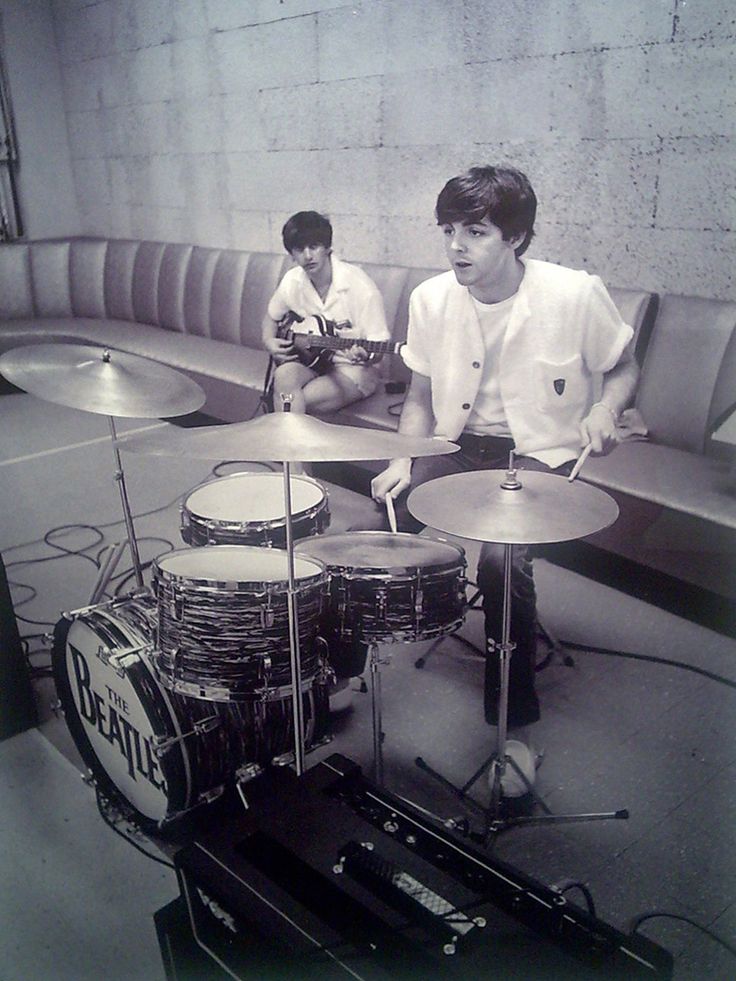
"In February 1964, the Beatles stayed at Miami Beach's Deauville Hotel for their second appearance on The Ed Sullivan Show, a live broadcast on February 16 that drew 70 million viewers, solidifying their American fame." Rehearsal on February 15, 1964:

View attachment 7408606
Oh, by the way, while they were in Miami, they just happened to meet a young fella named Cassius Clay, who was training to fight Sonny Liston for the heavyweight championship of the world:
1768335678975.png
 
Oh, by the way, while they were in Miami, they just happened to meet a young fella named Cassius Clay, who was training to fight Sonny Liston for the heavyweight championship of the world:
View attachment 7408941

Yep, besides rehearsal, they also did some publicity shots.

cassius-clay-vs-the-beatles-1964-1the-vincent-vigil-collection-452130_1024x1024@2x.jpg

But, it wasn't all working rehearsals & publicity shots, either! They found time for fun, too.

497830338_9917037151695714_2496708699316983591_n.jpg beatles-in-miami.jpg images (17).jpeg
 
"In February 1964, the Beatles stayed at Miami Beach's Deauville Hotel for their second appearance on The Ed Sullivan Show, a live broadcast on February 16 that drew 70 million viewers, solidifying their American fame." Rehearsal on February 15, 1964:

View attachment 7408606
Seems in one of the books I read along the way that George had the flu during this second Sullivan appearance and Neil Aspinal stood in for the dress rehearsals. Hard to tell from the hairy legs, but George doesn't appear very flu-like here.
 
  • Like
Reactions: DJ Bebop
Seems in one of the books I read along the way that George had the flu during this second Sullivan appearance and Neil Aspinal stood in for the dress rehearsals. Hard to tell from the hairy legs, but George doesn't appear very flu-like here.

It was during rehearsal for their first Ed Sullivan appearance that Neil Aspinall stood in for sick George! Think anyone would'a noticed if he'd done the performance, too? 🤣

neil-aspinall-standing-in-for-george-v0-f2bchl2ct3cb1.jpg