

Enjoy the benefits of a premium membership!
Upgrade Account
-
TalkBass has been independent since 1998. Add your voice.
Create a free account to reply to discussions, view embedded media, and browse with fewer display ads.
Join free Log in
Want zero display ads or expanded classifieds tools? Compare plans.
You are using an out of date browser. It may not display this or other websites correctly.
You should upgrade or use an alternative browser.
You should upgrade or use an alternative browser.
All Things Must Beat. Share Anything Beatles!!
- Thread starter Rumble Thunder
- Start date
More options
Who Replied?

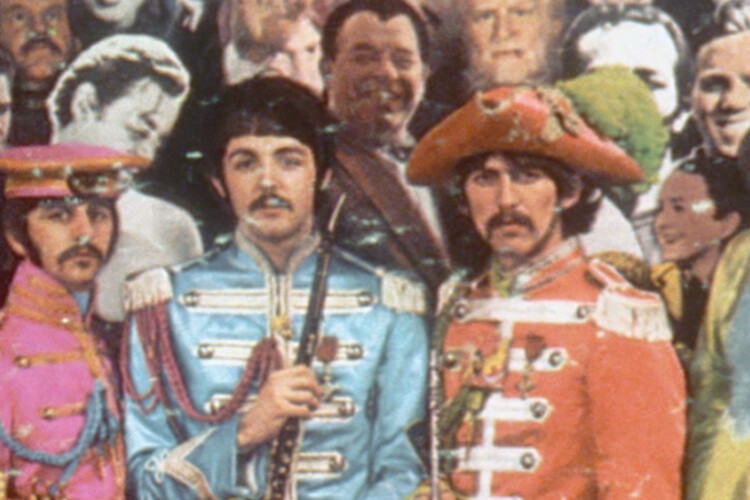
One more time…let’s tally all of the clues…
 apple.news
The strange rumour that shook rock music at the twilight of the 1960s — BBC Music Magazine
In the dying weeks of the Sixties, a Beatles myth captivated fans and amateur sleuths – turning album covers, lyrics and whispers into a nationwide obsession January 28, 2026 Few conspiracy theories in music history have been as elaborate, playful... or strangely affectionate. Emerging at the...




Alkali Ike
Gold Supporting Member
- Jan 1, 2011
- 2,854
- 15,665
- Disclosures
- I never actually learned to play very well
OK, not ashamed to admit it, those videos made me a little emotional. There's no denying the power of the music regardless of who or where you are.

The real 1st chord in A Hard Day's Night.

The real 1st chord in A Hard Day's Night.
D-7add11
Not all that rare in Jazz.
The real 1st chord in A Hard Day's Night.
Close, but not quite correct.
Hard Day's Night Chord Solved
A Gsus4/D is the same as a D-7add11. Either of these chords can be voiced in many different ways.
A Gsus4/D is the same as a D-7add11. Either of these chords can be voiced in many different ways.
Of course. Just as you don't need a 12-string guitar, a 6-string guitar, and a bass. If a band's ambition is simply to hit all the notes of the chord, a ukulele, a harmonium, and a "D" didgeridoo would serve.
Randy Bachman's demonstration will enable any band with members playing a 12-string, a 6-string, and a bass to approximate closely the sound of the chord as played in the studio by the Beatles and George Martin. But, as the Fourier analysis showed, it won't be perfect without a piano in the mix.
I once heard Macca talking on the Sirius Beatles station that George had an uncanny knack for creating memorable openings for many of those great Lennon/McCartney classics, though I don't know if this was one of them.

I once heard Macca talking on the Sirius Beatles station that George had an uncanny knack for creating memorable openings for many of those great Lennon/McCartney classics, though I don't know if this was one of them.
"The iconic opening chord of "A Hard Day's Night" (1964) was a collaborative effort, primarily created by George Harrison playing a Rickenbacker 12-string guitar, John Lennon on acoustic guitar, Paul McCartney on bass, and George Martin on piano. The distinctive sound is a complex Fadd9 (or G11sus4) chord, with Lennon and Harrison playing the chord, McCartney providing a D note, and Martin adding piano notes to create the "mighty" sound."
- - - -
"A Hard Day's Night" is widely known for its iconic Rickenbacker 360/12 12-string guitar's "mighty opening chord". According to George Martin, "We knew it would open both the film and the soundtrack LP, so we wanted a particularly strong and effective beginning. The strident guitar chord was the perfect launch," having what Ian MacDonald called "a significance in Beatles lore matched only by the concluding E major of 'A Day in the Life', the two opening and closing the group's middle period of peak creativity"."According to musicologist Jeremy Summerly, "the sound of this chord is the most discussed pop opening of all time". Analysis of the chord has been much debated, it having been described as G7add9sus4, G7sus4, or G11sus4 and others below. It is most simply described as F6/9 in third inversion, or F6/9/D".
"According to Walter Everett the opening chord has an introductory dominant function because McCartney plays D in the bass: Harrison and Martin play F A C G, over the bass D, on twelve-string guitar and piano respectively, giving the chord a mixture-coloured neighbour, F; two diatonic neighbours, A and C; plus an anticipation of the tonic, G – the major subtonic as played on guitar being a borrowed chord commonly used by the Beatles, first in "P.S. I Love You", and later in "Every Little Thing", "Tomorrow Never Knows" and "Got to Get You into My Life" (in the latter two against a tonic pedal)".
"Alan W. Pollack also interprets the chord as a surrogate dominant, the G being an anticipation that resolves on the G major chord that opens the verse. He suggests it is a mixture of D minor, F major, and G major (missing the B). Tony Bacon calls it a Dm7sus4 (D F G A C), which is the minor seventh chord (plus the fourth, G)".
"Dominic Pedler has also provided an interpretation of the chord, with the Beatles and George Martin playing the following:
- George Harrison: Fadd9 in 1st position on Rickenbacker 360/12 12-string electric guitar
- John Lennon: Fadd9 in 1st position on a Gibson J-160E 6-string acoustic guitar
- Paul McCartney: high D3 played on the D-string, 12th fret on Hofner 500/1 electric bass
- George Martin: D2-G2-D3 played on a Steinway Grand Piano
- Ringo Starr: subtle snare drum and ride cymbal
"This gives the notes: G-B-D-F-A-C (the B is a harmonic). One of the interesting things about this chord (as described by Pedler) is how McCartney's high bass note reverberates inside the soundbox of Lennon's acoustic guitar and begins to be picked up on Lennon's microphone or pick-up during the sounding of the chord. This gives the chord its special "wavy" and unstable quality. Pedler describes the effect as a "virtual pull-off"."
"In 2004, Jason Brown, a mathematics professor at Dalhousie University, published a report titled "Mathematics, Physics and 'A Hard Day's Night'", in which he analysed the properties of the song's opening chord using Fourier transforms. He concluded that Martin's piano contribution provided the important element in the chord beside Harrison's playing. In November the following year, Wired published an article on Brown's use of Celemony's Melodyne Editor with Direct Note Access technology to further analyse the chord. Brown's findings were partly challenged in 2012 by another mathematician, Kevin Houston from the University of Leeds. Houston, who also used a Fourier transform, attributed a greater importance in Lennon's contribution on acoustic guitar, rather than the piano notes played by Martin".
"Harrison played a repeated guitar arpeggio, outlining the notes he contributed to the opening chord, thereby ending the song in a circular fashion. Martin said that the ending was his idea: "Again, that's film writing. I was stressing to them the importance of making the song fit, not actually finishing it but dangling on so that you're into the next mood."

You people are slipping…what happened 62 years ago today?


The Shirley Temple show, Red Skelton show, and also the Ed Sullivan show  .
.
.


