You are able to play roots in rhythm with a decent tone, you know a bunch of songs, and you are in a band that gigs. Congratulations, that's awesome! That is a great place from which you can build.
So, you only play roots. There's nothing intrinsically wrong with that, although it is not how I want to play (or for the most part, listen to). There are many great bassists that play simply. But, do you play simply because you choose to, or because you are unable to do anything else? The challenge is to play what sounds best. Not to play the absolute minimum. Sometimes those two things are the same, and sometimes they are not.
In the video you posted, the band sounds fine. You sound fine. In my humble opinion and for my taste, if you tastefully did bit more (rhythmically and harmonically/melodically, a fill here and there), you could add some excitement to the groove and feel. Do you feel you want to do that? If you do, you are not as competent as you should be. Ideally we should know enough to express the sounds that are in our heads and hearts. If what you hear when you imagine the best bass line is quarter note roots, then that is what you should play. If imagining yourself playing your best sounds different in your head, then you should learning enough that you can produce externally what you imagine internally.
That's my bar for competence. Higher than "you don't get fired", but lower than "the audience bows down to you". If you don't know any theory but can play everything you ever want, that's great. Very few of us are that pure. I'd say start with learning to use octaves and fifths.
I would start thinking in shapes on the fretboard.
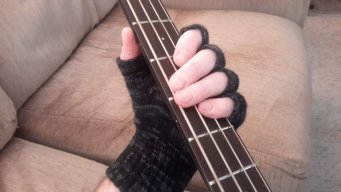
An octave is a note that has the same name as the root, but is higher (by 12 half steps) or lower (again by 12 half steps). If you play a C on the 3rd fret of the A string, the higher octave is the C on the 5th fret of the G string. That note can be used interchangeably with the lower octave. I generally play the root with my first finger, and play the high octave with my pinky. Remember that shape. You can use it on any note.
The 5th is the note 7 half-steps above or 5 half-steps below the root (those are the same note, an octave apart). If you play the C on the 3rd fret of the A string, the 5th down is the G on the 3rd fret of the E string. The 5th up is the G on the 5th fret of the D string.
In general the most used notes to add are a 5th down(same fret, one string lower, meaning thicker), and an octave up (two frets higher, two strings higher).
If you listen to country music or a lot of early rock, the bassist plays what is called a root-five line, which usually means alternating between the root and a 5th down. Generally you want to start each chord with the root, but try experimenting with a few 5ths or root octaves during the bar.
I would try this stuff out on your own, with the radio or Spotify or something. When it feels pretty good, try it (sparingly) with the band. At some point it will click, and you will be able to use it whenever you want that sound.
A few lessons with teacher would be a huge help to get you jump-started.
Personally, I strive to be a bit more "competent" each day, no matter how tiny the difference. And usually, it is really really tiny.
So, you only play roots. There's nothing intrinsically wrong with that, although it is not how I want to play (or for the most part, listen to). There are many great bassists that play simply. But, do you play simply because you choose to, or because you are unable to do anything else? The challenge is to play what sounds best. Not to play the absolute minimum. Sometimes those two things are the same, and sometimes they are not.
In the video you posted, the band sounds fine. You sound fine. In my humble opinion and for my taste, if you tastefully did bit more (rhythmically and harmonically/melodically, a fill here and there), you could add some excitement to the groove and feel. Do you feel you want to do that? If you do, you are not as competent as you should be. Ideally we should know enough to express the sounds that are in our heads and hearts. If what you hear when you imagine the best bass line is quarter note roots, then that is what you should play. If imagining yourself playing your best sounds different in your head, then you should learning enough that you can produce externally what you imagine internally.
That's my bar for competence. Higher than "you don't get fired", but lower than "the audience bows down to you". If you don't know any theory but can play everything you ever want, that's great. Very few of us are that pure. I'd say start with learning to use octaves and fifths.
I would start thinking in shapes on the fretboard.
An octave is a note that has the same name as the root, but is higher (by 12 half steps) or lower (again by 12 half steps). If you play a C on the 3rd fret of the A string, the higher octave is the C on the 5th fret of the G string. That note can be used interchangeably with the lower octave. I generally play the root with my first finger, and play the high octave with my pinky. Remember that shape. You can use it on any note.
The 5th is the note 7 half-steps above or 5 half-steps below the root (those are the same note, an octave apart). If you play the C on the 3rd fret of the A string, the 5th down is the G on the 3rd fret of the E string. The 5th up is the G on the 5th fret of the D string.
In general the most used notes to add are a 5th down(same fret, one string lower, meaning thicker), and an octave up (two frets higher, two strings higher).
If you listen to country music or a lot of early rock, the bassist plays what is called a root-five line, which usually means alternating between the root and a 5th down. Generally you want to start each chord with the root, but try experimenting with a few 5ths or root octaves during the bar.
I would try this stuff out on your own, with the radio or Spotify or something. When it feels pretty good, try it (sparingly) with the band. At some point it will click, and you will be able to use it whenever you want that sound.
A few lessons with teacher would be a huge help to get you jump-started.
Personally, I strive to be a bit more "competent" each day, no matter how tiny the difference. And usually, it is really really tiny.