• TalkBass has been independent since 1998. Add your voice.
    Create a free account to reply to discussions, view embedded media, and browse with fewer display ads.
    Join freeLog in
    Want zero display ads or expanded classifieds tools? Compare plans.

Ambient/Post-Rock/Textural bass playing thread

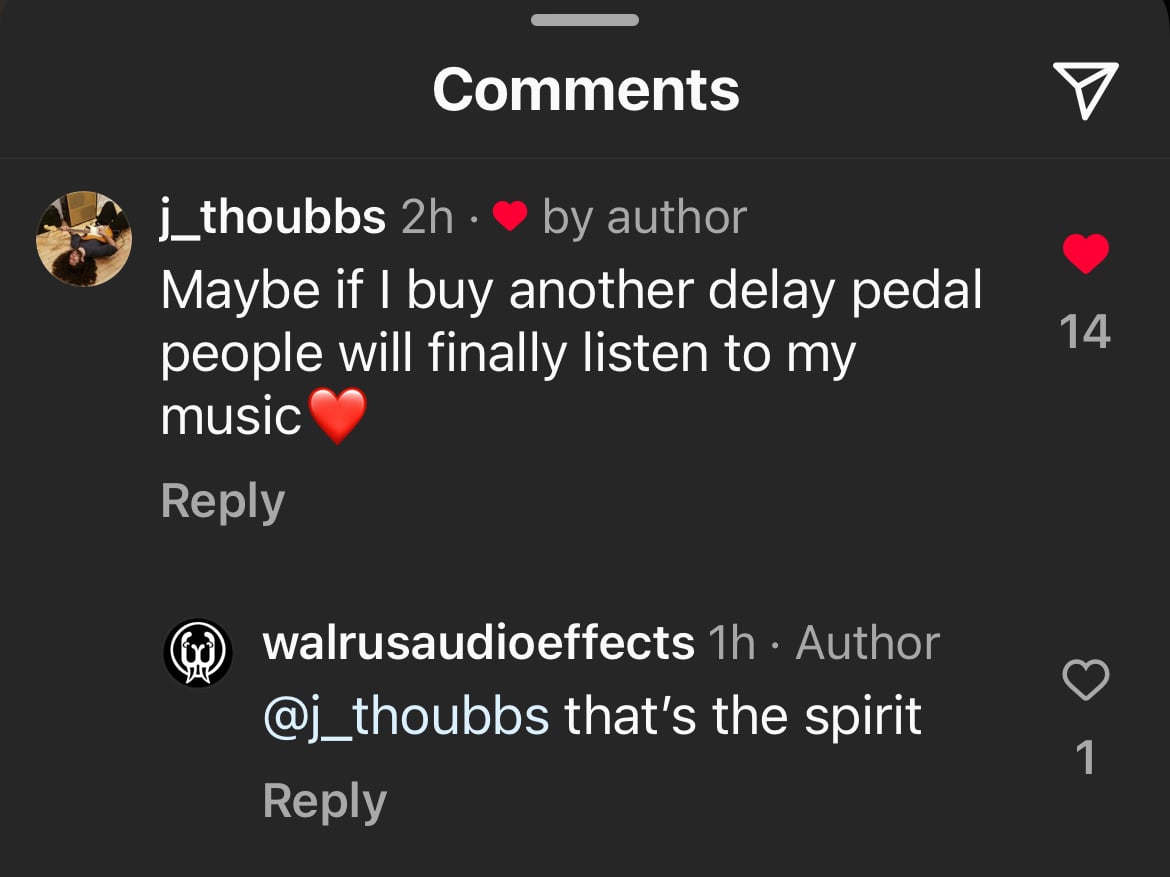
A little comedy some of us can appreciate

IMG_0172.jpeg
IMG_0173.jpeg
 
I'm not sure I grok what you're getting at, could you elaborate on ^^^that point?

Otherwise, that was a wonderfully insightful post, thanks!

The thing that immediately comes to mind is a story about Miles Davis - I thought it was in reference to George Coleman who preceded Wayne Shorter in the Second Great Quintet, but the only direct quote I can find is Herbie Hancock saying: "Once he heard a sideman practicing in his room and that night heard him play those same scales in a solo. Afterward Miles said, 'Look, I pay you to practice on the bandstand.'"

I was probably being idealistic when I wrote "the lines between 'practicing' and 'performing' are blurred in improvised music" but it seems like it's less about perfecting parts and then reproducing them and more about "just playing." One band I was in before the pandemic was allegedly a "jam band" style group - I said "let's just play" and the guitar player thought for a moment, then started playing something. We all jumped in on it, but later I found out he was playing a riff that either he had come up with before, or maybe even by another band. He wasn't able to just start playing on the spot - that's what I wanted to do, to see what would come out of the four of us "just playing" - I guess I've been fortunate to be in bands where that was possible, but that was over 20 years ago.

In my recent live electronic performance, I had definitely identified things that I like to do, and then tried to do them, so it's not like I have mastered this art of practice/performing!
 
On the subject of practicing and improvising, Phish used to do practice exercises together specifically focused on group improvisation. (Whether you like Phish or not, they have managed to get quite a few people interested in their improvisations.) There was a time when I could've specifically described some of the exercises but I can't remember...if anyone is interested I'm sure some Googling would quickly turn up some relevant info.

 
  • Like
Reactions: hieronymous
On the subject of practicing and improvising, Phish used to do practice exercises together specifically focused on group improvisation. (Whether you like Phish or not, they have managed to get quite a few people interested in their improvisations.) There was a time when I could've specifically described some of the exercises but I can't remember...if anyone is interested I'm sure some Googling would quickly turn up some relevant info.
Good point - and of course jazz musicians practice improvising as well. I might have been talking out my a$$ on this one!
 
Last edited:
On the subject of improvised performances, I’ve been enjoying this Drumeo series where they have a drummer listen to a song they’ve supposedly never heard, and without the original drum track. Then they get a few shots at creating a part on the spot. It’s quite interesting to hear how these drummers interpret what they hear and process it. I’m not a fan of Imagine Dragons, but I do like Lamb of God, so this one caught my ear. I liked the final result (time stamped so you can jump to it) and the energy and attitude about the whole process.

 
On the subject of improvising, it can be helpful to think of how this is handles in other art forms. I wouldn't be surprised of Phish and many others used this concept.

Yes, and... - Wikipedia...

I've never heard of this "Yes, And..." concept, but it does remind me of something an improvisational actor told me, something that I've tried to utilize in my musical improvisations. I'm sure this is simply a variant of (or a corollary to) "Yes, And..." Thinking, but what he told me was it is essentially everyone in the ensemble's responsibility to ensure that no one backs themselves into a corner, or leaves themselves dangling in the wind, or shoots themselves in the foot, or [insert favorite aphorism].

In other words, just because Mr. Trumpet Player somehow steered this jam into some crazy area, there's no point in blaming Mr. Trumpet Player, you can't not go where Mr. Trumpet Player went, and you can't expect Mr. Trumpet Player to steer us back out and into a more musically gratifying place...you have to all accept that somehow you've gotten there -- I think that's explicitly what "Yes, And..." is all about -- but then you all have to work collectively to get the music moving in an appropriate direction. Shared responsibility: We Are Here, Therefore We Got Ourselves Here, Now Let's Get Ourselves Out.
 
I've never heard of this "Yes, And..." concept, but it does remind me of something an improvisational actor told me, something that I've tried to utilize in my musical improvisations. I'm sure this is simply a variant of (or a corollary to) "Yes, And..." Thinking, but what he told me was it is essentially everyone in the ensemble's responsibility to ensure that no one backs themselves into a corner, or leaves themselves dangling in the wind, or shoots themselves in the foot, or [insert favorite aphorism].

In other words, just because Mr. Trumpet Player somehow steered this jam into some crazy area, there's no point in blaming Mr. Trumpet Player, you can't not go where Mr. Trumpet Player went, and you can't expect Mr. Trumpet Player to steer us back out and into a more musically gratifying place...you have to all accept that somehow you've gotten there -- I think that's explicitly what "Yes, And..." is all about -- but then you all have to work collectively to get the music moving in an appropriate direction. Shared responsibility: We Are Here, Therefore We Got Ourselves Here, Now Let's Get Ourselves Out.

Don't discount the "No, but..." either. I'm not second nature with either on the spot, but I do try to think this way when planning.
 
  • Like
Reactions: Bob_Ross