• TalkBass has been independent since 1998. Add your voice.
    Create a free account to reply to discussions, view embedded media, and browse with fewer display ads.
    Join freeLog in
    Want zero display ads or expanded classifieds tools? Compare plans.

Anyone else feel like expensive basses are arbitrarily priced?

Status
Not open for further replies.
I was in involved with piano and organ sales in the 90's, and I think this probably applies to rich-people basses as well: the prices go sky high to account for trade-in value. There is a high and low price on every instrument. You'd be amazed and appalled - a 10,000 bass might have a low of 4250, because its expected a very high value trade-in will be part of the deal. If not, and you get full price, fat payday for you. Some instruments may come back more than once, and make you money many times over.

From a player perspective, I don't think there's any reason to go beyond $600-800 in a solidbody instrument, but the main "bump" is much lower than that even. A decent platform with higher end pickups. Everything beyond that is cosmetic.
 
This is a totally loaded question and does not deserve an answer.

If you want to read about the debates regarding tone wood, it has been covered to death on this board and elsewhere...yep I am telling you to "do a search"...

Hah, very good. My legitimate question isn't worth answering because it points out that this big concept of expensive tonewood is very likely just a ploy at marketing. That would make a boutique maker look bad because they emphasise the exoticness of the wood improving the quality of your instrument. I'm simply asking if Fodera has indeed discovered proof that can be validated. Maybe they have because they have created very high end basses for years so it would be in their interest to shut people like me up.

People point out that a lot of research hasn't been done but what has points to wood not being important to sound. Again, I harp on this because even the Fodera rep here was pointing out how expensive tone woods are. People are willing to believe, in absence of proof, that wood is so very important. A finite resource which drives up the production cost handily.

Again, if Fodera or another maker can prove me wrong, I'm totally willing to accept it.
 
  • Like
Reactions: FlatwoundFunk
Hah, very good. My legitimate question isn't worth answering because it points out that this big concept of expensive tonewood is very likely just a ploy at marketing. That would make a boutique maker look bad because they emphasise the exoticness of the wood improving the quality of your instrument. I'm simply asking if Fodera has indeed discovered proof that can be validated. Maybe they have because they have created very high end basses for years so it would be in their interest to shut people like me up.

People point out that a lot of research hasn't been done but what has points to wood not being important to sound. Again, I harp on this because even the Fodera rep here was pointing out how expensive tone woods are. People are willing to believe, in absence of proof, that wood is so very important. A finite resource which drives up the production cost handily.

Again, if Fodera or another maker can prove me wrong, I'm totally willing to accept it.
Dude, your very arguments have been echoed here thousands of times. Most of us are quite tired of hearing about it. There will never be a scientific study that will satisfy all of the pseudoscientists who insist on infallible controlled studies to prove them wrong. Such a study simply cannot be possible. So you can go on believing wood doesn't matter those that do will...and the world will continue to revolve.
 
Dude, you're very arguments have been echoed here thousands of times. Most of us are quite tired of hearing about it. There will never be a scientific study that will satisfy all of the pseudoscientists who insist on infallible controlled studies to prove them wrong. Such a study simply cannot be possible. So you can go on believing what doesn't matter those that do will...and the world will continue to revolve.

Remember kids, controlled studies are bull**** pseudoscience. The scientific method is invalid, you heard it here. If you will excuse me, I need to go eat goat testicles to cure my cold, my shaman told me it's legit!
 
Instruments are priced at what the consumer is willing to pay. If the instrument is not worth the price tag, people will not buy it and the manufacture will adjust the price accordingly. Its simple economics.

Also with things like vintage instruments, there is only so much of a supply of them and some people prefer their sound/tone/feel. Which is something that cant be replicated today (Because we don't have the same types of metal, the same types of wiring, the same types of finishes etc.) Especially things like Brazilian rosewood fretboard basses.

Yep. In Capitalism you can charge whatever you can convince people to pay! It might only cost 10-50% of what they sell the bass for to make it.

Apple is an example of a company that is adept at convincing people to pay high prices for electronics/computers. Their manufacturing costs aren't that different than their competitors. They still make everything in China. However, they make a killing because they have a customer base willing to pay that premium for an Apple product.
 
Again, you're just repeating the same crap all heard over and over.

It's not you, E. I just can't believe the fiction people buy into so readily. But again, broken record right? It's just that it irks me when people spout wrong information like it's fact and people accept it or shrug and say 'it is valid because opinions'' etc.

Not to you specifically E just saying; When you say something, you have a burden of proof. It's not up to your detractors to prove you wrong it's up you to prove it right. Sigh anyway I'm gonna take your advice and bow out.
 
As it has been stated before, much thought goes into pricing and people have already contributed thoughtful answers detailing all of the factors. What some people aren't accepting is that there are customers who don't feel the same way and choose to buy a boutique instrument anyway- totally blown away, almost annoyed that someone would make the personal choice to spend $$$.
imgres.jpg
Maybe it's time to move on, eh?
 
  • Like
Reactions: FlatwoundFunk
Please re-read my post without assaulting my intelligence and ability to communicate. Every time you buy something you are expressing your OPINION on the correct price. So yes, in your head for everything in the world that has value and price, you have an opinion if you are willing to comment on whether or not that price is "over" or "under" your opinion. That's prices in the abstract. All prices for all things. Ever.
That my friend is not necessarily true. Everytime you buy something, that does not mean that "you are expressing your opinion on the correct price". That in it's very essence is an opinion. As you well know, there are variables such as necessities, desires, societal pressures, available funds, lack of competition and availability, governmental regulation, FEAR, and etc... (just to name a few), that aid in the decision making process of an purchase.

Sir, we're just having a healthy grown up conversation. No assaults. Just know that when you dish out intellectual hidden insults, they can come back at you. ;)
FF
 
Remember kids, controlled studies are bull**** pseudoscience. The scientific method is invalid, you heard it here. If you will excuse me, I need to go eat goat testicles to cure my cold, my shaman told me it's legit!
Part of my day gig is designing and conducting social science studies. Essentially, if you wanted a good tone wood study, it would look a lot like a psych experiment, but a really messy psych experiment because of natural variation from one chunk of wood to the other. We are talking multiple basses for each tone wood, all painted an opaque color to hide the grain. Then you'd probably need a couple hundred players... Long story short, a controlled study is theoretically possible, but highly impractical
 
  • Like
Reactions: FlatwoundFunk
It's not you, E. I just can't believe the fiction people buy into so readily. But again, broken record right? It's just that it irks me when people spout wrong information like it's fact and people accept it or shrug and say 'it is valid because opinions'' etc.

Not to you specifically E just saying; When you say something, you have a burden of proof. It's not up to your detractors to prove you wrong it's up you to prove it right. Sigh anyway I'm gonna take your advice and bow out.
Try to understand that your argument for proof of what you do not believe goes both ways. There are people that do believe that wood affects the tone of their instrument and you cannot prove them wrong with science or otherwise. So, like you it also bothers me when people spout their opinion as fact.
 
Remember kids, controlled studies are bull**** pseudoscience. The scientific method is invalid, you heard it here. If you will excuse me, I need to go eat goat testicles to cure my cold, my shaman told me it's legit!

This is the beauty of the interwebs.....that no one has to smell someone else's breath after they've been eating testicles. ;)
 
Dude, your very arguments have been echoed here thousands of times. Most of us are quite tired of hearing about it. There will never be a scientific study that will satisfy all of the pseudoscientists who insist on infallible controlled studies to prove them wrong. Such a study simply cannot be possible. So you can go on believing wood doesn't matter those that do will...and the world will continue to revolve.
Like Gin Rummy of the Boondocks said, "The absence of evidence is NOT evidence of absence".
FF
 
Dude, your very arguments have been echoed here thousands of times. Most of us are quite tired of hearing about it. There will never be a scientific study that will satisfy all of the pseudoscientists who insist on infallible controlled studies to prove them wrong. Such a study simply cannot be possible. So you can go on believing wood doesn't matter those that do will...and the world will continue to revolve.

Its completely possible to do a study like this. We have incredible technology for measuring things these days, and the philosophy of science, statistics, and our models for the physical world are advanced enough to figure this out. Basses aren't in high energy environments, working at quantum scale, or near black holes. We can model and measure what happens. There is an answer.

I think the main problem is there isn't so much INTEREST in doing so. What practical purpose is there for figuring out whether tone woods affect tone on electric instruments? Only a very small fraction of anyone even cares about it, and it doesn't really fix any problem we are facing (global warming, or whatever) or advance some science that makes life better for anyone.

From what I've read I think that for solid instruments, the species of wood has almost no perceptible effect on the sound. More often than not it's some perceived effect that is tied to confirmation bias. Your mind plays tricks on you all the time which is why we have the philosophy of science, logic, and scientific instruments to measure things around to check ourselves.

I do think that heavy/dense vs. lighter woods may change the sound SLIGHTLY. However the vast majority of people won't detect it without confirmation bias coming into play, and your audience (even the player) doesn't know the difference in the mix. There are so many other factors in a bass, like how it's constructed with the bridge and other parts involved.

For example, my G&L basses with the saddle lock bridge have incredible resonance in the wood. Maybe tone wood makes a difference there because of that? I don't know. Many other basses you don't feel the vibration in the body quite the same way, so it's hard for me to believe there is some strong interaction between the strings and wood going on that is changing the tone.

With acoustic instruments I'd hypothesize wood would absolutely have some more effect simply because you are amplifying your sound USING the wood. With electric instruments the pickups are doing that, you don't need wood.
 
Last edited:
Hah, very good. My legitimate question isn't worth answering because it points out that this big concept of expensive tonewood is very likely just a ploy at marketing. That would make a boutique maker look bad because they emphasise the exoticness of the wood improving the quality of your instrument. I'm simply asking if Fodera has indeed discovered proof that can be validated. Maybe they have because they have created very high end basses for years so it would be in their interest to shut people like me up.

People point out that a lot of research hasn't been done but what has points to wood not being important to sound. Again, I harp on this because even the Fodera rep here was pointing out how expensive tone woods are. People are willing to believe, in absence of proof, that wood is so very important. A finite resource which drives up the production cost handily.

Again, if Fodera or another maker can prove me wrong, I'm totally willing to accept it.

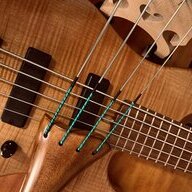
Fodera isn't the only builder out there. Besides, the bulk of their body, neck, and fingerboard woods tend to be the same types of wood used on plenty of other instruments. I don't think too many people are under the impression that gallery tops enhance the tone. Woods like buckeye burl are known for having poor resonance, but this isn't a huge issue given the thickness and that it's likely on a solid body bass.

Other luthiers are able to get woods like mahogany, ash, and alder at desired desnsity ranges. This allows them to have control over the tone, but more importantly, weight. One of my favorite things about some of my boutique basses is that they're often 2-3lbs lighter than stuff off the rack.
 
Fodera isn't the only builder out there. Besides, the bulk of their body, neck, and fingerboard woods tend to be the same types of wood used on plenty of other instruments. I don't think too many people are under the impression that gallery tops enhance the tone. Woods like buckeye burl are known for having poor resonance, but this isn't a huge issue given the thickness and that it's likely on a solid body bass.

Other luthiers are able to get woods like mahogany, ash, and alder at desired desnsity ranges. This allows them to have control over the tone, but more importantly, weight. One of my favorite things about some of my boutique basses is that they're often 2-3lbs lighter than stuff off the rack.
You'd be suprised at the amount of misinformation that is passed on that has people believing that the top woods enhance the tone. I've actually witnessed people state that the walnut top and back on a Smith give it a deeper and darker tone (when it has a maple core). They see walnut and they associate it with those properties.
FF
 
Some yes.I payed $2000 for both of my basses and they are from a relatively unknown builder.They are just as good as any Fodera or other boutique bass I've played I just payed a lot less.10k is just crazy though.I'd never pay that for 1 bass.I could have my builder make me 3 or 4 basses that I'd be just as happy with.
 
  • Like
Reactions: Old Blastard
Status
Not open for further replies.

Latest posts