• TalkBass has been independent since 1998. Add your voice.
    Create a free account to reply to discussions, view embedded media, and browse with fewer display ads.
    Join freeLog in
    Want zero display ads or expanded classifieds tools? Compare plans.

Anyone else feel like expensive basses are arbitrarily priced?

Status
Not open for further replies.
I am sure this is in here but there exists a market for the extremely wealthy in any given product, from kitchen drawer knobs to bass guitars. Basically, if you want the uber-wealthy to buy your junk you have to price it out of the range of poor people, it gives the item "prestige" and "social status." It's basic sales stuff, the uber-wealthy do not care what is better they care what is more expensive.

Do you think a $300 plate of food taste better than a $30 one? It doesn't, it just keeps the riff raff from eating near your table.
 
  • Like
Reactions: FlatwoundFunk
I agree that many instruments are overpriced for a variety of reasons .While some expensive instruments definitely warrant their asking price many others are "on the boutique bandwagon" and not worth their weight ..I once owned a Spalt bass, Aluminum and wood body (my avatar) a 4k or 5k bass new i don't remember ,a piece of artwork(to me ) .....it played beautifully .Bartolini m+J p/us active w/ bart preamp but I could get a better sound out of a $300 Yamaha .......value is in the eye of the beholder
 
  • Like
Reactions: FlatwoundFunk
Do you think a $300 plate of food taste better than a $30 one? It doesn't, it just keeps the riff raff from eating near your table.

I've paid $300 for a pair of steaks at Morton's, and $30 for a pair of steaks at Sizzler, and they were definitely not of equal quality.

You are correct, however, about the lack of riff-raff at the higher-end joint.

original-833e042f509c996b.jpg
serves considerably tastier steak than
NEWSizzler-LOGO.jpg
 
Answer 1: The price of admission is different for different clubs. Understand what your aspirations really mean. Caveat emptor.

Answer 2: The price of an upscale instrument just as often reflects the aspirations of the builder. Again, caveat emptor.

Clever quote: "You don't always get what you pay for, but you always pay for what you get." -Don King
 
  • Like
Reactions: FlatwoundFunk
I am sure this is in here but there exists a market for the extremely wealthy in any given product, from kitchen drawer knobs to bass guitars. Basically, if you want the uber-wealthy to buy your junk you have to price it out of the range of poor people, it gives the item "prestige" and "social status." It's basic sales stuff, the uber-wealthy do not care what is better they care what is more expensive.

Do you think a $300 plate of food taste better than a $30 one? It doesn't, it just keeps the riff raff from eating near your table.
Really, so people buy expensive basses to avoid venues where people are playing mims?
And do you really think that people who buy expensive basses are rich? Sure they have some kind of disposable income, but do you really believe that stockbrokers, hedge fund managers, plastic surgeons, Russian oligarchs, oil sheikhs and Chinese businessmen are buying up all those expensive basses to hang on their walls just cause they flirted with a little Metallica in their youth?
 
Really, so people buy expensive basses to avoid venues where people are playing mims?
And do you really think that people who buy expensive basses are rich? Sure they have some kind of disposable income, but do you really believe that stockbrokers, hedge fund managers, plastic surgeons Russian oligarchs, oil sheikhs and Chinese businessmen are buying up all those expensive basses to hang on their walls just cause they flirted with a little Metallica in their youth?

It is indeed stereotyping to assume all wealthy people spend lavishly. There exist many rich men with a war-ration, hoarder mentality. Wealthy people are often so precisely because they are extremely hard-nosed. I knew a multi-millionaire who packed his lunch to save a buck.

I would imagine the majority of these so-called coffee table basses are owned by jazbos who can play the bejeeebuz out of them. But then perhaps that is my own stereotyping?
 
Last edited by a moderator:
Like anything else, they are priced at the highest price point they think the market can bear. If they get it right, or low, they sell the instruments. If they get it wrong or too high, they do not.
 
Belka said:
And do you really think that people who buy expensive basses are rich?
My experience has been that many people can afford _one_ extravagance. For some it's cool fishing boat or jet ski. For some it's top-line golf equipment they use every weekend. For some it's a Mercedes or Ferrari or Porsche. Some people cycle through them as their interests change. And some take on more than they afford... Many working professionals can afford whatever they want - but not all at once. Choose wisely.
I would imagine the majority of these so-called coffee table basses are owned by jazbos who can play the bejeeebuz out of them.
Personally I doubt that's true although I'm sure a lot are.
I've got one (two, actually) and I don't claim I can play the bejeeebuz out of them, but I work at it every day and they never fail to put a smile on my face. I've been through a few phases where I had to buy a succession of better stuff as my skill increased. _This_ time I decided I would get what I wanted the first time and just grow into it.

I've said this before: Quality is like The Matrix - No one can be told about it - you must experience it for yourself. If you've played Foderas and Sadowskys and Roscoes and you _still_ prefer a Squier - good for you. If you're still saying "I can't imagine how they could be that much better..." you're right - you can't. You must experience it for yourself.
 
I do wonder about the difference between MIA and MIM pricing, especially now I know that the two respective factories are (if I'm not mistaken) less than a 1.5 hour drive away from each other. Now, I see the upgrades between say, MIM P and an MIA P, but sometimes I play £450 MIMs that sound and feel just as nice as the £1250 MIAs. It makes me wonder about how much of a crossover in quality there is between the two factories in relation to the widely differing pricetags.

Do you think that some unlucky people get MIAs that are more like MIMs, and other lucky guys are paying 3x less for a better bass?

MIMs have superb quality anymore. They are actually underpriced a bit IMO. Where they are priced at currently just makes them a fantastic deal for a workhorse instrument.

The MIMs would have some corners cut on the neck reinforcement, wood choice, hardware and pickups, however in general the machining and finishing is about as good. My understanding is the Ensenada plant gets all the old USA factory equipment, and of course they're so close they can train people or send parts that way easily, so it kinda makes sense.

That being said, I would probably pay for MIA mostly because I like the extras. However I'm not buying new MIAs anymore usually.
 
Last edited:
Its completely possible to do a study like this. We have incredible technology for measuring things these days, and the philosophy of science, statistics, and our models for the physical world are advanced enough to figure this out. Basses aren't in high energy environments, working at quantum scale, or near black holes. We can model and measure what happens. There is an answer.

I think the main problem is there isn't so much INTEREST in doing so. What practical purpose is there for figuring out whether tone woods affect tone on electric instruments? Only a very small fraction of anyone even cares about it, and it doesn't really fix any problem we are facing (global warming, or whatever) or advance some science that makes life better for anyone.

From what I've read I think that for solid instruments, the species of wood has almost no perceptible effect on the sound. More often than not it's some perceived effect that is tied to confirmation bias. Your mind plays tricks on you all the time which is why we have the philosophy of science, logic, and scientific instruments to measure things around to check ourselves.

I do think that heavy/dense vs. lighter woods may change the sound SLIGHTLY. However the vast majority of people won't detect it without confirmation bias coming into play, and your audience (even the player) doesn't know the difference in the mix. There are so many other factors in a bass, like how it's constructed with the bridge and other parts involved.

For example, my G&L basses with the saddle lock bridge have incredible resonance in the wood. Maybe tone wood makes a difference there because of that? I don't know. Many other basses you don't feel the vibration in the body quite the same way, so it's hard for me to believe there is some strong interaction between the strings and wood going on that is changing the tone.

With acoustic instruments I'd hypothesize wood would absolutely have some more effect simply because you are amplifying your sound USING the wood. With electric instruments the pickups are doing that, you don't need wood.


Wood like any material is characterize by measurable physical quantities. The first thing I think about in terms of acoustic properties is the sound speed of the material. In terms of sound speed, it is very clear that different woods have vastly different sound speeds. Moreover, wood is not a homogeneous material and the sound speed is typically very different in a given piece of wood relative to the grain. This is just one example but there are other quantities like wave dispersion and dissipation. The mechanical behavior of different woods is easy to understand and model. One does see quite a bit of difference in the behavior of different woods. An electric instrument is much harder to analyze. One would certainly hypothesize that the mechanical behavior of the wood has a significantly lesser effect (if any) on the sound because of the pickups. However, because the pickups are mechanically coupled to the body and neck and the strings also mechanically coupled to the body an neck, one can certainly expect to measure a difference. State of the art instrumentation can most certainly pick-up a difference. In my world, we routinely measure the movement of fractions of a micron on the nanosecond level. The key question then becomes not whether not there is difference but whether it that difference is perceptible. This then requires an understanding of human perception and that is a much different ball game.

Consider the following references.

[Invalid or Expired Link Removed]

https://hal.archives-ouvertes.fr/hal-00808347/document

[Invalid or Expired Link Removed]
 
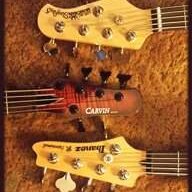
I like my Carvin bass. It's made of koa / koa, probably gonna sell it though.
Actually, no, if folks stopped buying basses for 2 years we would go out of business, not drop our prices. The reality, for better or worse, is that we price our instruments where we need to in order to remain a viable, self-funding business. There are numerous threads in which I have gone into great detail about the economics of Fodera. In a good year (and, sadly, not all years are good years), we generate a 10% profit...

There seems to be a theme from some in this thread that all high-end basses are arbitrarily priced. In our case, at least, that is absolutely not the case. We price our basses based on the cost of making them and, hopefully, to allow for a modest profit. I think that there are massive misconceptions about just how expensive it is to build things from the very best materials available, almost entirely by hand using fairly-paid people (with reasonable, company-paid benefits) in a
I am sure this is in here but there exists a market for the extremely wealthy in any given product, from kitchen drawer knobs to bass guitars. Basically, if you want the uber-wealthy to buy your junk you have to price it out of the range of poor people, it gives the item "prestige" and "social status." It's basic sales stuff, the uber-wealthy do not care what is better they care what is more expensive.

Do you think a $300 plate of food taste better than a $30 one? It doesn't, it just keeps the riff raff from eating near your table.
Was just thinking... Ive raised the question why 10 large for a Fodera when to me A Carvin Vanqusih at almost 10x less sounds and plays just as good. My thoughts were who am I to judge or guage this comparison?? Am I a $10,000 player? Nope, Im not and probably never will be. The question needs to be thrown at the Les's, Geddy's, and God bless them the Jacks and Jacos of our time. I'll be and have been the first to say 10 grand??? No freekin way! But if I were wealthy, heck yeah Id have one, and super bad ass one at that. But Id have more Carvins that any other maker.
 
I've always thought it is interesting to compare Fender price lists from the 60s with modern prices to try to get a sense of whether prices have really increased. For example, in the price list from 1960 shown below, a Precision Bass listed for $229.50. Taking inflation into account, that would be the equivalent of about $1,800 in today's dollars. A 63 AVRI Precision has a street price of about $2,000, which is basically in the ballpark with the inflation adjusted cost of the 1960 model.

image.jpg
 
Wood like any material is characterize by measurable physical quantities. The first thing I think about in terms of acoustic properties is the sound speed of the material. In terms of sound speed, it is very clear that different woods have vastly different sound speeds. Moreover, wood is not a homogeneous material and the sound speed is typically very different in a given piece of wood relative to the grain. This is just one example but there are other quantities like wave dispersion and dissipation. The mechanical behavior of different woods is easy to understand and model. One does see quite a bit of difference in the behavior of different woods. An electric instrument is much harder to analyze. One would certainly hypothesize that the mechanical behavior of the wood has a significantly lesser effect (if any) on the sound because of the pickups. However, because the pickups are mechanically coupled to the body and neck and the strings also mechanically coupled to the body an neck, one can certainly expect to measure a difference. State of the art instrumentation can most certainly pick-up a difference. In my world, we routinely measure the movement of fractions of a micron on the nanosecond level. The key question then becomes not whether not there is difference but whether it that difference is perceptible. This then requires an understanding of human perception and that is a much different ball game.

Consider the following references.

[Invalid or Expired Link Removed]

https://hal.archives-ouvertes.fr/hal-00808347/document

[Invalid or Expired Link Removed]

Wood absolutely has acoustical properties, I just think these properties don't affect electric, solid-body instruments as much as people seem to believe.

If you're talking about a solid-wood, bolt-on bass with a top-loading bridge attached to the surface of the body I start becoming skeptical that the pickups would have any sort of strong-enough vibrations from the strings traveling to their contact points. There is a lot of material between the string contact points and the pickups that would be dampening the effect. I'm sure that the vibrations from the strings through the body wood is measurable, but likely these measurements are too small to make any perceptible difference.

I'm also sure there are some configurations where that isn't true. For example, hollow bodies or certain bridge styles may transfer more energy through the wood to the pickups. You feel the vibrations against your ribs when you use a G&L saddle lock bridge for example, but it has a metal tongue underneath that goes deep into the body. It's different.

I'd be much more inclined to believe that the neck wood, nut and the bridge has some effect on the strings (and thus tone) because of the mechanical coupling and the fact that the neck is a long, narrow piece of wood. Hit a square block of metal, then hit a tuning fork against a wall and see which you can hear better.

Lots of things are measurable, but most of those things are imperceptible. In general we know what sort of frequencies and changes to amplitude, frequency content, etc. your ears and brain can detect. I still think we can answer this question, but of course it has little importance so I doubt anyone will bother really investigating it. Also even if someone proves the point, a bunch of people will continue just believing whatever they want, and create 'Fool's Markets' (for example some people still buy Magic crystals). We have people denying overwhelming evidence and consensus for things all the time.
 
Last edited:
Was just thinking... Ive raised the question why 10 large for a Fodera when to me A Carvin Vanqusih at almost 10x less sounds and plays just as good. My thoughts were who am I to judge or guage this comparison?? Am I a $10,000 player? Nope, Im not and probably never will be. The question needs to be thrown at the Les's, Geddy's, and God bless them the Jacks and Jacos of our time. I'll be and have been the first to say 10 grand??? No freekin way! But if I were wealthy, heck yeah Id have one, and super bad ass one at that. But Id have more Carvins that any other maker.
I wish someone who knows would just talk a little as to REALLY why the Foderas SO MUCH more. No harm intended here or calling out or anything disparaging meant so dont fire back with insults. So how about it?
 
Status
Not open for further replies.