• TalkBass has been independent since 1998. Add your voice.
    Create a free account to reply to discussions, view embedded media, and browse with fewer display ads.
    Join freeLog in
    Want zero display ads or expanded classifieds tools? Compare plans.

Anyone else NOT into lightweight mini rigs?

Everywhere I look people praise the tiny class D gear, leightweight neo speakers, their rigs that fit into a handbag. Some old rockers stand strong to their SVT with their 8x10 for rocker reasons. But honestly - isn't there anyone around who just likes a big fat iron transformer and a big bad speaker in a massive cabinet that reeeeally moves some air, that you can physically feel when you play it and handles all the heavy low-end you could ever possibly want? I mean, come on! Who needs that tiny little mini poopie anyway when you can really rattle some bones instead? Just saying...:D
The other night my B|Amp/HDN212 rig was flapping my pants so hard they were frayed all the way to the knees. After load-out, my back was fine.
 
So... what happens when you combine the two? Like, say, a Class D head and a pair of big, clobberin' 4x10's?

...asking for a friend...

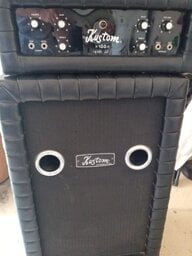
I may or may not have done such a thing in the past:


Attachments

  • upload_2017-12-7_23-45-37.png
    upload_2017-12-7_23-45-37.png
    141.2 KB · Views: 17
Same here.

I still prefer my Crest CA9 when I need full-on slam compared to my Aguilar Tonehammer 500, but IMO the TH500 is still a great little amp.
Can agree completely. I had a TH500 and it was great.... my CA9 is just real though... it hits like none of the smaller heads I've tried. My GK MB200 does its job as a light backup and something for quick rehearsals though. Toss it in the gig bag and I'm good to go.
 
Curious, why the meatsmoke pre AND the meatsmoke head?

I've been asked that question several times. The simple answer, apart from how awesome they look, is that I gives me a few more options. The Barefaced 610 is loud enough to bring down the house, and this gives me the opportunity to drive the power tubes hard AND get preamp overdrive without having to deal with cracks in the concrete walls and bleeding ears. Seriously, this rig reaches ridiculously dangerous sound levels if need be (and sounds terrific while doing it). I have a 100W switch on the amp, but that's rarely loud enough (though it worked well in a studio setting last weekend). This way, I control the dirt with the pedal and power amp, and the volume with the onboard preamp. Works very, very well. Besides, the pedal appears to deliver quite a bit more overdrive than the onboard.

And, although I've not yet had use for it, this gives me six possible Meatsmoke flavors on tap without having to turn a single knob (I've only had the amp for a few weeks, so I have yet to dial in my preferred sounds perfectly):

Amp CH1 + pedal OFF/CH1/CH2
Amp CH2 + pedal OFF/CH1/CH2

From clean to extreme saturation in six steps. Love it.
 
  • Like
Reactions: sludgelord3000
Can agree completely. I had a TH500 and it was great.... my CA9 is just real though... it hits like none of the smaller heads I've tried. My GK MB200 does its job as a light backup and something for quick rehearsals though. Toss it in the gig bag and I'm good to go.

Crest CA9 - 1800 watts into 8 ohms.
TH500 - 250 watts into 8 ohms.

A legitimate comparison for Class D/lightweight would be something like CA9 vs. Crown XLS2500
 
Crest CA9 - 1800 watts into 8 ohms.
TH500 - 250 watts into 8 ohms.

A legitimate comparison for Class D/lightweight would be something like CA9 vs. Crown XLS2500
My legitimate comparison comes from the ton of amps that I've owned and played on. Its not like we were having a decibel war and I preferred the more powerful head. I've played on higher wattage class D's, lower wattage SS power amp, and everything between.
 
Crest CA9 - 1800 watts into 8 ohms.
TH500 - 250 watts into 8 ohms.

A legitimate comparison for Class D/lightweight would be something like CA9 vs. Crown XLS2500

Regarding Class D SS vs Class A/B SS, I think much of the perceived differences are due to optimistic power ratings of integrated bass amps that use OEM Class D modules vs older vendors that tended to rate far more conservatively (thinking pre-Gibson Trace, pre-US Music Eden, etc.). Amps for the PA market tend to rate more conservatively regardless of operating class. This is purely subjective observation on my part—I'd love to hear more knowledgeable folks chime in.
 
  • Like
Reactions: MordBass
Regarding Class D SS vs Class A/B SS, I think much of the perceived differences are due to optimistic power ratings of integrated bass amps that use OEM Class D modules vs older vendors that tended to rate far more conservatively (thinking pre-Gibson Trace, pre-US Music Eden, etc.). Amps for the PA market tend to rate more conservatively regardless of operating class. This is purely subjective observation on my part—I'd love to hear more knowledgeable folks chime in.
Agreed. Additionally, on a 4 string, passive, standard tuned bass... how much should extra wattage really impact tone when playing at a reasonable volume?
 
Agreed. Additionally, on a 4 string, passive, standard tuned bass... how much should extra wattage really impact tone when playing at a reasonable volume?

There's a lot of variables there. What's a reasonable volume? The power required to achieve that volume is not equal in different rooms or outdoors. How efficient are your cabs? Wattage to acoustic output is a logarithmic scale so to get perceivably louder, 3db, requires 2x the wattage of the previous level. Any other difference less than 2x would just equate to an increase in headroom. The lower your output is in relation to your system headroom, the lower the distortion level. Which is generally a good thing in SS output devices.
 
  • Like
Reactions: MordBass
There's a lot of variables there. What's a reasonable volume? The power required to achieve that volume is not equal in different rooms or outdoors. How efficient are your cabs? Wattage to acoustic output is a logarithmic scale so to get perceivably louder, 3db, requires 2x the wattage of the previous level. Any other difference less than 2x would just equate to an increase in headroom. The lower your output is in relation to your system headroom, the lower the distortion level. Which is generally a good thing in SS output devices.
Im talking spirited basement playing alone on a reasonable cab... say a 210. From what I've seen, the extra wattage really shines once youre at a higher volume or with much larger cabs. My th500 was a great bedroom amp and rocked for smaller rehearsals but there was always something missing from the sound.
 
If class d gear was all we had back in the day, we wouldn't be having this conversation about what's better. My opinion is mostly rock guys are stuck on the old stuff. Big, heavy and loud. And an image thing. My first rig ever was a Traynor. Heavy as heck. 1973. I complained about the weight back then. I then went to combos until the early 2000's. My first class d was a Yamaha BBT500. I think it was class d. In any case it was lightweight. Then a GKMB150s. Then a Markbass and so on and so forth. Then I went for smaller lighter cabs. As long as I have the sound and volume I need, I'm good. Zero desire for old heavy gear. My back thanks me.
 
If class d gear was all we had back in the day, we wouldn't be having this conversation about what's better. My opinion is mostly rock guys are stuck on the old stuff. Big, heavy and loud. And an image thing. My first rig ever was a Traynor. Heavy as heck. 1973. I complained about the weight back then. I then went to combos until the early 2000's. My first class d was a Yamaha BBT500. I think it was class d. In any case it was lightweight. Then a GKMB150s. Then a Markbass and so on and so forth. Then I went for smaller lighter cabs. As long as I have the sound and volume I need, I'm good. Zero desire for old heavy gear. My back thanks me.
If class D was all we had back in the day, we'd be 40 years further with it.
I get what youre saying though. I feel it comes down to use and ability. If you dont play loud music on large-ish stages, and you have no desire to carry heavy gear.. then of course, use class D. If your back doesnt let you lift a rack, dont.
Its no different from 5 strings vs 4 strings.. we all know the ups and downs... consider your use and make a choice.
 
As a note to anyone saying "Well, do you hate the sound man? Why disrespect him with a big rig and make his job hard?", a few points:

First, while I understand the sound man is on the venue's dime and it's his job to make a variety of bands sound good, that doesn't mean they should all sound the same. I know they have to do it for band after band, but if they're getting paid, then they aren't being paid to take the route of least effort. I work tech support, if I took the path of least effort, I'd be fired, I'm paid to do the best I can and if need be put in that little extra to go the distance. Far too often I encounter sound men who maybe just don't want to put in the effort, are burnt out or maybe just lazy. They go through the motions, do the same setup on every band. If all I ask for is for him to mic me, giving me the same common courtesy afforded to guitar players, I shouldn't get attitude like I just spit on his mother's grave. I shouldn't be treated like I don't know what I'm doing, and be flat out told "no, a DI is better". If anything I should be asked "okay, what would you like?" which is a starting point to then come to a compromise amenable to both parties and resulting in a good sound, and when I do get to have those conversations, it always ends up with the best sound.

Second, my amp has a volume knob, just because it's big doesn't mean it's going to blow out the room.

Agreed!

Third, and this seems to be lost on so many sound men now, is that I can carry the room, I don't need to be in the PA, let the PA be for the vocals and drums and keyboards, and mix the guitar and bass up as needed. Going back to point one, when a sound man starts the conversation with what I want, I'll usually ask for them to use my mic (I always bring one so I'm not putting them out to find one), and then say let's work out a good volume for my rig, and then you can fill in as needed with the mic. That method has absolutely garnered the best live sound when I play. I turn my rig up to where I want it, we see if that's a good point to fill the majority of the space, make some tweaks (little louder, little quieter as needed), and then he REINFORCES that sound if needed, because that's the purpose of a PA, sound reinforcement. Enforce with the amp, reinforce with the PA. Many times, I'll talk afterwards and they'll say they left me out of the mains entirely and just used the mic for the monitors, and that it was an exceptionally good sound. Often when the PA does the heavy lifting for the bass, it and the bass drums get too muddled and boomy, but when you Mic and go with the amp carrying the room, you don't end up with all that excess low end excursion that the PA is capable of. It also gets muddled up in the mids where they overlap, but the cause is likely because while the sound man sets the levels of the mix in the PA, they don't do too much EQ'ing, so especially off a DI, you might just be getting everything with little EQ, except maybe to tame the highs.

........Not so much IME.

I think it's hubris to make an amp sound good on stage and therefore expect that it will sound good in the room. If you turn your rig up to where you want it, it may be bleeding into other mics, exciting the snare, booming in the room or a myriad of other things.

If the PA has too much low excursion on the bass then use a hpf, if it's muddying with the drums that is again an eq issue. There's more than one way to skin a cat but I'm very wary of too much stage volume, seems to make soundmen happier too. And soundmen often have a say over who gets asked back.
 
  • Like
Reactions: Marko 1
It boils down to preference and/or experience. There is simply no need for a large dedicated bass rig, even on the largest of stages. I played an outdoor festival a couple of months ago on a large stage. There were 18 twin 15 bass bins under the front of the stage; I have no idea how many mid- and high-range cabs were flown above the stage. With that many drivers for the front of house there is simply no way an SVT, or an other large rig for that matter, would be heard anywhere but on stage, and even then it could only be heard by the bass player standing in close proximity to it.

For that particular gig, the back line was provided by the sound reinforcement company. I used the supplied back line in this case. Our band has horns, which were on the opposite side of the stage from me. They couldn't hear the bass rig at all, so all of their bass signal came from their wedges.

Personally, I'm wholly indifferent about what is used in the back line. I can get a decent tone from just about anything these days, and I frequently simply use my Kemper without an amplifier straight to the monitor and FOH board; my signal comes to me through either wedges or my IEMs. The sound crew prefers such a setup as they don't have to deal with bleed from the bass amp into the drum and vocal mics; further, without the bleed, one can capture a better board mix for recording, a mix that can be mastered without having bass in all the open mics on stage. Also, the other band members on stage don't have to deal with the volume coming from a dedicated bass amp; they get only what they want in their wedges or IEMs and nothing more. I can easily dial in whatever sound I like from the Kemper, including any number of amp/cab combinations, so just about everyone wins.

That said, use what you want. If you don't mind schlepping hundreds of pounds of gear and you don't cause problems for the FOH engineer by having to high a stage volume, do whatever you're comfortable doing. The ginormous tube amps of yore is an example of working with the best technology available at the time. We have very high quality options that simply weren't available back in the day, options that allow for better overall sound quality when mixed with the rest of the band. As such, I prefer to go without a dedicated rig on stage. It saves time setting up and at sound check and saves drayage costs getting to the gigs.
 
  • Like
Reactions: Marko 1
You know what they say about blanket statements - the above is not correct in ALL situations, IMO/IME...
You are fundamentally correct. At the moment, however, the only time I can currently think of when a large dedicated bass rig is the best solution is when there is inadequate PA support. In such a case, how the bass is amplified is the least of your worries. I get your point though.
 
You are fundamentally correct. At the moment, however, the only time I can currently think of when a large dedicated bass rig is the best solution is when there is inadequate PA support. In such a case, how the bass is amplified is the least of your worries. I get your point though.
If used in a reasonable manner, and there's space (and labor) to locate a large bass rig, there's really no practical downside, but often it's "necessary" within a player's mind, or where a visual aspect might bring something unique or make a statement about the band.