
While I TOTALLY agree that $200 AC cables are B***S***... there is absolutely a difference in a $2 one and a proper $25 one that will still likely not SOUND better (at least to the human ear) but will let your amp run a LOT more happily and for a longer time at a lower temperature. The larger conducters and better construction (more flexible) will make it heat up less and more capable over time of providing the added juice that loud transients demand.Not to mention endorses a $200 AC cable that sounds the same as the $1 cable that comes with your computer, then says, "If I didn't hear a difference, I wouldn't be bragging about it."

Enjoy the benefits of a premium membership!
Upgrade Account
-
TalkBass has been independent since 1998. Add your voice.
Create a free account to reply to discussions, view embedded media, and browse with fewer display ads.
Join free Log in
Want zero display ads or expanded classifieds tools? Compare plans.
You are using an out of date browser. It may not display this or other websites correctly.
You should upgrade or use an alternative browser.
You should upgrade or use an alternative browser.
More options
Who Replied?
Actually, it makes it a unicorn. The B500 is a class AB1 power amp like all "lead sleds" and almost (if not all) tube amps.
It's probably a good time, given the number of people who listen to amps with their eyes, to dispel the "class A" marketing rot.
ALL preamps are class A, and always have been. There's no distinction just because you bias the stage hotter; it's still class A. Specialized circuits used in dirt (distortion) channels are the exception.
Unless they have opamps in them, of course. If they are opamp based they are inherently class B.

The number of brands of class A power amps (outside of the audiophile market) in MI use can be counted on the fingers of one hand, and they're custom amps that live in studios.
Yeah, they're very few and far between outside of the audiophool racket. The coolest class A power amp I ever saw was made by a company called Wavac. It used an 833 tube with a KT88 driver and did something like 150W. You could feel the heat radiating off them from 8 feet away. Pretty cool idea but massively impractical and unbelievably expensive (something like $150k for a pair). This is the one:
Invalid Link Removed
As for the supposed inferiority of class D amplifiers, if I went to work and built two amps to identical specs, one with a big PT and a class-AB output stage and one with a class-D module and a sandbag to make up for the weight, I doubt anyone would ever be able to tell them apart. There are good and bad implementations of all classes of audio amp and until you can compare apples to apples (i.e. everything identical except for the power amp) than any statements about the inherent qualities of the class of power amp are just conjecture.

And anyone who thinks that vinyl contains "more information" than CD is fooling themselves. More distortion, yes. More information? Nope. And before anyone takes umbrage, I am an unabashed lover of vinyl (and tubes and classic amp designs, etc.) and I definitely think vinyl sounds better than CD but I'm not under any false impressions of why that is. It sounds better because it's technically inferior, essentially. "Better" in that I like the set of distortions it adds. YMMV, of course.

Funny thing is that if people are not arguing about what topology is better, they are then arguing about what amp brand is better. I think it is safe to say that one side is not going to change the opinions of the other side. If you love your amp and it is Class A/B, more power to you. If you love your amp and it is Class D, again more power to you. I'm just glad that there is a large selection of fine amplifiers from different brands and of different topologies for us to choose from. Great time to be a bassist.
Last edited:

- Feb 12, 2006
- 60,989
- 5
- 220,789
- Disclosures
- Development Engineer-Mesa Boogie, Development Engineer-Genzler (pedals), Product Support-Genz Benz
Well, once a power cable meets the designer's specifications (assuming they are well though out), and passes agency safety criteria, any difference beyond this is so far to the right of the decimal point as to be virtually immeasurable. It will have zero effect on the temperature the amp runs at.While I TOTALLY agree that $200 AC cables are B***S***... there is absolutely a difference in a $2 one and a proper $25 one that will still likely not SOUND better (at least to the human ear) but will let your amp run a LOT more happily and for a longer time at a lower temperature. The larger conducters and better construction (more flexible) will make it heat up less and more capable over time of providing the added juice that loud transients demand.

I like amps based on how they work within my signal chain in getting my tone. I have a couple A/Bs and a D. They are all great, but I may psychologically prefer A/B since being big and heavy seems to have more mojo.

I do expect there are actual people who live on the extremes of a bell curve. For example "Can hear the difference between Class-AB and Class-D" here's a theoretical curve
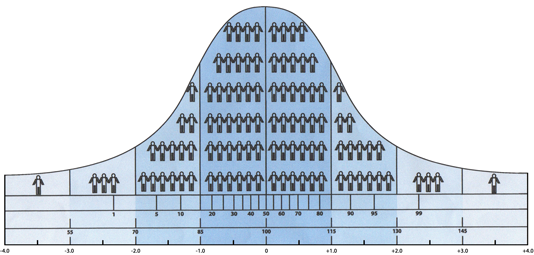
Some here may be standing off to the high side. A lot more than what you'd expect to find in general population. I do think manufacturers know this and design for the masses and for the high end. Engineers by nature over-design.
There's an old double blind study comparing tube versus transistor amps, and one test subject could always hear the tube amp. So the researchers dug a little deeper and found the tube amp had some problems with inter-modulation distortions. When they fixed it the test subject could no longer tell a difference. Others could never hear the IM distortion or just didn't care.
There just may be some artifact that the bulk of the people don't hear, or don't care about that the golden ears can always hear. I don't know what it is as modern test equipment today far exceeds capabilities of human hearing. But makers aren't spending a lot of time on the extreme ends. There's not a lot of potential customers there.
Some here may be standing off to the high side. A lot more than what you'd expect to find in general population. I do think manufacturers know this and design for the masses and for the high end. Engineers by nature over-design.
There's an old double blind study comparing tube versus transistor amps, and one test subject could always hear the tube amp. So the researchers dug a little deeper and found the tube amp had some problems with inter-modulation distortions. When they fixed it the test subject could no longer tell a difference. Others could never hear the IM distortion or just didn't care.
There just may be some artifact that the bulk of the people don't hear, or don't care about that the golden ears can always hear. I don't know what it is as modern test equipment today far exceeds capabilities of human hearing. But makers aren't spending a lot of time on the extreme ends. There's not a lot of potential customers there.
Class D for convenience of size weight and features.
TC RH450 main head.
GK MB 500 for a back up amp.
TC RH450 main head.
GK MB 500 for a back up amp.

Well you should have a gauge of wire that isn't too little for the job, and I have nothing against quality wire with quality connectors. But considering our buildings are plumb full of the cheapest 18 ga wire known to man and don't usually spontaneously catch fire, I'm fine with any cable that meets UL spec for the job it's doing.While I TOTALLY agree that $200 AC cables are B***S***... there is absolutely a difference in a $2 one and a proper $25 one that will still likely not SOUND better (at least to the human ear) but will let your amp run a LOT more happily and for a longer time at a lower temperature. The larger conducters and better construction (more flexible) will make it heat up less and more capable over time of providing the added juice that loud transients demand.
- Feb 12, 2006
- 60,989
- 5
- 220,789
- Disclosures
- Development Engineer-Mesa Boogie, Development Engineer-Genzler (pedals), Product Support-Genz Benz
Absolutely! I've worked with vinyl for decades and the higher distortion, lower dynamic range, higher noise floor, not to mention horrible cross-talk, are all inferior to CD audio.And anyone who thinks that vinyl contains "more information" than CD is fooling themselves. More distortion, yes. More information? Nope. And before anyone takes umbrage, I am an unabashed lover of vinyl (and tubes and classic amp designs, etc.) and I definitely think vinyl sounds better than CD but I'm not under any false impressions of why that is. It sounds better because it's technically inferior, essentially. "Better" in that I like the set of distortions it adds. YMMV, of course.
That said, some folks like additional distortion which kind of flies in the face of the marketing and personal opinions on the subject, but often folks actually prefer one thing in spite of saying that they prefer something else, usually because they don't know the real details behind what they think they prefer. In some regards, this is why hyperbolic marketing works so well.
- Feb 12, 2006
- 60,989
- 5
- 220,789
- Disclosures
- Development Engineer-Mesa Boogie, Development Engineer-Genzler (pedals), Product Support-Genz Benz
Close Jimmy, and your postulation that the building wire contributes to the total power circuit is completely correct, but building wire (in the US and Canada) must be a minimum of 14 gauge for 15A circuits and 12 gauge for 20A circuits. What is important is the TOTAL circuit impedance, and since length plays a major role in this, the wire size must be larger (even if 18 gauge is adequate for a shorter distance).Well you should have a gauge of wire that isn't too little for the job, and I have nothing against quality wire with quality connectors. But considering our buildings are plumb full of the cheapest 18 ga wire known to man and don't usually spontaneously catch fire, I'm fine with any cable that meets UL spec for the job it's doing.
Absolutely! I've worked with vinyl for decades and the higher distortion, lower dynamic range, higher noise floor, not to mention horrible cross-talk, are all inferior to CD audio.
That said, some folks like additional distortion which kind of flies in the face of the marketing and personal opinions on the subject, but often folks actually prefer one thing in spite of saying that they prefer something else, usually because they don't know the real details behind what they think they prefer. In some regards, this is why hyperbolic marketing works so well.
I am considering marketing a new device. It will basically be a box with an Amazon fire stick in. You will connect your record desk to it, and it will use Shazam to work out what you are playing, stream at FLAC of it from Amazon, and apply a filter to it to degrade the quality, and lift the needle 1mm off the vinyl to preserve it. $1500 msrp.
Have you ever felt the top of your amp running off of an excessively long (or thin) extension cord? Same diff. And while the spec may be spec'd the accountants/purchasers are likely to get the worst cable that will turn the amp on - same as the "guitar cables" that come in your case they DO work but they're of such low grade that they only work at an acceptable level for a very short time - in the case of an instrument cable, it adds noise or degrades your sound, in the case of a power cord, it adds resistance which makes the amp run hotter because the amp and cord are a system the same way the amp and bass are a system.Well, once a power cable meets the designer's specifications (assuming they are well though out), and passes agency safety criteria, any difference beyond this is so far to the right of the decimal point as to be virtually immeasurable. It will have zero effect on the temperature the amp runs at.
Again - I said you'd never hear it - but your amp will not be happy - also note I talked about over time - it may meet spec off the shelf - but the cheap ones break down more quickly meaning they DON'T meet spec after not so many gigs.
Close Jimmy, and your postulation that the building wire contributes to the total power circuit is completely correct, but building wire (in the US and Canada) must be a minimum of 14 gauge for 15A circuits and 12 gauge for 20A circuits. What is important is the TOTAL circuit impedance, and since length plays a major role in this, the wire size must be larger (even if 18 gauge is adequate for a shorter distance).
Back in the 90s I played places that I'm pretty sure didn't meet electrical safety specifications and whilst I liked to use an RCD many times the sound engineer implored me to remove it due to it tripping my safety tested amp, and so I presume it was venue wiring. To be fair I started using an RCD after a failed and spectacularly burning tube amp apparently nearly sent 415 volts in to me.
These days venue wiring is much safer.
Thank you for the correction, Andy. It's still the cheapest wire known to man that they useClose Jimmy, and your postulation that the building wire contributes to the total power circuit is completely correct, but building wire (in the US and Canada) must be a minimum of 14 gauge for 15A circuits and 12 gauge for 20A circuits. What is important is the TOTAL circuit impedance, and since length plays a major role in this, the wire size must be larger (even if 18 gauge is adequate for a shorter distance).
but I did get the gauges wrong.
You are confusing the gauge of the wire with the quality of the wire.Have you ever felt the top of your amp running off of an excessively long (or thin) extension cord? Same diff. And while the spec may be spec'd the accountants/purchasers are likely to get the worst cable that will turn the amp on - same as the "guitar cables" that come in your case they DO work but they're of such low grade that they only work at an acceptable level for a very short time - in the case of an instrument cable, it adds noise or degrades your sound, in the case of a power cord, it adds resistance which makes the amp run hotter because the amp and cord are a system the same way the amp and bass are a system.
Again - I said you'd never hear it - but your amp will not be happy - also note I talked about over time - it may meet spec off the shelf - but the cheap ones break down more quickly meaning they DON'T meet spec after not so many gigs.
Thank you for the correction, Andy. It's still the cheapest wire known to man that they use
My next product idea is high quality power wiring for your house ($100 per foot) for enhanced listening pleasure
This sounds more like a case where an AC cable doesn't meet gauge spec for the job it's doing. I've never had this problem with a cable that meets spec.Have you ever felt the top of your amp running off of an excessively long (or thin) extension cord? Same diff. And while the spec may be spec'd the accountants/purchasers are likely to get the worst cable that will turn the amp on - same as the "guitar cables" that come in your case they DO work but they're of such low grade that they only work at an acceptable level for a very short time - in the case of an instrument cable, it adds noise or degrades your sound, in the case of a power cord, it adds resistance which makes the amp run hotter because the amp and cord are a system the same way the amp and bass are a system.
Again - I said you'd never hear it - but your amp will not be happy - also note I talked about over time - it may meet spec off the shelf - but the cheap ones break down more quickly meaning they DON'T meet spec after not so many gigs.
No, I'm not. Guage is size and affects resistance and capacitance. Quality is a mixture of features that will tend to include guage but will also include the type of braid and flexability - which will affect long term functionality.You are confusing the gauge of the wire with the quality of the wire.
Also... note I did start my post by saying that anyone who buys into "high-end" power cords is an idiot. I also believe that a $25 cord (also remember I'm in Canada, so we pay more for everything) is a rip off, but the cheap one's are trash. Or become it very quickly

Perhaps the tube preamp designs such as my G-B Shuttle 6.2 are not adequate for the ears of others, but I cheerfully crank up the gain on my preamp to near maximum, and the resulting sound is plenty warm and period-appropriate to my ear. I play blues and classic rock, and to my ears the tube OD sound provided by pushing the Shuttle preamp gain is very pleasing.


