• TalkBass has been independent since 1998. Add your voice.
    Create a free account to reply to discussions, view embedded media, and browse with fewer display ads.
    Join freeLog in
    Want zero display ads or expanded classifieds tools? Compare plans.

Are jazz bass necks too small?

I may have girly hands, but I have VERY long fingers, and have hypermobility. (if I hold my hand up to most average6' tall guys, my whole hand with fi gers are often the same overall length, sans thumb.)

No one is born with a bass fretting hand. It will feel small, but it will be fast. It's good to be able to switch as well, in case something happens at the worst moment.

 
image.png
image.png


I'll just drop this here for ya'! :D
 
If you have small hands, then the jazz neck will feel just right. My classic stingray 5 had a 1.44mm neck width. My favorite bass luthier (Christopher Royce), rescaled my 5 string neck to the popular 1.38mm nut width. (the jazz bass nut width). And now, she handles like a dream. So I would say that for big hands the jazz bass neck size would be an issue; but Louis Johnson played a jazz bass on occasion and you know how big his hands are!!!

1.44mm nut? That's a mighty thin neck! ;)
 
  • Like
Reactions: pcake
You could put a Precision neck on the Jazz body.

Absolutely! Put a P neck on a J body!

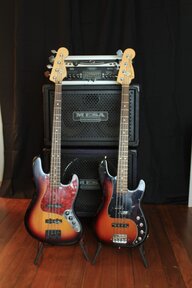
Answer to the thread..............for me, YES!............the J neck is too small and skinny. I had a Geddy MIJ Jazz Bass for about 3 weeks. (Sold it!) I just hated that neck so much! Felt like something a 14 yrs old kid would play.

The paradox with a Jazz Bass neck is that they are a 1/4 of an inch narrower at the nut than a P neck but @ the 20 fret, they are the same width. Around the 7th or 8th, it just doesn't feel so narrow anymore.

But, I'm not knocking a J neck. For others, it might be their "cup of tea".
 
I'd be interested to know which has the higher occurrence of the Fender ski jump and other neck issues: P or J. At a certain point, the P neck has more wood to it, so it's stronger right? However, maybe its "strength" actually works against the truss rod in some cases, making the thinner neck actually more stable since the rods will have more control. I have no idea, nor any dog in the fight, but it's interesting.
 
About 5 years ago I found a 2007 Squire P-bass at a pawn shop that was going out of business. While playing around making sure every thing worked I noticed it had a jazz size neck. Looked at the head stock and it said Squire Precision so it was the right neck & since I like jazz necks I scoped it up for $95
 
Just received my first Jazz bass, the neck was off so I sat there for no kidding a hour thinking do I put the standard P bass neck(1.620"nut) on or this Jazz neck (1.500"nut) on? well .... told myself you need a open mind, so I put the Jazz neck on, and then the strings and started practicing, and with a very surprised face and saying "hey this is not too bad", Wow I could easily go down the neck to the 20 fret without spreading my paws too much, this got so good to me I then decided to change out my P bass to a standard neck 1.62" nut, and now I have a 1.750" wide neck that I need to figure out what to do with?
Now this may sound a bit nutty or not, the wider necks I was running larger diameter strings, and they felt comfy, I then noticed the jazz bass came with these lighter small diameter strings and that seemed to aid in the comfort of playing, I look at this way, when I had the 1.750" neck on I ran meds 105-55 and my 1,620" neck were 100-45 and the Jazz runs .095-.040, then again I do not know if this is part of my ease of playing, yeah I know we are only talking about .005" to .010" difference in string sizes.
 
Last edited:
Okay wow. Mine is the top right one in the chart on the right. I think it is too thin. Thanks for the chart.
I definitely don't think that the '60 J U-Shape neck is thin. If you see the depth measurements, it features the same as the '60 P Oval C-Shape; it is just narrower at the lower registers. Feels substantial to your hand.
 
I definitely don't think that the '60 J U-Shape neck is thin. If you see the depth measurements, it features the same as the '60 P Oval C-Shape; it is just narrower at the lower registers. Feels substantial to your hand.
To me it feels like a twig and it doesn’t seem to be able to handle the pressure of four bass strings.
 
  • Like
Reactions: Pbassmanca
Jazz Basses that feature even smaller necks have been in existence all those years, without any pressure-handle problem reported systematically. My CS '64 neck feels solid as rock. Even my CIJ Geddy (which series probably feature the thinnest necks ever made by Fender) was able to handle Rotosound RS77LD flats for years.
correct ... not much really to do in principle with the neck's cross sectional area per se ... variables involved are:

- distance from strings plane to neck cross section centroid.
- force in strings and strings gauge.
- neck wood quality.
- wood viscosity and time lapsef under constant loading.

of course a thick and wide 50s P bass neck of good quality maple has less chances of getting into a troublesome condition than a jazz bass neck of equiavalent wood, strings gauge and distance between strings plane and neck cross-section centroid
 
  • Like
Reactions: Midak