• TalkBass has been independent since 1998. Add your voice.
    Create a free account to reply to discussions, view embedded media, and browse with fewer display ads.
    Join freeLog in
    Want zero display ads or expanded classifieds tools? Compare plans.

Are Peterson strobe tuners worth the extra $$?

I use the Sonic Research ST300 and mini. LOVE them both! I had the switch pop issue (as mentioned earlier) from the full sized one in one venue. Never had the problem since. I also noticed they track the low strings best in chromatic mode.
A band mate used both Sonic Research and Peterson. He's currently using Peterson. Anyway, both of us agree these quality tuners are DEFINITELY worth it.
 
Literally no one listening to your music is going to know or care whether you tuned your bass with a fancy strobe tuner or a Boss TU-2. But if you are looking for super accurate and can "tell a difference", knock yourself out.
You are correct that nobody will know what you tuned up with however the immediate response of the Sonic Research Turbo Tuner (and I assume the Peterson ones are just as quick) actually make tuning up easier than with a pedal or clip-on that has some lag between plucking a string and giving a reading. There is literally no time lag with the good strobe tuners.

I'm on a bass, EADG. It depends on how you define barely moving, to me any movement means it's not in tune, too arbitrary for me, I'll stick with the D'Addario/Planet Waves Micro.
When the strobe tuners are "barely moving" you already have your tuning more accurate than when most tuners are showing it spot on.
I still have Planet Waves Micro clip on tuners on the headstock of most of my basses but I was getting frustrated when trying to tune up on some of my basses where there isn't much room on the headstock. Some areas on some headstocks (such as my Ibanez SR1200) just don't seem to vibrate enough at times to get a good reading. Added to that, tuning up in noisy environments was at times difficult. The Turbo Tuner has no such issues.
 
...Added to that, tuning up in noisy environments was at times difficult. The Turbo Tuner has no such issues.

The Micro tuners work off vibration not sound, as do all clip-on tuners I've ever used. I've never had interference from sound, even in a room of 30-40 uke players talking and tuning up. The only time I've seen that happen is when using an app on my phone, which only works by sound.
 
  • Like
Reactions: JoratioMumbles
The Micro tuners work off vibration not sound, as do all clip-on tuners I've ever used. I've never had interference from sound, even in a room of 30-40 uke players talking and tuning up. The only time I've seen that happen is when using an app on my phone, which only works by sound.

Yes, I do realise that they work on vibration which is why on some basses they will work fine clipped to one part of the headstock and won't work very well on other parts of the headstock. I have two basses where it is very difficult to get it clipped on an area that works well.

As for the noisy environments, ukulele's won't be an issue as their higher register won't make the neck of a bass vibrate, nor will loud talking or other noise like that.... however an electric guitar and/or drummer can cause vibrations in the neck of a bass to the point of the clip-on not being able to read properly. It is almost impossible to check your tuning with a clip-on while the guitarist is playing an intro to a song... no such issue with a pedal tuner.
 
Yes... and kinda. The Peterson is absolutely the best tuner on the market. (though there are a few strobe tuners that claim to be more accurate so, who knows) I have literally every edition of strobo stomp (Blue, Silver, Classic, HD). The sauce that makes it the best is setting up the intonation on your instrument with it, and using the 'Sweetened Tuning' for tuning. The sweetened thing makes a bit of a difference on bass, more so on guitar because of the B string. But here is the kinda part...
If you are not going to use the sweetened tuning, or other people in your band aren't using it, honestly the Peterson doesn't do anything that any other quality tuner will do. Under shootout conditions, all things being equal, all tuners were pretty much equal. And if you're the only person in the band using it and everyone else is using a Boss TU-2... Get a Boss TU-2. BUT!!! Having played in a band with 3 guitarists using 3 different brands and scale length guitars, that sweetened tuning thing cleaned up a lot of sonic problems and made the overall sound of the band...:bored: :eek: sweeter...:rage:
I agree, just using standard tuning, I tested this out with my strobe clip HD and my korg pitch black in strode mode. Tested both at the same time, and they are pretty much the same...
 
  • Like
Reactions: SLO Surfer
It will be more accurate to the point where you'll go nuts because you'll never be in tune unless you spend 10 minutes fine tuning each note.

For regular stage use I much prefer a fast&reliable Boss TU-3. For setting intonation at my workshop I prefer a Korg OT120. Strobe tuners are TOO accurate to have any practical purpose for my needs and just a waste of time IMO.
I disagree. I use a Petersen strobe clip-on, and I can tune my bass in less than 30 seconds. The strobe is easier to see when you are in tune on dimly lit stages, much easier to see than a needle on a meter. Simply bring your pitch up until the bars stand still. Easy.
 
I agree, just using standard tuning, I tested this out with my strobe clip HD and my korg pitch black in strode mode. Tested both at the same time, and they are pretty much the same...
I'll even double down on that. My time in music retail, we did a shoot out with the Strobo clip and a Snark. In EQU temperament mode on the Strobo Clip, it read the same as a Snark. What was interesting is seeing the differences in Sweetened mode compared to the Snark. A lot of people bag on the Snark, but honestly, it's as good as anything else on the market. I know guys have said they have a hard time getting a low B to track, I haven't experienced this, and I literally used it to tune hundreds of basses.
 
I've found the opposite with the Turbo Tuner. It reacts so quickly it is easy to tune up to the note without going over. While I can easily get each string tuned almost perfectly (where the strobe stops moving) you actually don't need to be that close. If the strobe is rotating a tiny bit you are already closer to perfect than with most headstock tuners and even most pedal tuners.
True, but many people's OCD won't allow for them to leave it slowly spinning. :)

But I totally agree. I've been using an ST-300 for years and it's just so quick and accurate, yet simple. So much so that when I go to my friend's place and use his clip-on Snark, I get so frustrated with how slow and twitchy it is.
 
Well, one can have the tuner lock in and indicate in tune when slightly out, or one can see how slightly out of tune they are. Both work; it just depends on your preference. I like the later so I can see just how far off perfectly in tune I am, and whether flat or sharp. Locking in quickly is not what I want. I like to decide what close enough is. I’m happy with the Peterson Strobostomp HD. YMMV.
 
  • Like
Reactions: JoratioMumbles
True, but many people's OCD won't allow for them to leave it slowly spinning. :)

This is where getting used to using it comes in to play. You can spend too much time fussing over getting it to stop turning completely, only to have it start turning again if you pluck the sting harder or softer, of if wearing the bass on a strap, move your body a bit. Once you've used one for a while, you'll know when it's good enough. They are so sensitive that good enough with a strobe tuner is still closer to pitch than most others. I have a Korg Pitch Black custom too, and have used many tuners over the years with various needle and LCD/LED displays. In most cases, that center "dot" has a lot of wiggle room. It's clearly good enough, but there is something very intuitive and satisfying about a strobe tuner.
 
  • Like
Reactions: JoratioMumbles
Well, one can have the tuner lock in and indicate in tune when slightly out, or one can see how slightly out of tune they are. Both work; it just depends on your preference. I like the later so I can see just how far off perfectly in tune I am, and whether flat or sharp. Locking in quickly is not what I want. I like to decide what close enough is. I’m happy with the Peterson Strobostomp HD. YMMV.
I agree. I'm happy with my tuning when it is either stopped or rotating counter-clockwise (flat) a tiny bit.... because as soon as I fret a note it is sharpened a small amount.

This is where getting used to using it comes in to play. You can spend too much time fussing over getting it to stop turning completely, only to have it start turning again if you pluck the sting harder or softer, of if wearing the bass on a strap, move your body a bit. Once you've used one for a while, you'll know when it's good enough. They are so sensitive that good enough with a strobe tuner is still closer to pitch than most others.

I realised that I didn't need for it to stop moving for it to be more than good enough when I was sitting on a chair tuning up one day. I had the bass sitting on my knee and the readout was moving counter-clockwise (flat) just a touch. I leaned back a little, the bass leaning back a little with me, and the strobe started moving clockwise very slowly. In other words, it is so accurate that simply tilting the bass back or forward will show a change in tune. Bottom line, don't let your OCD rule your life. On these tuners near enough is way more than good enough. :laugh: ;)
 
Equal vs Just Temperament.

In isolation it’s good to practice with a tuner for technical proficiency and playing a predicable pitch consistently in the same place.

When playing chordal music, tweaking your note slightly can actually sound better (after you’ve mastered the basics). That’s one of the reasons I love Fretless bass.

Equal Temperament Intonation Reference | Alex Yoder's Blog

The M2, P4, P5 & m7 intervals are very close to sounding in tune. (Memory tip: box pattern notes on fingerboard).

The m2, m3 and m6 intervals sound flat and can be sweetened by raising them a hair.

The M3, TT, M6 and M7 sound sharp and can be sweetened by flattening them a hair.

(Memory Tip:
- bring m3 & M3 closer towards each other. Same with m6 & M6.
- Take M7 & m2 (m9) away from each other ie. ‘stop crowding the root/tonic’).

temperament-intonation.png


eMCQP.png
 
Last edited:
  • Like
Reactions: JoratioMumbles
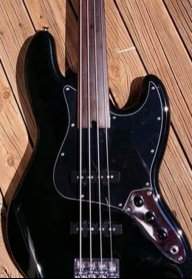
I play fretless, and use a tuner to monitor my stopping points on notes. I'm hoping that this will be more visible and accurate.
Practise this at home playing each individual note along the fingerboard, then with playing scales, then while playing songs (slowed down at first).

It’s slow and painful at first but once you’ve burnt it into your ‘muscle memory’ you have the skill for life. Be patient, it gets A LOT easier over time.
 
  • Like
Reactions: JoratioMumbles
I disagree. I use a Petersen strobe clip-on, and I can tune my bass in less than 30 seconds. The strobe is easier to see when you are in tune on dimly lit stages, much easier to see than a needle on a meter. Simply bring your pitch up until the bars stand still. Easy.

IMHO, 30 seconds is too much time to tune on stage.
 
  • Like
Reactions: byacey