

Enjoy the benefits of a premium membership!
Upgrade Account
-
TalkBass has been independent since 1998. Add your voice.
Create a free account to reply to discussions, view embedded media, and browse with fewer display ads.
Join free Log in
Want zero display ads or expanded classifieds tools? Compare plans.
You are using an out of date browser. It may not display this or other websites correctly.
You should upgrade or use an alternative browser.
You should upgrade or use an alternative browser.
AudioKinesis 112 Cab
- Thread starter KJung
- Start date
- Status
- Not open for further replies.
More options
Who Replied?I think it would work fine for PA; basically it's a little PA cab that's optimized for bass guitar. One possible problem is that it doesn't have a tophat on the bottom of the enclosure for pole mounting, and installing a tophat would be complicated because the bottom of the cabinet is occupied by the crossover. I'd have to split the crossover onto two boards and mount them on the sides, which can be done, I suppose - but my point is, installing a tophat is more complex than it would seem at first glance.
Home audio style inputs can be installed as an option, in addition to the Speakeron/quarter inch jacks. I use recorded music in the crossover design phase, and the cab is voiced a little bit brighter than most high-end home audio speakers. The reason is, more high frequency energy is lost to various causes in a prosound setting. In a home audio setting, I would recommend severe toe-in such that the axes criss-cross in front of the normal listening position. This helps with the brightness and results in good soundstaging and good tonal balance across a wide area.
Here's a shot of some of my home audio speakers that actually have the recommended 45 degrees of toe-in built into the design:
http://gallery.audioasylum.com/cgi/wi.mpl?u=2112&f=LoneStar2010.jpg&w=900&h=595
I'd be curious how other amplified instruments sound through the Thunderchild in a band practice setting, just in case there are other applications.
The 2x12 that's in the pipeline will perform better for PA in many settings, but it will be a lot heavier and more expensive. However JimmyM's intention to use it for vocals not only caused me to rework its crossover, but also influenced the crossover design of the Thunderchild. As it now stands Thunderchild probably has better midrange clarity than the cab JimmyM beta-tested, but the production version of the 2x12 will outperform Thunderchild in that regard.
I wasn't thinking of going that far into the PA realm, it just seems a pair and a powered mixer would make a pretty good Sub-less setup. KIck drum should be fine... I'm sure your flagship model will be a multi-purpose monster.
I'd imagine that Acoustic Guitar, violin, cello, and keys could all see use from your cabs.
Your site took a few hours of my life when I first found it, very impressive stuff. It made me twice as interested in this product. I notice you didn't have much geared towards theater rooms, is that on purpose? Do you have center channels that you have designed?
Slight thread dereail, in the Hi-Fi world there is this weird "cultish" sect who prefer these massive single driver, crossover-less speakers I don't understandI don't understand how they can cover the entire spectrum? Do you have any light to shed on the situation or do you think they are strange too? I see you idealogically go the exact opposite direction by concentrating on crossovers, as opposed to avoiding them like the plague.

Thanks, Duke! I had gone to a few CES shows in the mid to late '80s, plus the first Stereophile show in Santa Monica, I think in '87. I always loved those kind of shows (not the bigness of CES, but the individual hotel room demos). At the Stereophlie show I met some great folks like John Eargle, and Saul Marantz! 
 Saul was very nice but he clearly had no idea of what his namesake company was making after around the very early '70s.
Saul was very nice but he clearly had no idea of what his namesake company was making after around the very early '70s.
Passinwind
I know nothing.
- Dec 3, 2003
- 23,066
- 46,000
- Disclosures
- Designer/Toaster Tech @ Passinwind Electronics
I think it would work fine for PA; basically it's a little PA cab that's optimized for bass guitar. One possible problem is that it doesn't have a tophat on the bottom of the enclosure for pole mounting, and installing a tophat would be complicated because the bottom of the cabinet is occupied by the crossover.
You could do what I did on one of my dual purpose DIY cabs: use an external cup that mounts via t-nuts. No intrusion into the cab volume, and easily removable when not needed. I also managed to implement a tilt-back feature that worked perfectly for my needs. But wait, there's more...


Minor question, Duke: Is that a Line-X coating on Ken's cab? Or a Duratex coating?
Thanks,
MM
I'm reasonably certain it's Duratex.

there are a lot of gullible dopes in the hi fi world and a lot of opportunistic a-holes ready to take advantage of them. this is why you have $1000 patch cables, $500 wood knobs, and people selling bags of shiny rocks and claiming they have tremendous audio properties.Slight thread dereail, in the Hi-Fi world there is this weird "cultish" sect who prefer these massive single driver, crossover-less speakers I don't understandI don't understand how they can cover the entire spectrum? Do you have any light to shed on the situation or do you think they are strange too? I see you idealogically go the exact opposite direction by concentrating on crossovers, as opposed to avoiding them like the plague.

there are a lot of gullible dopes in the hi fi world and a lot of opportunistic a-holes ready to take advantage of them. this is why you have $1000 patch cables, $500 wood knobs, and people selling bags of shiny rocks and claiming they have tremendous audio properties.
Not to further derail, but this is irrelevant to the fact that even with their obvious limitations, there are some great-sounding relatively inexpensive single driver systems out there, many using DIY built horn cabs or even simple open baffles. They may not do justice to Metallica or Mahler, but they can arguably reanimate Miles and Mingus in your living room better then many high $$ multi driver designs.

- Nov 24, 2008
- 4,343
- 7,163
- Disclosures
- Owner & designer, AudioKinesis; Auth. mfg, Big E (Home Audio only)
Minor question, Duke: Is that a Line-X coating on Ken's cab? Or a Duratex coating?
Duratex, four coats. Two with a smooth roller and brush, and then two with the textured roller.
Your site took a few hours of my life when I first found it... I notice you didn't have much geared towards theater rooms, is that on purpose? Do you have center channels that you have designed?
I can do a center channel for anyone who wants one, but I've found that there is, relatively speaking, far less acceptance of small, tweaky "boutique" manufacturers in home theater than in two-channel. Home theater people tend to be less interested in investigating the technical side, preferring to follow the advice of the masses and the magazines. I'd rather build bass guitar cabs than try to break into home theater. You guys impress the hell out of me because you listen and think and really care about the sound, not to mention you are real live musicians, creators of the magical vibrations we call music, so I look up to every single one of you. It's that "blacksmith and the artist, each must know his part" thing Geddy sings about. You're an artist, I'm a blacksmith.
Slight thread dereail, in the Hi-Fi world there is this weird "cultish" sect who prefer these massive single driver, crossover-less speakers I don't understand how they can cover the entire spectrum? Do you have any light to shed on the situation or do you think they are strange too?
Well a bass guitar speaker sans crossover tries to reproduce the full spectrum, but the cone is too heavy and unsuitable and the voice coil inductance too high (which naturally rolls off the top end). If we make the cone light enough, maybe include a wizzer, and reduce the voice coil inductance, we have a "fullrange" driver. Here's an example from the Eminence catalog; it doesn't go all the way up because they didn't fix the voice coil inductance issue, which would have probably doubled the cost of the driver:
[Invalid or Expired Link Removed]
My first commercial product used a fullrange driver, augmented on top by a supertweeter and on the bottom by a built-in powered subwoofer. Since that was cheating, I called it the "Cheetah". Sadly the old bit of playground wisdom "Cheetahs never prosper" proved true; I only sold a few pairs. Like most fullrange driver based systems, it lost clarity on loud, complex passages. Great for "little girl with guitar", though.
More recently I was planning to introduce a fullrange-driver-based speaker at about the same time as my 45-degree baffle Rhythm Prisms. The parts cost was somewhat higher for the fullrange driver speaker, but the crossover didn't take as long to build.... Anyway, I listened to them side-by-side and to my amazement the two-way outperformed the single-driver across the board, including midrange and low-level detail. If there was a difference in coherence, it was insignificant. So I pulled the plug on my fullrange single-driver speaker. That being said, there are other manufacturers who do a much better job with fullrange drivers than I do.
Some of the best reasonably-priced fullrange driver speakers made today are manufactured by a company called Omega. Very refined, and their custom drivers have parameters that allow decent bass extension (unlike most fullrange drivers):
http://www.omegaloudspeakers.com/
I see you idealogically go the exact opposite direction [from fullrange drivers] by concentrating on crossovers, as opposed to avoiding them like the plague.
I'm taking a different road, but we're both trying to get to Rome.
I believe that most of what makes crossovers audible is stuff that's happening in the frequency response domain. The ear is relatively insensitive to phase issues; getting that right is icing on the cake, but it's more important to get the basics right. Where frequency response anomalies arise in the crossover region is from the radiation pattern mismatch; typically a woofer that is beginning to beam is crossed over to a very wide-pattern tweeter, and so the reverberant field has big glitch in it. Most of the sound we hear in most rooms is reverberant energy, so the tonal quality of the voice changes as we move through the crossover region. Single-driver speakers avoid this abrupt off-axis discontinuity. My designs likewise avoid or at least minimize the off-axis discontinuity because I try to match up the radiation pattern of woofer and horn where they cross over - and therefore hopefully render the crossover inaudible.
At the Stereophlie show I met some great folks like John Eargle...
John Eargle was one of the pioneers of the radiation-pattern matching concept that I just described above. Here's a paper on the subject that he and some of his cohorts at JBL wrote thirty years ago:
http://www.pispeakers.com/AES_v31_n6_p408.pdf
You could do what I did on one of my dual purpose DIY cabs: use an external cup that mounts via t-nuts. No intrusion into the cab volume, and easily removable when not needed. I also managed to implement a tilt-back feature that worked perfectly for my needs. But wait, there's more...
Great idea - THANKS!
...even with their obvious limitations, there are some great-sounding relatively inexpensive single driver systems out there, many using DIY built horn cabs or even simple open baffles. They may not do justice to Metallica or Mahler, but they can arguably reanimate Miles and Mingus in your living room better then many high $$ multi driver designs.
Well said. On the more expensive side, the best imaging I have ever heard, and one of the best speakers overall within its inevitable limitations, was based on a wizzerless field-coil-motor 8" fullrange driver made by a French company called Supravox.
It is really something. And, the price is in line with the other 'super 112s'. Surely not cheap, but not crazy, especially since this is designed to be a 'one cab solution'.
I wish I knew enough about crossovers to intelligently comment on this one. The only thing I can say is you would think this is one big speaker or something. A totally transparent transition from the driver to the horn.. really a bit disturbing when you are playing it looking at that big horn, yet hearing a smooth, organic sort of tone. Don't get me wrong... it goes all the way up to the sizzle area, but it is totally smooth and, well, 'good sounding'.
With the switch set at that 3.5K cut-off (if I have that right... I'm going to ask Duke to post up the nitty gritty on that stuff here), you would never know there is even a horn in this thing.
This is truly GREAT NEWS!
I experimented some time ago with a Meyer sound 2-way (self powered) cab in the hopes of realizing what Ken seems to be describing here.
Well, it did not work out in the end because I could 'hear the horn' ...just couldn't get away from the coloration it imparted.
THIS sounds like what I had hoped to achieve, and is why I plunked down some cash when I heard about it. I just could not accept that it could not be done, and Duke renewed my hopes after several discussions.
Everyone out there looking not to get buried in the mix, just think of the projection/articulation coverage and throw that this approach achieves. WOW! ... HUGE POTENTIAL HERE.
It's been attempted before but this implementation sounds like it finally does 'take the horn out of the horn, so to speak.
Can't wait to find out for myself when mine arrives in the next week or so


...
I expect my cab to play louder than most 1x12s but fall short of a 2x12. In displacement-limited output, it's roughly comparable to a 3x10.
...
My EA CX-310 is not your typical 3x10 -- I'd love to have a 1x12 that could keep up with it!
...
The 2x12 that's in the pipeline will perform better for PA in many settings, but it will be a lot heavier and more expensive. However JimmyM's intention to use it for vocals not only caused me to rework its crossover, but also influenced the crossover design of the Thunderchild. As it now stands Thunderchild probably has better midrange clarity than the cab JimmyM beta-tested, but the production version of the 2x12 will outperform Thunderchild in that regard.
Love to hear a bass guitar through one of those!
- Nov 24, 2008
- 4,343
- 7,163
- Disclosures
- Owner & designer, AudioKinesis; Auth. mfg, Big E (Home Audio only)
My EA CX-310 is not your typical 3x10 -- I'd love to have a 1x12 that could keep up with it!
The top and bottom woofer of the EA 310 look to me like they're not "typical" bass guitar woofers; they may well have considerably longer throw than normal, in which case my claim would not hold up.
My woofer has more linear displacement than any three stock Eminence 10" bass guitar speakers EXCEPT for the BP-104 series.
* * * *
Mothra2, thank you very much for having enough confidence in me and my approach to vote with your wallet and thus help me cover that initial production run of custom woofers. If my little cab fills a niche and helps keep me busy, I'll be a happy camper.
My woofer has more linear displacement than any three stock Eminence 10" bass guitar speakers EXCEPT for the BP-104 series.
In actual displacement limited output, three S2010s should be a smidgen louder than your woofer (guessing 1-2db) unless I am missing something crucial. Assuming 95db sensitivity and 450 watts displacement limited power handling I'm showing your woofer being 1 to 1.5db behind roughly.
That's a pretty darned good showing for a single 12" woofer, even moreso since it's 4 ohms and will be able to take all of what any previous generation micro head will put out (whereas a trio of basslites will wind up being a weird ohmage unless you customize them).
- Nov 24, 2008
- 4,343
- 7,163
- Disclosures
- Owner & designer, AudioKinesis; Auth. mfg, Big E (Home Audio only)
In actual displacement limited output, three S2010s should be a smidgen louder than your woofer (guessing 1-2db) unless I am missing something crucial. Assuming 95db sensitivity and 450 watts displacement limited power handling I'm showing your woofer being 1 to 1.5db behind roughly.
We're measuring with different yardsticks, and therefore getting slightly different results. Three S2010s have a linear displacement of 420 cubic centimeters, and my woofer has a linear displacement of 496 cubic centimeters. That's what I was going by.
We're measuring with different yardsticks, and therefore getting slightly different results. Three S2010s have a linear displacement of 420 cubic centimeters, and my woofer has a linear displacement of 496 cubic centimeters. That's what I was going by.
Right, similar displacement, difference is sensitivity (real sensitivity of 3 S2010s is around 98db-ish, closer to that of a 3015LF than a 3012LF). Displacement limitations never tell the whole story.
That said: The 3x10 figure is dead on in approximate max output, as most vendors are not going to use a driver as good as the Basslite. You'll see stuff like a Beta, or a Beta with increased xmax and decreased sensitivity, etc. Or the previous generation of deltalite in some cases.
it's possibly the most unique cab design i've ever seen, at least in MI world. here's what will happen...you will see it and think, "there's no way in hell it's going to work." then you'll hear from me that it actually does work exactly like duke claims, then you'll fly to florida and make me let you play through it, and then you'll believe itLove to hear a bass guitar through one of those!
The top and bottom woofer of the EA 310 look to me like they're not "typical" bass guitar woofers; they may well have considerably longer throw than normal, in which case my claim would not hold up.
My woofer has more linear displacement than any three stock Eminence 10" bass guitar speakers EXCEPT for the BP-104 series.
* * * *
Mothra2, thank you very much for having enough confidence in me and my approach to vote with your wallet and thus help me cover that initial production run of custom woofers. If my little cab fills a niche and helps keep me busy, I'll be a happy camper.
Yeah, they're really subwoofers (looks like they have butyl (sp?) rubber surrounds. The center 10" is a coax, so the cab is sort of a 2.5-way cab with a transmission line enclosure.
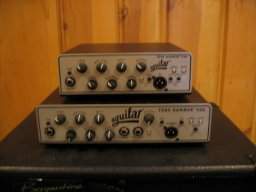
Yeah, they're really subwoofers (looks like they have butyl (sp?) rubber surrounds. The center 10" is a coax, so the cab is sort of a 2.5-way cab with a transmission line enclosure.
I had the 210 version of that cab for a while. Yes, combination of the old hi xmax type drivers from the old VL line, and then a full range, more typical midrange voiced coax driver. There was no attenuator to balance the mid driver and low freq drivers. Nice sounding box, weighed a TON (I think my CXL210 was almost 80 pounds.... ridiculous.
Sounded OK to me.
To all those talking about volume, I expect this cab to perform at about a 210 level (i.e., between a typical 112 and a 212 in volume). It sure will get a bit deeper than many 210's I've owned, but of course, there is a price to pay for deep low end voicing in a small box.
Having spent quite a few hours with the other super 112's (a number of LDS 3012LF based 12/6 boxes, and the Bergantino HT112ER), these should all be viewed as VERY good 112 boxes, not something 'otherworldy' or 'shocking' regarding performance.
That being said, a 34 pound small box that can go lower than most 210's and generate the same or higher max SPL with a deeper fuller low end makes me VERY happy.
Also, I prefer the higher crossover (hence more paper cone upper mids) of Duke's design versus the typical 12/6 build. This cab has a bit more warmth and 'character' that the 12/6's I've played, which are very, very smooth and almost too organic for my tastes, especially in the upper mids.
Now that I'm back in town, I'll put up a clip later today. This cab definitely compares well to the amazing but heavier Bergantino HT112ER, and the four or five 12/6 and 12/6/1 cabs I've played (and I like the tone better than both those cabs for my tone goals), and it is smaller and lighter and about the same price as all of them.
Is it going to replace my 410 or 212? No. Will it allow me to take a MUCH smaller cab than usual to a variety of gigs and still sound good? Yes!
Having spent quite a few hours with the other super 112's (a number of LDS 3012LF based 12/6 boxes, and the Bergantino HT112ER), these should all be viewed as VERY good 112 boxes, not something 'otherworldy' or 'shocking' regarding performance.
That being said, a 34 pound small box that can go lower than most 210's and generate the same or higher max SPL with a deeper fuller low end makes me VERY happy.
Also, I prefer the higher crossover (hence more paper cone upper mids) of Duke's design versus the typical 12/6 build. This cab has a bit more warmth and 'character' that the 12/6's I've played, which are very, very smooth and almost too organic for my tastes, especially in the upper mids.
Now that I'm back in town, I'll put up a clip later today. This cab definitely compares well to the amazing but heavier Bergantino HT112ER, and the four or five 12/6 and 12/6/1 cabs I've played (and I like the tone better than both those cabs for my tone goals), and it is smaller and lighter and about the same price as all of them.
Is it going to replace my 410 or 212? No. Will it allow me to take a MUCH smaller cab than usual to a variety of gigs and still sound good? Yes!

To all those talking about volume, I expect this cab to perform at about a 210 level (i.e., between a typical 112 and a 212 in volume).
Is it going to replace my 410 or 212? No. Will it allow me to take a MUCH smaller cab than usual to a variety of gigs and still sound good? Yes!
So DUKE; With Ken's above comments in mind, and revisiting the 8 Ohm option, what sonic differences would be heard with the 8 Ohm (3012LF) version?
Roughly 5%-10% of my yearly gigs are outdoor festival type affairs with FOH support, of course. I can usually get the job handled using just my Goliath 4x10, but with a compact cab, I would need to shore up the bass output with an additional cab such as a single 3015, or perhaps build a similarly sized cab with another 3012 or 3012LF. My amps all have a 4 Ohm minimum, and plenty of power (up to 800 w at 4 Ohms).
So DUKE; With Ken's above comments in mind, and revisiting the 8 Ohm option, what sonic differences would be heard with the 8 Ohm (3012LF) version?
Roughly 5%-10% of my yearly gigs are outdoor festival type affairs with FOH support, of course. I can usually get the job handled using just my Goliath 4x10, but with a compact cab, I would need to shore up the bass output with an additional cab such as a single 3015, or perhaps build a similarly sized cab with another 3012 or 3012LF. My amps all have a 4 Ohm minimum, and plenty of power (up to 800 w at 4 Ohms).
I'll throw a comment out here that maybe Duke can react to with regard to your question. The 12/6's I've played (a bit larger boxes, with the stock 3012LF (8ohm) and a mid driver crossed at about 800hz) had less SPL than Duke's box (I assume due to the 8ohm versus 4ohm difference with my little micro heads), less 'punch' in the mid mids, and a bit more low end extension when playing below the D note on the B string.
Two of the 8ohm 3012LF based 12/6's with a lot of power could EASILY outperform a 410 in the low end and max SPL in general (I've done this A/B with a couple of the LDS 212/6/1 4ohm cabs with dual 3012LFs... HUGE sounding... and a very large box... there is a clip on my Youtube channel of a 'red' one!), but of course would sound much different than your 410 (deeper, smoother, less punchy, less grindy).
I don't think there really is any 'free lunch' here. Duke seems to have given up a touch of the deepest low end in his design in order to provide good SPL with moderate power and a small, lightweight box. Since he still has that huge xmax sort of thing in that driver, the 'specialness' of Duke's small 112 is not (IMO) the absolute low end extension to 'Acme B210' levels, but rather that the box just HAMMERS out the transients without compression, and provides a relatively deep low end response versus many other 'typical 112's (along with, I assume, a bit better dispersion of the upper mids and also one heck of a smooth crossover that gives a glorious sound to the top end of the instrument). Pretty cool.
- Status
- Not open for further replies.


