
Enjoy the benefits of a premium membership!
Upgrade Account
-
TalkBass has been independent since 1998. Add your voice.
Create a free account to reply to discussions, view embedded media, and browse with fewer display ads.
Join free Log in
Want zero display ads or expanded classifieds tools? Compare plans.
You are using an out of date browser. It may not display this or other websites correctly.
You should upgrade or use an alternative browser.
You should upgrade or use an alternative browser.
AudioKinesis Cabs Part VI...
- Thread starter Thor
- Start date
More options
Who Replied?
Recessing the side drivers makes sense for ease of transport. I don't think you need to recess the front ones. It looks good the way it is.
One plus to recessing is that it makes it easier to measure for a cover. Not a big deal though.

- Apr 3, 2003
- 35,516
- 19,950
- Disclosures
- Editor-in-Chief, Bass Gear Magazine
I got into working on the switch... and, it turned into two switches: one to smooth the 1-2 kHz octave, and another to smooth the mids' top end (there is also some emphasis from 4-6.5 kHz which stands out a bit more once we smooth the 1-2 kHz region).
Perfect!


- Apr 3, 2003
- 35,516
- 19,950
- Disclosures
- Editor-in-Chief, Bass Gear Magazine
How would a 2x1203 stack compare with a single 1855? A 1544?
I actually did those exact comparisons a little ways back in this thread, starting about page 28 (with a few random thoughts appearing sooner).
I was able to spend some time last night comparing the Baer ML-112 to the 1203, and then, briefly, to the 1855, as well.
The ML-112 is bigger and deeper in the lows than the 1203, and it really hammers nicely on a low B. Of course, it's a much larger enclosure than the 1203, so no real surprise. The 1203 is a bit more warm/round, and totally keeps up with the larger Baer on the E string (possibly even a tad more full on the E and D strings). The upper mids have a lot of similarities, with the 1203 being a bit more smooth and laid back, and the ML a bit more precise and clear. The treble is a bit more present on the Baer, as well. Both cabs held up very well to getting slammed by my MB Fusion 800 (I was playing an MTD 535). The 1203 gets a tad more warm (in a good way) when really cranked.
Breaking out the 1855, is is more massive and dynamic down low - and also more aggressively articulate - when compared to the ML-112. The ML, in turn, is smoother than the 1855. In fact, the ML-112 in many ways sounded like a midway point between the 1203 and the 1855 in regards to relative smoothness, low end, and aggressiveness of the upper mids/treble region.
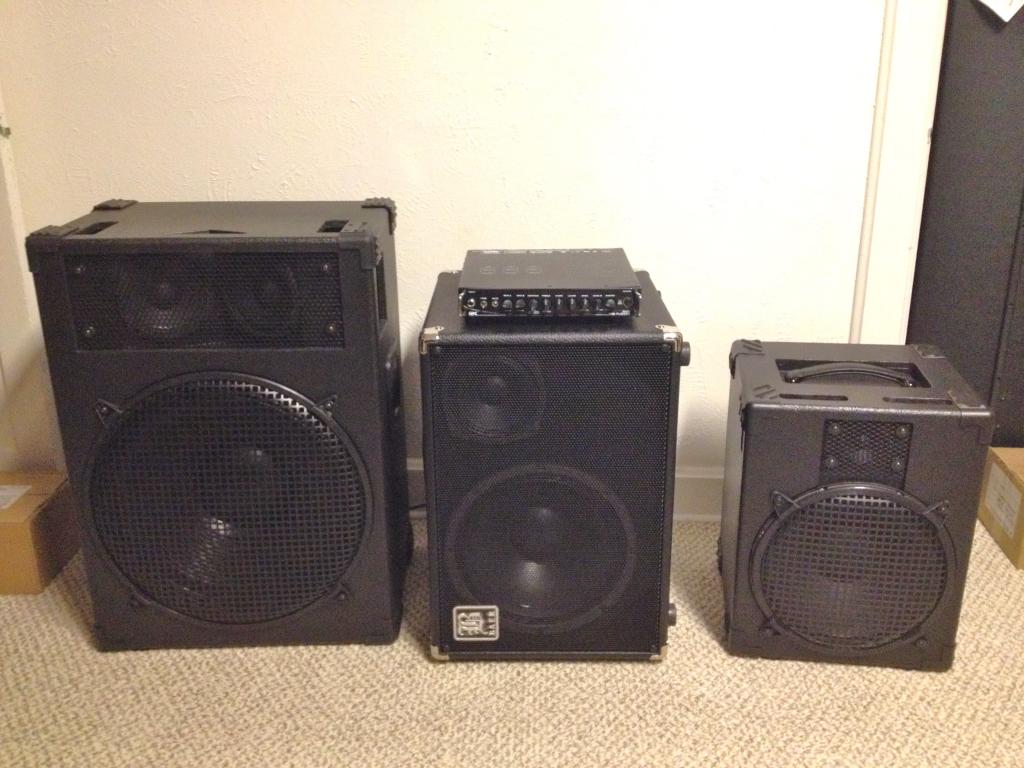
Here is a quick iPhone pic showing the relative size of the three cabs:
__________________
- Apr 3, 2003
- 35,516
- 19,950
- Disclosures
- Editor-in-Chief, Bass Gear Magazine
Here's a bit more from an e-mail I sent to Duke (hope you don't mind me sharing, Duke!):
Comparing the 1855 to the double 1203 stack, the 1855 has tighter, slightly bigger, almost growly lows. Very nice, and very addicting! The 2x1203 stack is a bit more warm/round down low, with more bloom. This can also be very nice in the right situation, and some folks will certainly prefer this kind of low end presentation.
Moving on to the midrange, this is where the meat of the story lies, and itll take some time to suss out the details. At first, the 1855 sounded more lean in the mids, but I think this is just the lower to middle mids. It is definitely more articulate and more present the upper mids. The more I played around, the more I felt like the 1855 had more peaks and valleys in the mids and the 1203s were more consistent and balanced. One big caveat is that this initial round of testing was all done from a seated position a few feet in front of the cabs. I am guessing that as I move around, the perceived mids (and the relative balance through the mids) may vary quite a bit.
The high end (which might technically be the upper mids not sure on this one) between the two was probably their most similar feature. The 1855 is a tad more pure and clean, and the 1203s seemed to have more harmonic content through the highs. Both setups leave you wondering why youd ever need a horn.
Now, things got interesting when I switched from my MTD 535 (a two-pickup, active bass) to my Carvin PB5 (a passive P-bass). The 1855 became much more burpy/growly and has a lot more upper mids. The 1203s were much more round and smooth by comparison. This was not a subtle transition, and I view this as a credit to the cabs (both the 1855 and the 1203s) abilities to reflect the character of the signal being fed to them. In fact, the 1855 may be the best-performing cab that I have ever tried in this regard. First impressions can be misleading, mind you, but out of the gate, I was floored by its ability to just entirely transform its sound when switching instruments. The only potential downside to this is that if a player hears this cab at a GTG or demos one at home, unless he/she tries a variety of basses (and Im guessing, amps) with the cab, they may not really get to know its capabilities.
Comparing the 1544 to the 1855 or the two 1203s, the 1544 just sounds boxy and thin. With the right head (something big and meaty), this cab can sound great especially when you throw some overdrive at it. But when I compare it to your other cabs, I definitely prefer the 1855 and 1203.

Great to hear that little cab's still working for you! I think your cab was retrofitted with the Acoustic Friendly rear-firing tweet - is that correct?
Yep! Although the Hathor 1203 is tempting me for rock bass gigs.
knuckle_head
Commercial User
- Jul 30, 2002
- 2,621
- 58
- Disclosures
- Owner; Knuckle Guitar Works & Circle K Strings
If I may chime in . . .
I've been enthralled with/by the 1855 since we gave it a run on Sunday. Tuned as low as the Quake was (and has been for several months) I have not had the option of hearing what I approximate as half the sound the G# was making. The 1855 gave me pitch AND tonality that I always knew was there but has only ever been present in a line feed - not full signal obviously, but more than any single cab has given back, like, ever. Ask Spencer! - he walked up as we were playing through it and it stopped him dead in his tracks.
If I am to become a gigging bassist again I want/need this . . . I'm old and awfully busy but hope springs eternal.

I've been enthralled with/by the 1855 since we gave it a run on Sunday. Tuned as low as the Quake was (and has been for several months) I have not had the option of hearing what I approximate as half the sound the G# was making. The 1855 gave me pitch AND tonality that I always knew was there but has only ever been present in a line feed - not full signal obviously, but more than any single cab has given back, like, ever. Ask Spencer! - he walked up as we were playing through it and it stopped him dead in his tracks.
If I am to become a gigging bassist again I want/need this . . . I'm old and awfully busy but hope springs eternal.

Passinwind
I know nothing.
- Dec 3, 2003
- 23,075
- 46,022
- Disclosures
- Designer/Toaster Tech @ Passinwind Electronics
If I may chime in . . .
I've been enthralled with/by the 1855 since we gave it a run on Sunday. Tuned as low as the Quake was (and has been for several months) I have not had the option of hearing what I approximate as half the sound the G# was making. The 1855 gave me pitch AND tonality that I always knew was there but has only ever been present in a line feed - not full signal obviously, but more than any single cab has given back, like, ever.
If I am to become a gigging bassist again I want/need this . . . I'm old and awfully busy but hope springs eternal.
Hey Skip: as much as Duke says his cab is/was the bottleneck, on the amp side I could definitely program in a different HPF that'd buy more lows, albeit with the usual tradeoffs that you are so aware of. IIRC the setting we used is a compound curve set in the software at something like -3dB @ 22Hz, but I've never actually measured that, as that requires special tools I don't own myself. The tube preamp could be massaged at that end too, as I think I mentioned.
Anyhow, I've heard a number of your basses through various rigs before and this was a whole different thing, very cool!
knuckle_head
Commercial User
- Jul 30, 2002
- 2,621
- 58
- Disclosures
- Owner; Knuckle Guitar Works & Circle K Strings
We have always been fundamentally deprived - and I don't think that's going to change much no matter HOW good the cabs are.
I don't know that the HPF needed/s massaging given the rig as this particular application goes - the cab wasn't giving us 22 Hz back so why make the amp work that hard?
. . . unless you mean raising it in order to address the roll-off the 1855 has on bottom.
I am indeed finding the restriction to this kind of stuff is in the pre - very, very few designers/engineers scope to human threshold, let alone beyond it. But then, practically speaking, why would you . . . . I know a few who do - you do too - and their gear is very worth owning.
I don't know that the HPF needed/s massaging given the rig as this particular application goes - the cab wasn't giving us 22 Hz back so why make the amp work that hard?
. . . unless you mean raising it in order to address the roll-off the 1855 has on bottom.
I am indeed finding the restriction to this kind of stuff is in the pre - very, very few designers/engineers scope to human threshold, let alone beyond it. But then, practically speaking, why would you . . . .
I know a few who do - you do too - and their gear is very worth owning.
Passinwind
I know nothing.
- Dec 3, 2003
- 23,075
- 46,022
- Disclosures
- Designer/Toaster Tech @ Passinwind Electronics
We have always been fundamentally deprived - and I don't think that's going to change much no matter HOW good the cabs are.
I don't know that the HPF needed/s massaging given the rig as this particular application goes - the cab wasn't giving us 22 Hz back so why make the amp work that hard?
. . . unless you mean raising it in order to address the roll-off the 1855 has on bottom.
Quite possibly. I just meant that the DSP setting was optimized for another cab a long time ago and I could maybe do better by your and Duke's stuff. You guys are the stars here and my role is stay out of the way. What am I, the bass player? Oh, wait...
I am indeed finding the restriction to this kind of stuff is in the pre - very, very few designers/engineers scope to human threshold, let alone beyond it. But then, practically speaking, why would you . . . .
Yep. I have a fairly deep background in ultrasonics and a lot of my thing is about tweaking that end of the spectrum, but I always enjoy discussing your quandary and trying to help things along a little where I can.

Oi... I thought I had it all figured out with the Berg CN212, now I'm going to have read through all of these threads to find out more info on the TC212. Modern problems!
The TC212 is a great cab. I've had mine for about a year now and it sounds fantastic. At under 40 pounds transporting is a breeze.
Attachments

That's lighter than the Berg... plus one to the TC212...
I had mine made with the composite material hence the weight. Mike doesn't handle that material anymore due to health reasons. He makes a nice cab!

Passinwind
I know nothing.
- Dec 3, 2003
- 23,075
- 46,022
- Disclosures
- Designer/Toaster Tech @ Passinwind Electronics

I think Recessing Drivers is playing Coachella this year...
i heard they cancelled. four-legged photo is getting their slot.
They're both a couple of Fartout Threshold wannabes.


The wood TC212 weighs in the mid-40s and is very easy to move around. Awesome cab.
I have my 4th Audiokinesis cab due to arrive today and after reading this thread, I feel way behind! I'm still in the 3-digit models (e.g., TC115) and love the original smoothness and balance.
Duke - you gotta update that website of yours.
Can't wait to try a TC118 if someone wants to part with theirs.
I have my 4th Audiokinesis cab due to arrive today and after reading this thread, I feel way behind! I'm still in the 3-digit models (e.g., TC115) and love the original smoothness and balance.
Duke - you gotta update that website of yours.
Can't wait to try a TC118 if someone wants to part with theirs.


