
Enjoy the benefits of a premium membership!
Upgrade Account
-
TalkBass has been independent since 1998. Add your voice.
Create a free account to reply to discussions, view embedded media, and browse with fewer display ads.
Join free Log in
Want zero display ads or expanded classifieds tools? Compare plans.
You are using an out of date browser. It may not display this or other websites correctly.
You should upgrade or use an alternative browser.
You should upgrade or use an alternative browser.
AudioKinesis Cabs Part VI...
- Thread starter Thor
- Start date
More options
Who Replied?
Gift card sure is nice though, isn't it?I heard back from Duke, and it looks like I'll order a TC212 as soon as I have the balance of the purchase price.
 . So glad you're getting one - I think you'll enjoy it beyond belief!
It sure is! I just can't pass that up. After learning a little bit more about them I really like the idea of the 'smooth mids' switch. I really don't like mid/high-mid forward sound and the extra ability to control mids is right up my alley.

I heard back from Duke, and it looks like I'll order a TC212 as soon as I have the balance of the purchase price.
I think you'll be very pleased with Duke's work!

- Nov 24, 2008
- 4,343
- 7,163
- Disclosures
- Owner & designer, AudioKinesis; Auth. mfg, Big E (Home Audio only)
If I may chime in . . .
I've been enthralled with/by the 1855 since we gave it a run on Sunday. Tuned as low as the Quake was (and has been for several months) I have not had the option of hearing what I approximate as half the sound the G# was making. The 1855 gave me pitch AND tonality that I always knew was there but has only ever been present in a line feed - not full signal obviously, but more than any single cab has given back, like, ever. Ask Spencer! - he walked up as we were playing through it and it stopped him dead in his tracks.
If I am to become a gigging bassist again I want/need this . . . I'm old and awfully busy but hope springs eternal.

Thank you very much, Skip!
Given that my cab didn't even deliver the third harmonic without a fair amount of rolloff, I can't help but wonder what a truly capable system would sound/feel like.
I hadn't begun to appreciate what your creations do, and now having heard that low G# tuned Quake, your speakerquest is starting to make sense to me. Your bass is like a new class of instrument that bends the whole atmosphere of the room to its shuddering will (folks, the highest string on his bass was tuned to low-B!). Your explanation of how the Quake would be used in something like an orchestral setting has been on my mind ever since.
We have always been fundamentally deprived - and I don't think that's going to change much no matter HOW good the cabs are.
"Fundamentally Deprived"... sounds like another one of nostatic's Coachella bands!
Okay, you got me thinking about it. Again.
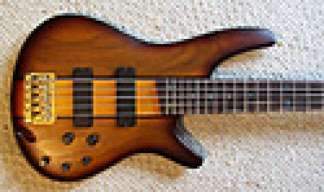

Assuming Low B is the top string of a four string bass and your tuning in fourths, the open strings would be:
G# C# F# B
G# C# F# B
Would someone please explain the tuning of the G# bass. A picture would be nice too.
Assuming Low B is the top string of a four string bass and your tuning in fourths, the open strings would be:
G# C# F# B
Wow. I'd love to hear how this applies in music! I can picture a movie score with mega rumbling low end but hard to imagine much definition down there. Intriguing!
The Quake bass is definitely something people need to hear to appreciate. Let's try to not stray too far from the topic though  . Duke's cabs did those the Quake very well though - better than any commercial cab I've heard hands down.
. Duke's cabs did those the Quake very well though - better than any commercial cab I've heard hands down.
knuckle_head
Commercial User
- Jul 30, 2002
- 2,621
- 58
- Disclosures
- Owner; Knuckle Guitar Works & Circle K Strings
Wow. I'd love to hear how this applies in music! I can picture a movie score with mega rumbling low end but hard to imagine much definition down there. Intriguing!
I have to say that the 1855 gave more tonal content to this bass at this tuning than any full range cab I can recall - there are certainly numerous musical applications with this bass/cab combo.
The G# shines in a studio environment where the signal is not truncated or diminished, and where the monitoring system gives you flat human treshold - this has you where most of us as players live any way. No fundamental and everything second harmonic and up.
I have to say that the 1855 gave more tonal content to this bass at this tuning than any full range cab I can recall - there are certainly numerous musical applications with this bass/cab combo.
The G# shines in a studio environment where the signal is not truncated or diminished, and where the monitoring system gives you flat human treshold - this has you where most of us as players live any way. No fundamental and everything second harmonic and up.
Interesting. No fundamental....hmmmm....you've created drawbars for bass guitar. The Hammond Organ of bass.

The Quake certainly takes that to a new level, even through an 1855.Interesting. No fundamental....hmmmm....you've created drawbars for bass guitar. The Hammond Organ of bass.
But there's actually nothing new about that. The vast majority of conventional cabs are down at least 3dB by the time they get to a low E, never mind a B.
Most bass rigs are all about the second harmonic...
[EDIT] It's also useful to note that electric basses generally don't deliver a flat response at the low end, in the first place.
Fundamental is the lowest frequency of the string's movement.Not intending to fully hijack the thread, but can someone do a quick rundown on fundamental vs harmonic and what we actually hear? My bass teacher spent a tiny amount of time on this but I'm still unclear.
B = 30.8 Hz
E = 41.2 Hz
A = 55 Hz
D = 73.4 Hz
G= 97.9 Hz
C= 130.8 Hz
Then each harmonic is the fundamental multiplied. I.e. the 2nd harmonic of the E string is 61.6 Hz.
I could go deep into the physics of all of this if you want (was pretty much what I studied in school, Engineering Physics), but probably too much for this thread.
All in all though, since bass rigs generally cannot reproduce even the 41.2 Hz of the E very well (they do, it's just usually below the -3dB point), what we mostly hear are the 2nd and up harmonics. Thanks to psycho-acoustics, our brain can more or less "fill in" the bottom for us.
I don't know what the fundamentals are for the Quake bass. I think the low G# is 13Hz?
When you play a note on a stringed instrument, like an electric bass, you actually play an extended chord. The overtones get progressively quieter as you move up the harmonic series, but the mix of those overtones are what gives the instrument it's character (ie; roundwounds vs flats, flute vs violin).
[Invalid or Expired Link Removed])
If you look at the Wiki article, you'll see that the first few overtones above a low C are CGCEG.
When your ear hears the location of that C major triad in the overtone series, your brain sort of triangulates the fundamental, even if it isn't there.
That's how we're able to hear decent "bass" from small studio monitors, computer speakers, etc.
[Invalid or Expired Link Removed])
If you look at the Wiki article, you'll see that the first few overtones above a low C are CGCEG.
When your ear hears the location of that C major triad in the overtone series, your brain sort of triangulates the fundamental, even if it isn't there.
That's how we're able to hear decent "bass" from small studio monitors, computer speakers, etc.

Passinwind
I know nothing.
- Dec 3, 2003
- 23,075
- 46,022
- Disclosures
- Designer/Toaster Tech @ Passinwind Electronics
Not intending to fully hijack the thread, but can someone do a quick rundown on fundamental vs harmonic and what we actually hear? My bass teacher spent a tiny amount of time on this but I'm still unclear.
Quick, not really. There's lots of contention and conflicting information and opinion, as you'll quickly see reading through this thread from the Amps FAQ.

Fundamental is the lowest frequency of the string's movement.
B = 30.8 Hz
E = 41.2 Hz
A = 55 Hz
D = 73.4 Hz
G= 97.9 Hz
C= 130.8 Hz
Then each harmonic is the fundamental multiplied. I.e. the 2nd harmonic of the E string is 61.6 Hz.
I could go deep into the physics of all of this if you want (was pretty much what I studied in school, Engineering Physics), but probably too much for this thread.
All in all though, since bass rigs generally cannot reproduce even the 41.2 Hz of the E very well (they do, it's just usually below the -3dB point), what we mostly hear are the 2nd and up harmonics. Thanks to psycho-acoustics, our brain can more or less "fill in" the bottom for us.
I don't know what the fundamentals are for the Quake bass. I think the low G# is 13Hz?
[Invalid or Expired Link Removed].
That low G# would be 12.98Hz.
The lowest pipe organ note that I've heard of (back in the day) was C/0 = 16.35Hz.
An acquaintance had a pair of EV Patrition 800 Cabs ( <- the pdf for the speakers) that supposedly go down to 15Hz (30" woofers) & played a wide variety of music with lots of low bass stuff -- they made the whole house shudder!


