

Enjoy the benefits of a premium membership!
Upgrade Account
-
TalkBass has been independent since 1998. Add your voice.
Create a free account to reply to discussions, view embedded media, and browse with fewer display ads.
Join free Log in
Want zero display ads or expanded classifieds tools? Compare plans.
You are using an out of date browser. It may not display this or other websites correctly.
You should upgrade or use an alternative browser.
You should upgrade or use an alternative browser.
AudioKinesis Cabs Part VI...
- Thread starter Thor
- Start date
More options
Who Replied?


So another interesting data point. I managed to wrench my back pretty good yesterday, but had a gig and the show must go on. This is probably the worst room (sonically) I play. It is a church with high ceilings and lots of reflective surfaces. It is boomy beyond belief, and I have never found the magic combination of amp/cabinet to tame it. Well, until last night. Single H1203 and the MB Fusion head. Drummer could hear me, I could hear me, and the room wasn't filled with low end mush. And this with grand piano and organ as well as horns. The 25 lbs certainly made the schlep easier. Game, set, match.
Last edited:

That is really interesting....This is probably the worst room (sonically) I play. It is a church with high ceilings and lots of reflective surfaces. It is boomy beyond belief, and I have never found the magic combination of amp/cabinet to tame it. Well, until last night. Single H1203 and the MB Fusion head...
I bought a little G-K MB110 combo, just because of one basement hall where I regularly play "unplugged" gigs. Same sort of deal- terrible acoustics, and every rig I have (including my 1st-gen TC112AF) booms really badly.
Blocking the ports on my Thunderchild didn't really get the job done. I'm not knocked out by the 110 either, as it doesn't do justice to my B string, but it gets me by in that room.
I might have to start saving up for a 1203...
As always, ymmv and every room/player is different. I was just struck by how well things worked last night relative to the other 40 or so times I've played the room. I think it is a case of the H1203 going just low enough and then rolling off. The Baer certainly is mid-present but I think it also has a bit more extension deep and the room doesn't like that. Problem is if you cut the bass at the amp then you lose too much as it is a fairly wide Q and is centered higher (depending on the amp).
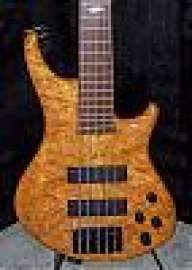
So final gig of the recent run, this time 10-piece band doing Steely Dan tunes at a largish restaurant/club. Used the pair of H1203s, no FOH support. I've played this room with this band at least half a dozen times and this was easily the best sound of the bunch. For whatever reason some of the band decided that they couldn't remember how to play their instruments, so I was really in "driving the band" mode. I could easily hear myself (with ear protection in), the bass was nicely supported in the low end, and plenty articulate. I have been having nasty back spasms the past two weeks, especially bad today. After some physical therapy I could sort of walk upright. The show must go on, and frankly having 25 lb cabs was incredibly welcome.
Keepers. Sorry for the bad candid - set up and waiting to hit.

Keepers. Sorry for the bad candid - set up and waiting to hit.

- Nov 24, 2008
- 4,343
- 7,163
- Disclosures
- Owner & designer, AudioKinesis; Auth. mfg, Big E (Home Audio only)
If the 4 Ohm version simply has a different response curve but can get the same extension/sound with a bit more low-end EQ, that doesn't seem a big deal. If it actually has less low-end handling/extension, then maybe not...
The power handling would be the same; the response curve would simply shelve down a bit in the low end. It could be brought back up by cranking in bit of EQ.
I know that one could always use two cabs, but it would be nice to be able to use one at something approaching its potential (though I would then be limited to using the one 1203 with any of my digital heads, which only go down to 4 Ohms).
I understand the attraction of a good 4-ohm cab, as that's what my first generation lineup consisted of. The natural shift in parameters as we go from 8 ohms to 4 ohms causes a "lightening up" of the low end, so in the ubercompact 1203 format, a 4 ohm cab is a tougher sell, unless I bill it as "low-E capable, and can be EQ'd for low-B". But I'm not sure how many people would want to pay the big bucks for a cab that needs EQ for low-B.
In recognition of the demand for a low-B capable 4-ohm cab, there's a 15" 4-ohm Hathor-style on the drawing board, and it should have no problem with low-B.
I was talking to Duke the other day and there might be a small change in the works that would give a little more strength in the low end.
If I can shorten the port by a couple of inches, theoretically I can gain about 1/2 dB at 62 Hz. Easier said than done... the modular port system I use is already at its design minimum in the 1203. I'd have to shorter the inner and outer flared sections, and figure out how to join them securely without the benefit of the "coupling ring" that's normally used.
My first effort was... a learning experience. Will try again this weekend.
Is the theoretical 1/2 dB improvement noticeable? I dunno... that will be the next question. I'll still be claiming -3 dB at 62 Hz... right now my modeling program says we're at -3.3 dB at 62 Hz, and the shorter port would bring us up to -2.7 dB at 62 Hz. Supposedly.
Last edited:
One other input - personally the least important dimension for a cab to me is height. Depth tends to be my biggest factor (cramped stages), followed by width. So if making the 1203 cab another inch or 3 taller would facilitate things, I think that would be a pretty good compromise. Shouldn't add that much weight and in some ways taller helps with self-monitoring.
- Nov 24, 2008
- 4,343
- 7,163
- Disclosures
- Owner & designer, AudioKinesis; Auth. mfg, Big E (Home Audio only)
One other input - personally the least important dimension for a cab to me is height. Depth tends to be my biggest factor (cramped stages), followed by width. So if making the 1203 cab another inch or 3 taller would facilitate things, I think that would be a pretty good compromise. Shouldn't add that much weight and in some ways taller helps with self-monitoring.
If the port-shortening experiment is successful I could theoretically make the cab shallower and taller, but we'd lose the recessed handle in the top along the way. And lose stability in stacked mode. Hmmmm. Well, I'll think about it. At any rate, your comment about vertical being the direction to grow in is quite helpful.
By the way, thank you very much for your gig reports! Very glad to hear the little cabs are working out so far.
Last edited:
If the port-shortening experiment is successful I could theoretically make the cab shallower and taller, but we'd lose the recessed handle in the top along the way. And lose stability in stacked mode. Hmmmm. Well, I'll think about it.
Hmm - don't do that. The recessed handle is one of the great features of the cabinet, and falls in the "keep at most any cost" category.
By the way, thank you very much for your gig reports! Very glad to hear the little cabs are working out so far.
I'm pretty shocked at how well they've handled everything I've thrown at them - mostly because the gigs have been pretty varied. Tue night I was thrilled with the cabs and the bass sound. I have yet to find any criticism for them.
Last edited:

Duke, I think you figured it out, but just in case, with the Precision Ports you can couple the two flares directly, i.e. two flares + one coupler, no tube. I did that on my first build to get as much "stretch" into the low end, like you're trying to do.
If you're beyond that, and assuming you've got the depth in the cab, you could go up a size in diameter and scale the length appropriately. Going up a size will drop your chuffage enough to maybe forgo the fancy flares and reduce the total length (I think), maybe to a manageable length.
Going taller is always better in my book for getting things closer to your ears.
If you're beyond that, and assuming you've got the depth in the cab, you could go up a size in diameter and scale the length appropriately. Going up a size will drop your chuffage enough to maybe forgo the fancy flares and reduce the total length (I think), maybe to a manageable length.
Going taller is always better in my book for getting things closer to your ears.

Tall and narrow is definitely better.
I concur as well. As Nostatic stated as well, vertical helps with self monitoring.
Duke, I also understand hitting the 8 ohm market as well. A lot of players seem to be going modular these days, so it makes sense. I was only interested in a 4 ohm because my amp doesn't perform well at 8 ohms for my needs, and I needed a 1 cab solution. My TC112 v1 arrives tomorrow and I'll be testing it in battle this weekend. Anyhow I digress.
I have a question for you Duke. I know with live sound systems, one of my concerns when purchasing a speaker is that it has a nice deep trapezoidal design for long throw. I always wondered why you never see bass cabs designed this way. It may be a hard sell due to the odd shape and loading into your car... Just wondered what your thoughts were on this?
- Nov 24, 2008
- 4,343
- 7,163
- Disclosures
- Owner & designer, AudioKinesis; Auth. mfg, Big E (Home Audio only)
Wow, thanks!I'm pretty shocked at how well they've handled everything I've thrown at them - mostly because the gigs have been pretty varied. Tue night I was thrilled with the cabs and the bass sound. I have yet to find any criticism for them.
Duke, I think you figured it out, but just in case, with the Precision Ports you can couple the two flares directly, i.e. two flares + one coupler, no tube. I did that on my first build to get as much "stretch" into the low end, like you're trying to do.
If you're beyond that, and assuming you've got the depth in the cab, you could go up a size in diameter and scale the length appropriately. Going up a size will drop your chuffage enough to maybe forgo the fancy flares and reduce the total length (I think), maybe to a manageable length.
I've looked at pretty much all the options; I do all of my design work with one eye on making sure I can use Precision Ports. Imo a significant but oft-overlooked advantage is the smooth sound of the midrange energy that escapes through them, in contrast with what we normally get through a straight-sided port. Thanks though!
I have a question for you Duke. I know with live sound systems, one of my concerns when purchasing a speaker is that it has a nice deep trapezoidal design for long throw. I always wondered why you never see bass cabs designed this way. It may be a hard sell due to the odd shape and loading into your car... Just wondered what your thoughts were on this?
As far as horns go, "throw" relates to the radiation pattern of the horn. The narrower the pattern, the longer the throw. In my opinion it usually makes more sense for bass cabs to have a wide pattern ("short throw"), as they're more likely to be used without PA in smaller venues. In applications where you'd need long throw, PA is usually available.
The trapezoidal shape of the cabinet doesn't affect the throw directly, though it might make it easier to mount a deep, narrow-pattern horn. The idea with trapezoidal cabs was that you could easily array them in an arc to get wider pattern coverage than a single cab would normally give you. The woofer(s) pattern at a given frequency is a function of cone diameter, array geometry, and (at the top end) cone breakup behavior.
I don't do trapezoidal cabs because a) they're harder to build; b) they're harder to find hardware for (like protective corners); c) they're harder to pack; and d) they are slightly harder for the bass player to transport than a same-internal-volume rectangular cab. The theoretical advantage is that less internal damping material would be needed to control internal reflections because we have some walls non-parallel.
That being said, I use odd-shaped cabinets in a lot of my home audio designs, for various reasons. But none that are outright trapezoids.
Last edited:
dunno. i really like what you've done so far. i haven't played it in the wild, but my comparisons at home tell me it's gonna do fine. smaller is better for me.
hathor 1203 and hathor 1203xt (extra tall)
hathor 1203 and hathor 1203xt (extra tall)

duke, et al., are musing on a taller version of the hathor. i was suggesting keeping the current version and also doing an xt version if people really wanted that.


