• TalkBass has been independent since 1998. Add your voice.
    Create a free account to reply to discussions, view embedded media, and browse with fewer display ads.
    Join freeLog in
    Want zero display ads or expanded classifieds tools? Compare plans.

Baer Amplification Megathread!

Flux Jetson said:
Something I find interesting ... I see from Roger's website that these cabs are made of poplar ply (Baltic Birch speaker baffles).

When I was researching Carvin cabs last night I'd read a few comments in other threads made by .. uh .. wood specialists and self annointed cab experts .. that "Poplar is complete shyte for cabs .. dead tone, cheap wood used by cost-pinching cab builders" .. and yet Roger's cabs are reported to sound so wonderful. Go figure, right?

It's actually Italian Poplar, which is a common lightweight ply. It's a tad on the soft side, but gets the job done and shaves some weight. Roger's smart to mix plywoods like he does, I think.

I always chuckle when I think of how Ampeg's marketing dept spun it with the PortaBass stuff: "Cab constructed of Italian poplar plywood for combination of resonance and light weight" Ha, a true tone wood apparently! :smug:

More OT, IP is also what's used in "wiggle wood," where all the plys are aligned. Cool stuff.

All that said, I'm not positive if there's a difference between Italian and non-Italian Poplar. My guess is it's like the difference between birch ply and baltic birch. The one with more words is made with better QC and not sold at HD/Lowes.
 
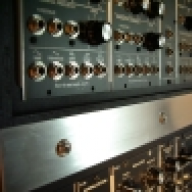
Using a Mackie 1400i for power, and this for preamplification and tonal shaping....

LCCwithjunk-2.jpg


Cab1perspective-1.jpg


Nearlyloadedcab-1.jpg


It's four "state variable" filters that provide LPF, HPF, Notch, and BPF all simultaneously from each one (and there are FOUR of them). You simply stick a patchcord into whichever filter mode you wish to use. The LPF and HPF are both 12db/oct (2 pole) and the Notch and BPF are 6db/oct (1 pole) filter modes. And of course all of them are resonant filters with fully adjustable resonance depth and fully tunable from 20hz to 20khz. And there are four of those modules (the pics are from before I got in more filter modules). I can sweep the filters' center freqs via control pedal as well. Once I get my stereo bass done, I'll be able to use my foot to sweep between pickups, each pickup will have two filters modules per. So I'll be able to sweep between each pickup AND their assigned filters with my foot in realtime.

I'm hoping that setup will cure the "E-A sound great but D-G sound like poo .. or .. D-G sound great but E-A sound like poo" issue by allowing me to change EQs and pickups on the fly with my foot.

I LOVE testing and doing this sortof fiddling about in the studio.

Couple it all with some dual-indenpendent DIY distortion stuff I have going on, I'm excited beyond description to get this rig on-line.

Up to now I've been fooling around with other methods of amplifying this rig (actually using a pair of Alesis M1 mk2 studio monitors as amps .. no friggin headroom with any kind of volume). So hitting a for-true bass cab with 300 watts of Mackie power will be a refreshing experience. I used to play through an SVT and an Ampeg 610 HLF cab so I'm really missing having my chest cavity rattled.

Fluxwith6-stringCarvinandAmpeg-1.jpg


Look carefully and you can barely see an HHB "Fat Man" stereo tube compressor on top of the SVT, an Avalon U5 DI, and a can of Cambell's Condensed Tomato soup to remind me to keep my bass riffs simple (hey it worked! I get a little too riffy for some music styles sometimes). So using these Alesis studio monitors has been a sore replacement.

A funny note about using those: The weirdest danged thing. One of those "3am nights" while working with the synth modules and the bass, I kept hearing this odd ~hisssss~ sound but only when I played lower notes. It sounded like a gated distortion or gated noise source ... it only made the hiss while there was x-amount of signal flow. I was convinced it was some sort of noise gate somewhere in the signal chain that was passing this distorted sortof hiss sound. I methodically begain removing and bypassing every single piece of the chain one at a time to troubleshoot the issue. I got all the way down to having the bass plugged directly into a monitor.

Here's the weird part. It was not an electronic or signal issue at all. It was the sound of AIR passing through the front ports of the Alesis studio monitors. So when I played lower notes and the cones were really moving in and out a lot, there was a LOT of air pumping in and out of the speaker boxes through the ports. I stuffed socks into all of the ports ... the sound completely went away.

There was that much air moving through the 1.5" dual ports per cab that it was actually audible over the sound of the bass itself.

Ha!

Sorry about the big post ... I'm just excited and needed to blab.
 
Something I find interesting ... I see from Roger's website that these cabs are made of poplar ply (Baltic Birch speaker baffles).

When I was researching Carvin cabs last night I'd read a few comments in other threads made by .. uh .. wood specialists and self annointed cab experts .. that "Poplar is complete shyte for cabs .. dead tone, cheap wood used by cost-pinching cab builders" .. and yet Roger's cabs are reported to sound so wonderful. Go figure, right?
It's actually Italian Poplar, which is a common lightweight ply. It's a tad on the soft side, but gets the job done and shaves some weight. Roger's smart to mix plywoods like he does, I think.

I always chuckle when I think of how Ampeg's marketing dept spun it with the PortaBass stuff: "Cab constructed of Italian poplar plywood for combination of resonance and light weight" Ha, a true tone wood apparently! :smug:

More OT, IP is also what's used in "wiggle wood," where all the plys are aligned. Cool stuff.

All that said, I'm not positive if there's a difference between Italian and non-Italian Poplar. My guess is it's like the difference between birch ply and baltic birch. The one with more words is made with better QC and not sold at HD/Lowes.

With regards to wood, there's quite a difference between the various types of woods. We even see huge differences between different brands of the same woods. Poplar ply can vary quite a lot. The Italian poplar we use is a very high quality ply with a good face and very few voids. We've come across some Chinese poplar that is full of voids and doesn't machine well on the CNC router. Birch ply has similar difference. Regular birch ply you get at say Home Depot, is usually nothing more than low grade birch ply that has voids, but has a nice birch veneer. Baltic birch is something entirely different. It's a much harder (and therefore heavier) birch, with more plys, and almost zero voids. This stuff is really dense! It's simply the best wood for cabinets, IMO, but you pay for it with a considerably heavier cabinet.

We used Baltic birch for the baffles, because I felt the poplar was just too soft for the driver Tee-nuts to hold tight over time. The Baltic doesn't compress at all, so the Tee-nuts and bolts won't loosen up over time. The ML212 actually has a Baltic birch top as well, as I was concerned that stacking another 70Lb. cab and 30lb. head on top would leave big dents in the bottom cab. Using Baltic for the baffle also helps to make the baffle much stiffer and stronger which is a very good thing.

You make light of the tone wood theory, but I do actually find some truth to that. Our first couple prototypes were Baltic birch and you could clearly hear the Baltic cabs as being a bit brighter in the top end when compared to the Italian poplar. With the ML cabs having a pronounced upper mid presence, I actually prefer the slightly mellower response of the poplar cabs.
 
Roger I hope you realize I was poking fun at the smartaxe that was going on about how poplar is "crappy wood" and yet your cabs are reported to sound so good (thereby impeaching the opinionated expert's "poplar is for crappy/cheapo cabs" statement .. right?

I mean, I wouldn't have bought one of your cabs today had I felt your judgement on wood selection was anything less that excellent. I don't part with sums of money unless I really believe in the product and the manufacturer's legitimacy.

:)
 
Remember not to neglect bass setup. If you're using a typical modern scooped cabinet your setup is almost surely going to need to be significantly revisited switching to a more full range cabinet.

+1 Besides the setup, I found that I needed to 'clean up' my technique a bit using these cabs. I found at first that I was getting more fret clack than I was used to and kept trying to eq it out. What I realized was that the fret clack was really due to a bit of sloppy technique on my part. Having my sound more "under a microscope" so to say, really let me zero in on aspects of my playing that needed improvement. So, while I found the cabs a little frustrating at first, they actually helped me improve my technique quite a bit.
 
+1 Besides the setup, I found that I needed to 'clean up' my technique a bit using these cabs. I found at first that I was getting more fret clack than I was used to and kept trying to eq it out. What I realized was that the fret clack was really due to a bit of sloppy technique on my part. Having my sound more "under a microscope" so to say, really let me zero in on aspects of my playing that needed improvement. So, while I found the cabs a little frustrating at first, they actually helped me improve my technique quite a bit.
And there lies the beauty of the adjustable freq low pass filter. For hacks like me it works wonders. I've fought clack my whole bass life. I have all the finesse and subtlety of a cement truck, so I had to come up with a way to compensate. Fixed-freq/fixed pole "treble" eq's simply do not cut it for monkey fingered technicians such as myself. Musical enthusiasm otherwhelms any hope of me keeping control over technique and holding true to anything that even approaches discipline. Thank the mojo gods for the 12db/oct sweepable freq low pass filter. Otherwise I'd have to go back to playing air bass.

:rolleyes:
 
And there lies the beauty of the adjustable freq low pass filter. For hacks like me it works wonders. I've fought clack my whole bass life. I have all the finesse and subtlety of a cement truck, so I had to come up with a way to compensate. Fixed-freq/fixed pole "treble" eq's simply do not cut it for monkey fingered technicians such as myself. Musical enthusiasm otherwhelms any hope of me keeping control over technique and holding true to anything that even approaches discipline. Thank the mojo gods for the 12db/oct sweepable freq low pass filter. Otherwise I'd have to go back to playing air bass.

:rolleyes:

I've fought the fret clack forever too, but the ML112 forced me to clean up my tone considerably and that's a good thing. That extra bit of work makes you a better player in the long run and makes you better suited to being able to play in more situations. I was so surprised at my first NAMM to hear guys playing through those cabs and getting no fret noise at all. Watching closely, I realized that these guys with the great tone strike the strings more parallel to the strings, where I tended to smack the strings downward much more. Learning to not smack the strings down so much, really helped my tone a lot. For so many years I never really heard that element in my technique, so I never really worked on it much. On the contrary, I like some upper mid bite, so I think I developed my finger style as a way to bring out those frequencies from the tradition bass cabs that tend to attenuate that area. The ML112's helped me clean up my technique, but still keep some bite in my tone, which I'm really liking these days.
 
I've fought the fret clack forever too, but the ML112 forced me to clean up my tone considerably and that's a good thing. That extra bit of work makes you a better player in the long run and makes you better suited to being able to play in more situations. I was so surprised at my first NAMM to hear guys playing through those cabs and getting no fret noise at all. Watching closely, I realized that these guys with the great tone strike the strings more parallel to the strings, where I tended to smack the strings downward much more. Learning to not smack the strings down so much, really helped my tone a lot. For so many years I never really heard that element in my technique, so I never really worked on it much. On the contrary, I like some upper mid bite, so I think I developed my finger style as a way to bring out those frequencies from the tradition bass cabs that tend to attenuate that area. The ML112's helped me clean up my technique, but still keep some bite in my tone, which I'm really liking these days.
Well, if that is the case it seems I am gonna be a frustrated player for a while then once the cab arrives. Hopefully I'll learn to get over myself and learn to play the bass better. Otherwise the 6" might get disconected. I've had to shut the tweeters off or completely unwire them in every cab I've owned since 1992. Maybe this new cab will teach me better technique, among keeping up with my Hammond chops, playing the modular synth, and staying sharp the guitar as well (I play Jeff Beck style ... no pick). Relearning the bass may be a challenge, I hope I'm up to it.

:confused:
 
It's not about being an EQ scooper, it's about playing cabinets with a big upper midrange/lower treble drop out, like about 80-90% of commercial cabinets including all your favorite big names.
For some reason I am totally not following you. Kinda par for the course, at times the simplest of ideas are beyond my grasp. Your point just seems to elude my comprehension for whatever reasons. It seems as though you're saying that "toppy" cabs require re-evaluating your setup and technique ... if so, I can't tell if you're saying the ML112 is one of those cabs or not. Sorry ... my brain just isn't functioning I guess.

I can't tell what you're getting at. Are you saying that Roger's cabs are toppy and may be difficult for hacks like me to play? Or are you saying something else? Like I said, sometimes the simplest concepts go right over my head. But if you find yourself getting impatient with explaining it to me, see my sig. In this instance I am obviously the stupid one. :) Haahaa!
 
I think what RP is saying is that cabs with properly crossed over mid drivers will be more revealing in the upper mids and lower treble, than your typical tweeter loaded cab. A lot of traditional cabs either have a dip in the upper mids, or have very poor off axis response in those frequencies. There is a lot of articulation and detail that comes from those frequencies, so hearing a cab where those frequencies are now out front for the first time, can be quite revealing. Sometimes a very low setup can create fret noise that just isn't as obvious on a traditional cab.

Basically, what I'm saying is that hearing your playing under a microscope may cause one to re-evaluate your technique, or set up a bit, but the rewards are well worth the effort. The good thing about the ML112 is that the midrange driver is very controllable with your amp's treble control.
 
Flux, I think your filter setup is awesome! I suspect you are going to really like the ML112 cab. The ML112 is incredibly responsive to small EQ adjustments and with all that tone shaping power at your disposal I bet you're going to have a lot of fun, especially after the cab has broken in. I look forward to hearing your impressions after you've spent some time with it...
 
I think what RP is saying is that cabs with properly crossed over mid drivers will be more revealing in the upper mids and lower treble, than your typical tweeter loaded cab. A lot of traditional cabs either have a dip in the upper mids, or have very poor off axis response in those frequencies. The is a lot of articulation and detail that comes from those frequencies, so hearing a cab where those frequencies are now out front for the first time, can be quite revealing. Sometimes a very low setup can create fret noise that just isn't as obvious on a traditional cab.

Basically, what I was saying. Hearing your playing under a microscope can cause one to re-evaluate your technique, or set up a bit, but the rewards are well worth the effort. The good thing about the ML112 is that the midrange driver is very controllable with your amp's treble control.
AH! Gotchya! :)

Ok, I get it now. I was getting a bit antsy for a little bit there. My head doesn't work well at night, I should just know better than to be active in-forum at night. I am much more clear minded during the day, I should just stick to headwork during the sunlit hours.

Thanks for clearing it up for me, Roger.

:)
 
Flux, I think your filter setup is awesome! I suspect you are going to really like the ML112 cab. The ML112 is incredibly responsive to small EQ adjustments and with all that tone shaping power at your disposal I bet you're going to have a lot of fun, especially after the cab has broken in. I look forward to hearing your impressions after you've spent some time with it...
Thanks for the encouraging compliments! One of the neatest things about the filter array is the ease of which getting "recorded tone" is accomplished. A DI placed either between the amp and cab, or between the filter array and amp taps in to the signal chain. Then a few sound check tracks roughly mixed in with the other tracks lets me hear what I need to add/change/subtract to get what I want on the raw recorded track. It doesn't take much to get it spot-on.

Hopefully I'll be able to post some kind of audio demos. I'm ridiculously camera shy so videos are out of the question. So I suppose I'll need to figure out the whole "soundcloud" thing so I can provide some reasonably good 15 to 30 second audio demos (even though I'm a total rock-based HACK player .. so I'll have to suck it up and just be embarrassed about my chops!). I have Sonar 6 Producer Edition and three M-Audio Audiophile USBs ... so I have the gear .. it's a time thing. My professional responsibilities have me anchored down presently. Just posting here is time consuming enough not to mention having a few somewhat less-than-patient clients to appease.

So thanks for the uplifting encouragement (and also for reenforcing my confidence about buying Roger's cab 100% unheard and based on testimony alone).

... demos a comin' ... "soon young Skywalkah ... soon".

;)