• TalkBass has been independent since 1998. Add your voice.
    Create a free account to reply to discussions, view embedded media, and browse with fewer display ads.
    Join freeLog in
    Want zero display ads or expanded classifieds tools? Compare plans.

Baer Amplification Megathread!

I'd be very appreciative if you or Roger could elaborate on the specifics of how/why setups need to be changed for more accurate cabs.
I think I get it now ... I was as confused as you seem to be, but I think I have a handle on it now. (I gotta admit some of the comments made about this by that one fella were quite vague, so I'm with ya.)

I think what was meant was that with other cabs things like fret buzz and ~ahem~ .. crappy technique will be more pronounced with Roger's cabs than with other-than-Baeresque cabinets.

With other cabs, your setup (and your technique) may have sounded ok .. passible at the least. But with Roger's box there is a chance that you may have to do a bit better job of instrument setup because fret buzz and/or little clicketyclacks might become more audible. Not because the ML112 is tweetery and clickety, but because many cabs ... even "good name" ones .. are not producing the frequency bandwidths that the ML112 is able to focus on. Consequently, your guitar may be set up so that any problems it may have "live" in those less-pronounced frequency bandwidths of the other cabinets. Switching to Roger's cab is like changing a graphic EQ in a sense. A bandwidth that might have been scooped a bit is now somewhat flatter, perhaps even humped a little. That slightly scooped/attenuated bandwidth was where all of your "nasty bits" were hiding so you didn't hear them when the EQ was scooped a little bit in that area.

Raise the levels of that particular bandwidth and little nasties and such may become more pronounced. This isn't a bad thing, it just means that you need to do a better job of setup. And once you change setup, you may find your technique to be a bit on the a ... hmmm ... how shall I say this delicately .... may be a bit on the CRAPPY SIDE. There, I believe I did that quite eloquently. :rolleyes:

It's like turning the lights on when naked. :) "Holy crap, I need to hit the gym!"
 
You make light of the tone wood theory, but I do actually find some truth to that. Our first couple prototypes were Baltic birch and you could clearly hear the Baltic cabs as being a bit brighter in the top end when compared to the Italian poplar. With the ML cabs having a pronounced upper mid presence, I actually prefer the slightly mellower response of the poplar cabs.

Fair enough, sir! Intuitively what you found makes sense. A softer wood should* provide more damping across a wider spectrum. So the resonance would be subtractive. I read the Ampeg line more as "this is why it's a good thing to use unbraced 3/4" ply," and less as you're using it.

*I'm an engineer by day and have learned a lot of things that didn't jive with my initial intuition. So I've come to be skeptical of my own "common sense." This is one of those areas I'm really curious to test this stuff out to better understand it.
 
...*I'm an engineer by day and have learned a lot of things that didn't jive with my initial intuition. So I've come to be skeptical of my own "common sense." This is one of those areas I'm really curious to test this stuff out to better understand it.

I've learned that *common sense* is neither. It's only common to you and those that think as you do, and "sense" is just as subjective. The only thing one can truly rely upon is change. I find change to be the single most acurate fact in the entire universe.

The most valuable thing I've learned in five+ decades of living on Planet Earth is that there really is no such thing as facts .. everything is an opinion (the sky is blue only because we say it is, and so on). That said, I've become much more open minded and more willing to accept new information, even if it conflicts with "the facts". I used to resist some ideas becuase they went against things that I knew to be .. ahem .. factual. Kinda the same idea you put out there when you said that you've become skeptical of your own common sense. In fact (nyuk nyuk nyuk) I'd have to say we are pretty much saying the same thing here. What was aceepted as "fact" in our earlier lives is now more of a soft reference point rather than a hard and rather unmovable "fact".

Applied to this topic, I'm totally open to the idea that the wood in the cab (as well as the wood in the bass itself) is a filter. O-scopes, frequency analyzers, physics, math be damned. My ears seem to be telling me something different than all of these machines and ... uhm ... facts.

:)
 
I've fought the fret clack forever too, but the ML112 forced me to clean up my tone considerably and that's a good thing. That extra bit of work makes you a better player in the long run and makes you better suited to being able to play in more situations.

...Learning to not smack the strings down so much, really helped my tone a lot.

This.

Ripping the tweeters out of two-way bass cabs is a sign of one of two things: the user didn't like the artificial, "woof and tweet" sound of under-engineered cabs, or they were instinctively repelled by the shortcomings in their own fretting technique.

I don't own an ML112 (although I would like one), but I was already using multi-driver, highly articulate cabs long before the current round of "super 12's" were created. It does force you to focus a little more on your technique, but it's oh, so worth it.

Once you get the hang of getting a smooth, un-clacky tone through a full-range system, then you have access to a much more expressive tonal range.

You can "pull your punches" by plucking gently near the middle of the fingerboard for round, almost synth-bass textures, and then switch to an over-the-top, grindy punk tone with nothing more than your plucking hand.

The more you work with it, the more the advantages hit home.

Sure, you can always step on a pedal to change tones between songs, or between phrases. But once the blanket is off your instrument, then you're free to change your tone, not just from section to section, but to morph from smooth to aggressive within a phrase. The effect is much more organic, more vocal, and incredibly addictive.
 
Complete agreement here on using 'revealing' cabinets. Before I bought my first nice five-string, I bought an Acme B-2. It was educational for my ears & fingers. ;) After a couple of incidents of woofer creasing and fuse-blowing (by another bass player @ church), I switched to Accugroove. I am an admitted midrange addict. Speaking of ripping out a horn to install a mid-driver, this was a nice sounding experiment:

p1110250up6.jpg


Greatly looking forward to hearing and beginning the break-in process on a ML-112 later this week. :hyper:
 
steve_rolfeca said:
This.

Ripping the tweeters out of two-way bass cabs is a sign of one of two things: the user didn't like the artificial, "woof and tweet" sound of under-engineered cabs, or they were instinctively repelled by the shortcomings in their own fretting technique.

I don't own an ML112 (although I would like one), but I was already using multi-driver, highly articulate cabs long before the current round of "super 12's" were created. It does force you to focus a little more on your technique, but it's oh, so worth it.

Once you get the hang of getting a smooth, un-clacky tone through a full-range system, then you have access to a much more expressive tonal range.

You can "pull your punches" by plucking gently near the middle of the fingerboard for round, almost synth-bass textures, and then switch to an over-the-top, grindy punk tone with nothing more than your plucking hand.

The more you work with it, the more the advantages hit home.

Sure, you can always step on a pedal to change tones between songs, or between phrases. But once the blanket is off your instrument, then you're free to change your tone, not just from section to section, but to morph from smooth to aggressive within a phrase. The effect is much more organic, more vocal, and incredibly addictive.

Just thinking about this lady night as I was blasting Quadrophenia. Listening to Ox going from punchy grind to attack-less cushion bass to horn-like riffing in a heartbeat is certainly compelling, and he was the king of low action. . My action has been getting lower and lower the more I play these days, for all your above reasons.
 
I like to use a 30hz test tone from a tone generator.
Why of course! I'll just go fetch my 30hz tone generator! Haahaa! :)

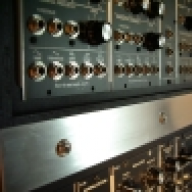
(Actually I suppose I could run the modular synth through it, the oscillators slow down to .1hz.)

What kind of wave? Sine? Now that you say something of that nature I can do about anything. A modulated sine wave that modulates up and down from whatever freq to whatever freq at whatever modulation freq.

So what would be optimal? Maybe the synth can provide it (good chance it can). Any wave form, any modulated pitch.
 
Anything and everything...not sure it's the best idea...seems the tone generator at 30Hz might be "the right" way to do it but I didn't have one and I'd imagine that just ONE hour of that would make me nuts ;-)

I haven't had any problems and it DEFINITELY worked...I'd never heard of "breaking in" a speaker before....
 
Why of course! I'll just go fetch my 30hz tone generator! Haahaa! :)

(Actually I suppose I could run the modular synth through it, the oscillators slow down to .1hz.)

What kind of wave? Sine? Now that you say something of that nature I can do about anything. A modulated sine wave that modulates up and down from whatever freq to whatever freq at whatever modulation freq.

So what would be optimal? Maybe the synth can provide it (good chance it can). Any wave form, any modulated pitch.

I used a 30hz sine wave with the NCH tone generator on my laptop.