• TalkBass has been independent since 1998. Add your voice.
    Create a free account to reply to discussions, view embedded media, and browse with fewer display ads.
    Join freeLog in
    Want zero display ads or expanded classifieds tools? Compare plans.

Best Strings for Ibanez Mikro Bass GSRM20?

Sorry, I don't know how long the winding is. Also sorry but could you explain more about the "taper" thing? Do you mean the string gets thinner? By "full wrap", do you mean the "silk winding?" If I can get some clarification on terminology, I will try my best to respond.
Yes, I meant where it gets thinner, and by full wrap I (imprecisely) referred to just the string's normal diameter, before the thinning starts. I omitted mentioning the silk because I was more interested in where said thinnage occurs (usually a fraction of an inch after the beginning of silk, and one can more or less see/feel where it gets thinner under it), relative to the tuning post; so no, no need for an actual measurement from the ball-end, just a description of how large the string is at the point where it reaches the post.
What I was getting at is: is the La Bella shortie flat E still "fat" around the tuning post of the Mikro? That might render some owners anxious: flatwound La Bellas are said not to like sharp turns, and to risk breakage there.
 
My mental hurdle is that if the scale is 28.5 then the silk would start at 30?... so that it's all silk on each post (can half be and not stretch out? ... is that my mistake?)
Remember that the ball end of the string isn't at the "end" of the scale length: it's at the back of the bridge. So the measurement from ball end of the string to the nut is longer than the scale length, and then there is the distance from the nut to the tuner posts. I don't have my 28.6" scale bass yet (arrives tomorrow!), but everything I've seen and read says that a ~32" ball-end-to-silk length works great for these basses.
 
Thanks for the explanations. I checked out the strings and the windings, and unfortunately I can't feel or see where they get thinner. So I can't respond directly. If it's of any relevance, I'll offer that on the E string, the winding goes right up to the post. If I turned it even a micro-turn more, there would be bare string wrapping around. On the other three strings, there is more winding to go, before the post. Sorry I couldn't be more help on this one.
 
Thanks for the explanations. I checked out the strings and the windings, and unfortunately I can't feel or see where they get thinner. So I can't respond directly. If it's of any relevance, I'll offer that on the E string, the winding goes right up to the post. If I turned it even a micro-turn more, there would be bare string wrapping around. On the other three strings, there is more winding to go, before the post. Sorry I couldn't be more help on this one.
You absolutely were, thank you very much. :)
 
Thanks for the explanations. I checked out the strings and the windings, and unfortunately I can't feel or see where they get thinner. So I can't respond directly. If it's of any relevance, I'll offer that on the E string, the winding goes right up to the post. If I turned it even a micro-turn more, there would be bare string wrapping around. On the other three strings, there is more winding to go, before the post. Sorry I couldn't be more help on this one.

Pardon my little blunder -- it's the G string where the winding goes right up to the post. Not the E. Sorry about the typo.
 
  • Like
Reactions: HaphAsSard
Probably a semi-zombie thread since the OP first posted, but now for something completely different:
1) First, change the stock pickups to something with some real wire on them to get real tone. The stock pickups are underwound fizzy crap. I helped a friend change out the P-pickup for a Fender Vintera with @ 12 kohm's worth of wire on it to get some girth. I then helped him change the J-bridge-pickup for a Seymour Duncan Apollo for some smoothness in the treble to extend the tonal options on the bass.
2) Second, make sure any deficient hardware is corrected. The MiKro has cheap hardware. Sometimes it works, sometimes it doesn't. To get good tone and sustain you gotta have good hardware. Not necessarily expensive hardware, but good hardware.
3) Strings: these didn't exist when the OP first posted: GHS Balanced Pure Nickels in short scale. To quote my friend who got a set for his MiKro: "Deep, warm, not overly mid-range-y. I actually dial in more P and less J now. Just enough push for definition, with nice growl."
 
Probably a semi-zombie thread since the OP first posted, but now for something completely different:
1) First, change the stock pickups to something with some real wire on them to get real tone. The stock pickups are underwound fizzy crap. I helped a friend change out the P-pickup for a Fender Vintera with @ 12 kohm's worth of wire on it to get some girth. I then helped him change the J-bridge-pickup for a Seymour Duncan Apollo for some smoothness in the treble to extend the tonal options on the bass.
2) Second, make sure any deficient hardware is corrected. The MiKro has cheap hardware. Sometimes it works, sometimes it doesn't. To get good tone and sustain you gotta have good hardware. Not necessarily expensive hardware, but good hardware.
3) Strings: these didn't exist when the OP first posted: GHS Balanced Pure Nickels in short scale. To quote my friend who got a set for his MiKro: "Deep, warm, not overly mid-range-y. I actually dial in more P and less J now. Just enough push for definition, with nice growl."

OP here, I've still got the Ibanez coated strings on the bass. They sound pretty good and aren't corroded yet so the coating is doing its job. But the gross metal smell is still there too! So, not the highest quality strings although the bass sounds decent. However I think your suggestions are some great ideas to improve the sound of this bass. I would think on point #2 upgrading the bridge would be the best bang for your buck.
 
  • Like
Reactions: iiipopes
My mental hurdle is that if the scale is 28.5 then the silk would start at 30?... so that it's all silk on each post (can half be and not stretch out? ... is that my mistake?)
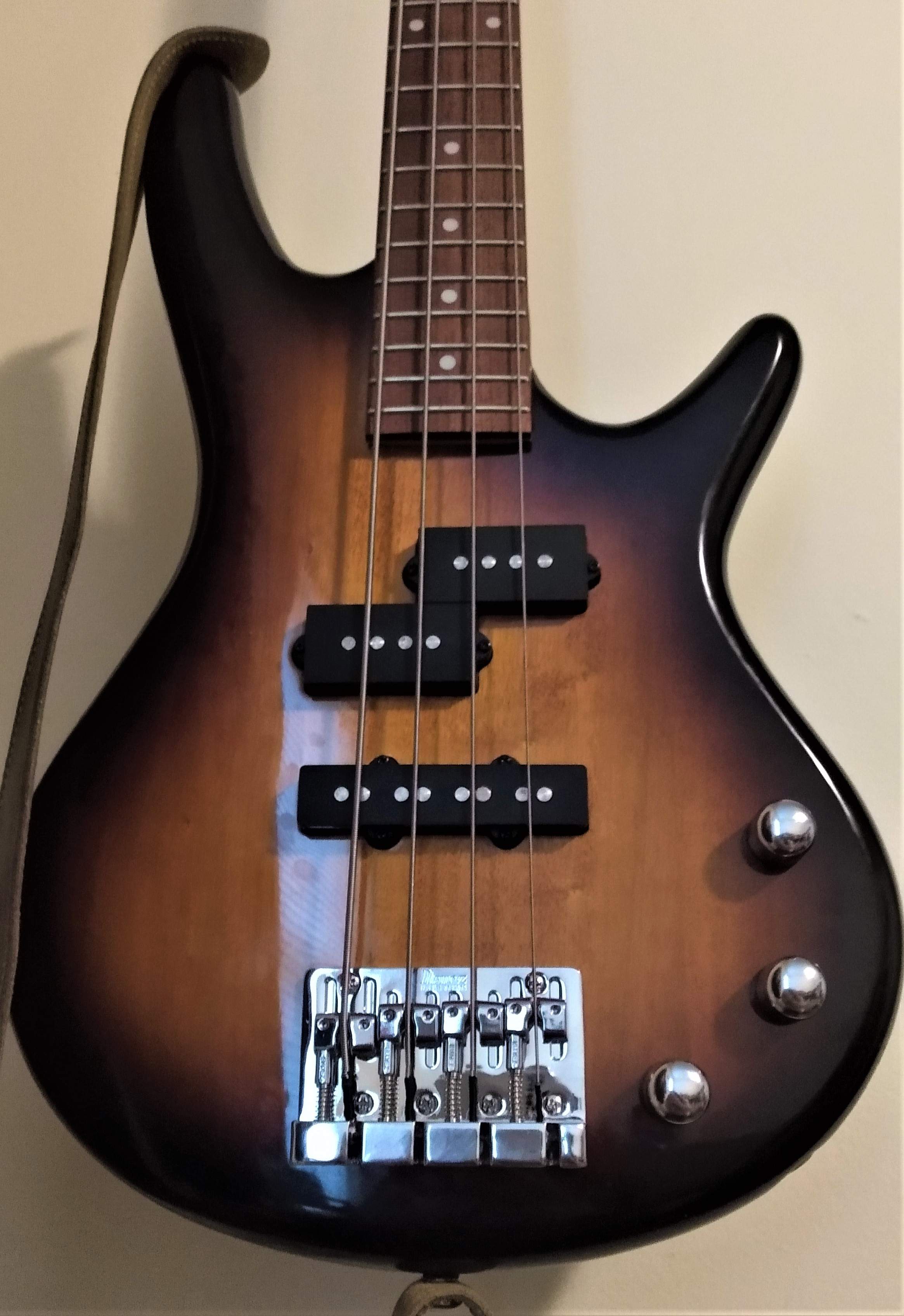
Ibanez took a lesson from Rickenbacker and offset the E-string tuner farther away from the nut than the G string. It is far enough away that any short scale set with 32 to 32 3/4 inch speaking length will fit without the speaking part of the E string going around the tuner. This leaves out Pyramid, DR and Ken Smith, which have 34-inch speaking lengths on their respective versions of short scale strings.
 
Time to remind everyone of the multi-quote feature:

If you see more than one post you'd like to quote, just press the +Quote button on each post, it's right beside Reply.
When you've selected all the posts you want to quote, go to the post dialog panel & hit Insert Quotes:
upload_2020-4-19_13-2-37.png


upgrading the bridge would be the best bang for your buck

I changed the bridge on our Mikro to a B100 & could not tell a difference from the stock B10:
TBH I don't find find any fault in the original hardware, including the wiring.
The pickups are the best of any brand at this price-range, & just damn good in general.
 
Last edited:
Which FLATWOUNDs will fit the Mikro?
Only ones that are in constant production are Dunlop Flats.
Except the Dunlop's have a 34-inch speaking length, and so they are just too long for a Mikro, and many other short scale basses.
Actually, as TBer @dBChad demonstrated, even medium-scale Dunlop flats are under 34" in speaking length:
View attachment 3511645

This is a Peavey Millennium AC 5. 34" scale with strings through the body.

I bought it as a project with the intentions of setting it up for flat wounds. I chose Dunlops as they were reasonably priced and I didn't want to throw a whole lot of money into something experimental at first, but these are too short to use.
I checked the package: these were a medium set. I thought that was in reference to string gauge, not scale length. Live and learn.
I took the advice given several times about marking the strings 1/4" past the nut. I measured 36-1/4" from the ball
That means the medium scale Dunlops are a wee bit less than 34" ball to silk - is this correct?
Yes, about 33-1/2" on average ball to silk (they are't all the same, but maybe the longest was exactly 34")
[^ Emphasis mine.]
 
  • Like
Reactions: Killed_by_Death
Time to remind everyone....
Do you have to criticize every single post I make, whether here or in all the other threads you have attempted to show that I am wrong when I speak from over 45 years experience playing bass in all venues, all genres, using all sorts of different equipment? If you want to criticize me, contact a moderator and he and I will discuss it.

This goes beyond simple disagreement. You have pestered me for over two years now. Stop.
 
Pardon my little blunder -- it's the G string where the winding goes right up to the post. Not the E. Sorry about the typo.
G strings are thin enough, in the 40-50 range, that it doesn't matter that any speaking length wraps around the post. Think about it: regular guitar tuners - the low E string is anywhere from 40-60 and winds around the little post with no problem.
 
  • Like
Reactions: HaphAsSard
I wish Dunlop posted their winding-lengths, one of the reasons I've never bought a set of Dunlops.
What thread did you get that info from?
Killed by Death has a point. In fairness, DR hides the string speaking lengths in the string details by type of string. I had consulted secondary sources that rounded everything to 34 inches. That is incorrect. It depends on the string model. I stand corrected. If a particular model of DR bass strings comes in short, extra long, or any string length besides standard, it is posted on the web page on that particular string. For example, for Hi-Beams, here is the quote off the DRstrings.com Hi-Beams web page:
"PRODUCT SPECS
Scale Length: 37 3/4"
Short Scale: 33 3/4"
Long Scale: 40 1/2"
Material: Stainless Steel. Round Core Wire with Ball End."
https://www.drstrings.com/bass-hi-beam
So if a player is looking to see if a particular model of DR bass strings comes in short scale, then that particular string's web page must be consulted. That amounts to 13 web pages, one for each of their bass string products. Now THAT is a safari! I hope this helps.
 
Killed by Death has a point. In fairness, DR hides the string speaking lengths in the string details by type of string. I had consulted secondary sources that rounded everything to 34 inches. That is incorrect. It depends on the string model. I stand corrected. If a particular model of DR bass strings comes in short, extra long, or any string length besides standard, it is posted on the web page on that particular string. For example, for Hi-Beams, here is the quote off the DRstrings.com Hi-Beams web page:
"PRODUCT SPECS
Scale Length: 37 3/4"
Short Scale: 33 3/4"
Long Scale: 40 1/2"
Material: Stainless Steel. Round Core Wire with Ball End."
https://www.drstrings.com/bass-hi-beam
So if a player is looking to see if a particular model of DR bass strings comes in short scale, then that particular string's web page must be consulted. That amounts to 13 web pages, one for each of their bass string products. Now THAT is a safari! I hope this helps.
You are absolutely correct, to the best of my knowledge, regarding DR Strings (dee arrr) and their nominally "short-scale" sets being (almost) 34" long ballend to silk/taper; with the lone exception being, appropriately enough, their coated sets for the 5-string Ibanez Mikro that you could order through BSO. (And still can on FretNation? Haven't checked.) Those were (/are) the only short-scale DR sets proper (= ~32" winding length until taper).

However, Jason's old post that you quoted and objected to above was about Jim Dunlop flats. Dunn-lawp; as in the tyre company of same name (except actually unrelated). At the time of the posts I quoted, no one knew, or bothered to post online, what long, medium and short meant in Dunlop parlance; that thread gave us the first glimpse into that ("Dunlop medium-scale flatwounds are a smidgen shorter than 34" ball-to-silk, on the average")*, so I mentally saved the info for later times, such as this one.


*[The relevant corollary for the present discussion (about strings for the Ibanez Mikro) being that there is no reason to doubt SLaPiNFuNK's assertion that shortie Dunlops fit Mikros (meaning that they must be true, 32"-wound short-shorts), since even Dunlop mediums are sliiiightly shorter than other companies' mediums.
And yes, there are other manufacturers that make strings that are fully wound to 34" or more (which is medium-scale territory) and call them shorts; like Thomastik-Infeld and, as said, DR; however, Dunlop is not one of them.]
 
Last edited:

Latest posts