• TalkBass has been independent since 1998. Add your voice.
    Create a free account to reply to discussions, view embedded media, and browse with fewer display ads.
    Join freeLog in
    Want zero display ads or expanded classifieds tools? Compare plans.

Blondes have more fun - a weekend build.

I'll have to try the beeswax polish on screws. Back in my early woodwork related learning days, (the 1960's/early 70's) it was soap for screws and I always keep a lump of good quality pure soap on hand.
Soap’s good. Paraffin is okay (albeit not as good as beeswax). Butcher’s or carnauba paste wax is good, too.

I recently bought the wrong beeswax - I read the description wrong and it turned out to be a hair product (oops!!) - but it has proven to be great for lubricating wood screws and also works wonders for keeping rust off of chisels and plane beds.
 
  • Like
Reactions: Durham52
20210917_165344.jpg
 
I'll have to try the beeswax polish on screws. Back in my early woodwork related learning days, (the 1960's/early 70's) it was soap for screws and I always keep a lump of good quality pure soap on hand.
Supposedly wax is preferable to soap because soap is hygroscopic, i.e. it will attract moisture. But if you’ve been doing it that way for fifty years without any problems, chances are it isn’t going to start now.
 
  • Like
Reactions: Beej
Of course I had to string it up just for the LOLz. I'll complete this tomorrow.

IMG_0350(1).jpg


To-do list:
  • Copper shielding in the control and neck pickup cavities.
  • Make electrical connections.
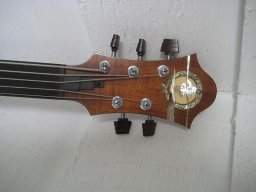
  • Headstock decal & matte lacquer.
  • Restring, set up.
So far I am 18 hours and $600 into this. That's not unreasonable and you could do this in a weekend if you plan ahead and have all the parts to hand. The $600 represents every penny spent, including shipping costs, and the costs of parts I already had laying around. You could probably shop around and save money on the exact same parts I used. I'm perfectly happy with spending that kind of money on a project like this.

Speaking of saving money, it occurred to me last night that Leo Fender's legendary penny pinching approach to manufacturing is hiding in plain sight on the Jazz Bass.

JB-PG.jpg


I mean is it just me, or is there an obviously missing screw right on the center point of that upper pick guard bend? I'll bet Leo was like "Hey we can save 3 cents per unit by missing that screw out, because the pickup cover screw is pretty close to where it would be and should do almost the same job".

Edited to add: Of course, by "Leo Fender's penny pinching approach to manufacturing", what I had meant to say was "Leo Fender's status as a pioneer of value engineering".
 
That PG looks nice with the black blocks. Nice build!

FWIW, “audio grade” solder is probably a little overkill here. Even if it made any sonic difference at all (I’m not a bat so I know I won’t hear it, but I doubt bats will either), the likelihood that there is silver-loaded “audio grade” solder anywhere else in your signal chain, from cable connectors to pedals to amps to speaker cabinets is very low indeed. I can assure you that your pickups and preamp weren’t soldered with it, either. Add to that the fact that 1/4” phono plugs were designed for telephone switching and are very far from “hi-fi” and there’s very little reason to use anything “better” than good, ol’ fashioned 60/40 solder. …and that’s because there isn’t anything better unless you’re working with extremely high frequencies.

There’s a brand called ’Multi-Core’ that I like a lot because of its melting properties. It’s more expensive than Kester but WAY cheaper than silver and nobody’s ears - or oscilloscope - will ever know the difference.

I agree with you entirely on the subject of solder grades, but the thing is I am going to be point-to-point rewiring my tube hi-fi amp very soon and I wanted the silver loaded solder for that, so why not use it on the JB too, given that I had approximately an inch of regular cored electronics solder left in my Big Box of Useful Things.
 
I mean is it just me, or is there an obviously missing screw right on the center point of that upper pick guard bend?
It certainly does seem like a good place for a screw, dunnit? Especially when you consider that the earlier P-bass has one in just that spot!

If I had to venture a guess (and this is totally a guess!) I’d say that Leo, in 1960, didn’t suppose anyone would want to take that cover off and the ear of the cover provides plenty of security for the guard. When nearly everybody immediately took that cover off and it didn’t really present a problem, Leo probably saw no reason to fix something that wasn’t broken. …and spend the cost of another screw in the process!!

Of course, you could always fly in the face of Fender tradition and add a screw there. Other bassists would feel uneasy when they looked at it but they wouldn’t be able to pinpoint why. :)

That’s really a great lookin’ bass you got there!
 
It certainly does seem like a good place for a screw, dunnit? Especially when you consider that the earlier P-bass has one in just that spot!

If I had to venture a guess (and this is totally a guess!) I’d say that Leo, in 1960, didn’t suppose anyone would want to take that cover off and the ear of the cover provides plenty of security for the guard. When nearly everybody immediately took that cover off and it didn’t really present a problem, Leo probably saw no reason to fix something that wasn’t broken. …and spend the cost of another screw in the process!!

Of course, you could always fly in the face of Fender tradition and add a screw there. Other bassists would feel uneasy when they looked at it but they wouldn’t be able to pinpoint why. :)

That’s really a great lookin’ bass you got there!

Fenders were engineered down to the last cent, to the degree where outdated parts were often used on new models in the hope nobody would notice, which gives collectors something to treasure I suppose, when they find a "transition model". Of course, those covers were never supposed to be removed, and Fender's original grounding scheme for the Jazz bass was to save money on drilling through into the control cavity for a grounding wire, and instead use a flat brass strip from under the bridge to the bridge pickup cavity, where it would connect to the pickup shield. The guy thought of everything.
 
  • Like
Reactions: Lo-E
…but the thing is I am going to be point-to-point rewiring my tube hi-fi amp very soon and I wanted the silver loaded solder for that…
It certainly won’t hurt anything and it’s a fun thing to geek out over but I promise you that there won’t be an audible difference. Microwave equipment…. maybe. Audio frequencies, not a chance. It definitely doesn’t fall into the category of “value engineering!” ;)

What hi-fi stuff are ya’ rebuilding?
 
It certainly won’t hurt anything and it’s a fun thing to geek out over but I promise you that there won’t be an audible difference. Microwave equipment…. maybe. Audio frequencies, not a chance. It definitely doesn’t fall into the category of “value engineering!” ;)

What hi-fi stuff are ya’ rebuilding?
It's actually a Chinese made amp, built into a very good quality welded steel chassis and based on an original Mullard circuit. It's all tube, point to point wired, paper in oil caps etc., etc. It even has tube rectification which is unusual on anything under $1000 now. I re-tubed it last year with NOS military tubes (including a brand new rectifier tube from the Royal Air Force, which had been originally used in a Bloodhound anti aircraft missile!), and replaced the output transformers with US made items. Given that my turntable arm has been silver rewired, and my speakers had the same treatment including point to point wired discrete crossovers, it's time to do the amp.

HVxdRSi
 
Last edited:
I mean I do remember reading somewhere that silver loaded audio grade solder had superior mechanical integrity to regular lead free, but given that the failure mode of a soldered joint is 99% of the time down to the work hardening and eventual breakage of the non annealed copper wire being used, it's not really a selling point.
 
  • Like
Reactions: Black Out Jazz
I mean I do remember reading somewhere that silver loaded audio grade solder had superior mechanical integrity to regular lead free, but given that the failure mode of a soldered joint is 99% of the time down to the work hardening and eventual breakage of the non annealed copper wire being used, it's not really a selling point.
Silver is harder and has a higher melt point. I used to use it on high power semiconductors(big MOSFETs) in RF amplifiers.
 
  • Like
Reactions: ChickWithaRic
I mean I do remember reading somewhere that silver loaded audio grade solder had superior mechanical integrity to regular lead free, but given that the failure mode of a soldered joint is 99% of the time down to the work hardening and eventual breakage of the non annealed copper wire being used, it's not really a selling point.
This stuff:
Invalid Link Removed
That’s not where I usually buy it but I think it’s actually cheaper here.

Best working properties of any solder I’ve used. It’s been my go-to for countless tube and solid-state projects including hi-fi, guitar and bass amps, lab test equipment, not to mention automation controls systems at work.
There’s likely about a pound of it lurking in the various parts of my stereo! I highly recommend it for your Box of Useful Things.
 
This stuff:
Invalid Link Removed
That’s not where I usually buy it but I think it’s actually cheaper here.

Best working properties of any solder I’ve used. It’s been my go-to for countless tube and solid-state projects including hi-fi, guitar and bass amps, lab test equipment, not to mention automation controls systems at work.
There’s likely about a pound of it lurking in the various parts of my stereo! I highly recommend it for your Box of Useful Things.

My Box thanks you.
 
  • Like
Reactions: Lo-E
Supposedly wax is preferable to soap because soap is hygroscopic, i.e. it will attract moisture. But if you’ve been doing it that way for fifty years without any problems, chances are it isn’t going to start now.
In addition, over time soap will cause the tannins to darken in the wood around the hole due to the lye in the soap. I like wax. :)