• TalkBass has been independent since 1998. Add your voice.
    Create a free account to reply to discussions, view embedded media, and browse with fewer display ads.
    Join freeLog in
    Want zero display ads or expanded classifieds tools? Compare plans.

Boutique Bass Benefits

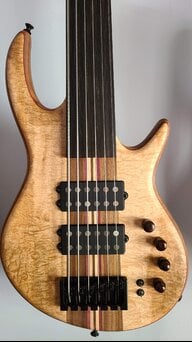
Screenshot_20191119-070318.png
Not my pix, (from the builder Stephen Kinnaird) but this is the Malaysian Blackwood back of my "boutique" acoustic bass

The "advantage" was I had a pre-owned boutique guitar and a guy in Hawaii had this bass so we traded through another forum's classified...

I have e-mailed the builder and we spoke on the phone, kind of cool, but no great thing

Is there anyone who would like me on this bass, but not like me on a Guild B-50 or Martin B-15 ? Doubtful...

This bass has other fancy woods, handbuilt, great vibe, but ultimately I probably got it because I have been messing with stringed instruments since 1978 and it was available on a trade and I wanted it...

Worth it for me under the circumstances, but I don't have a strong opinion about boutique either way...
 
Hello all,
I would like the opinions of what makes the custom made basses command the price we see in the market, especially those modeled after the P and J bass. The body style and necks are very similar. So if one pick up a used American P or J in the $ 1k range, what drives the market. Is this weight, pickups??

Your input is appreciated.

Regards,
Michael

Supply and demand ultimately controls the used market.

My favourite builder builds Ps and Js that command a high used pricing close to if not the same the price of new. This builder builds in small batches and puts his heart and soul into every instrument.
Each one is unique.

Fender has a formula and although you may end up with a great finished product, it won’t likely meet the tone, playability, and feel standard set by my favourite luthier regardless of the fact they are built in the same image.

Every bass is not created equally.
Most of this lies with Mother Nature at the atomic level of how the trees were created and lived before they became your bass. Even basses from the same tree or limb will sound different.
But that difference can be minor...but how it makes you as an individual feel or better yet...your audience!...well...that’s why life is a journey and how one chooses to command that journey is what matters.
If the journey is with a Fender...so be it.
If it’s with any other brand...so be it.
Try as many as you can. If you can’t justify the money after playing the expensive ones...maybe you found your answer. It’s your answer that counts!
 
Here's another little idea for thought process.

Rather than thinking "i'm lusting after an expensive MTD", You could be thinking "I'm lusting after an instrument hand-built by Michael and Daniel Tobias (I'm blanking on the name of the third guy) in a small shop in Kingston New York with high quality materials and an equally high attention to detail and design attained though years of experience.

For me, its just so much more fun to think about it like that :) Even if I can't afford one.
 
I don't think a handbuilt instrument is necessarily worth it for a newbie, nor for a hobbyist...

Totally agree. I started on a low end Fender Precision ~35 years ago and did fine - then bought a Fender Jazz. As I got better and needed better/different tone & higher volume, I upgraded gear - amp, cab & basses. In the late '80's, I "upgraded" to a Carvin and more recently (last ~10 years or so) I've since paid several high end luthier's to build me instruments.

As time progressed, I've sold most of the custom builds, traded a few others and now have come full circle back to Fender Precisions and Jazz styled basses. I still own a relatively high end Jazz, a Warmoth J, a Fender P, a Breedlove acoustic fretless and my original Chinese made upright (note the upright is almost 30 years old, so I guess it's now becoming antique-ish).

Does one "need" a high end instrument? No. Are high end instruments "easier to play"? In some ways yes, and in others, no. The player still needs to practice and put in their time playing - i.e. having a high end instrument doesn't guarantee skill... Dead notes are less frequent, harmonics may ring out better, it may also fit you or balance better. Thinner/Thicker necks, accurate frets, higher end components and better quality woods MAY make a bass sound & play better. Then again, if the Luthier doesn't have the skill or experience in building instruments, it also may be expensive "wall art".

Much of the gear upgrade-itis is that many have more disposable income and we generally think that we "want" better instruments - cool woods, nice electronics, high end tuners/bridges, etc. Look I wouldn't trade my experience with the custom instruments I had built - they were awesome, played well, looked cool and sounded great - and I paid a good amount to those Luthiers for them too. The Luthiers themselves were awesome to work with and generally had a passion for their work that doesn't happen when you walk into a GC or pawn shop to buy an instrument.

I cut my teeth as a substitute bassist years ago. I knew music theory, practiced a bunch of covers and jazz standards, and I got called. Sometimes I had uber great gear and sometimes i had what I had (read that as not so good). Now I'm a "hobbyist" and play for my own enjoyment. I still get calls and I so some GTG drop-ins from time to time.

Nothing beats playing with others. Play what you own, buy what you want/can afford, practice a bunch and play out. It's all good.

John
 
Totally agree. I started on a low end Fender Precision ~35 years ago and did fine - then bought a Fender Jazz. As I got better and needed better/different tone & higher volume, I upgraded gear - amp, cab & basses. In the late '80's, I "upgraded" to a Carvin and more recently (last ~10 years or so) I've since paid several high end luthier's to build me instruments.

As time progressed, I've sold most of the custom builds, traded a few others and now have come full circle back to Fender Precisions and Jazz styled basses. I still own a relatively high end Jazz, a Warmoth J, a Fender P, a Breedlove acoustic fretless and my original Chinese made upright (note the upright is almost 30 years old, so I guess it's now becoming antique-ish).

Does one "need" a high end instrument? No. Are high end instruments "easier to play"? In some ways yes, and in others, no. The player still needs to practice and put in their time playing - i.e. having a high end instrument doesn't guarantee skill... Dead notes are less frequent, harmonics may ring out better, it may also fit you or balance better. Thinner/Thicker necks, accurate frets, higher end components and better quality woods MAY make a bass sound & play better. Then again, if the Luthier doesn't have the skill or experience in building instruments, it also may be expensive "wall art".

Much of the gear upgrade-itis is that many have more disposable income and we generally think that we "want" better instruments - cool woods, nice electronics, high end tuners/bridges, etc. Look I wouldn't trade my experience with the custom instruments I had built - they were awesome, played well, looked cool and sounded great - and I paid a good amount to those Luthiers for them too. The Luthiers themselves were awesome to work with and generally had a passion for their work that doesn't happen when you walk into a GC or pawn shop to buy an instrument.

I cut my teeth as a substitute bassist years ago. I knew music theory, practiced a bunch of covers and jazz standards, and I got called. Sometimes I had uber great gear and sometimes i had what I had (read that as not so good). Now I'm a "hobbyist" and play for my own enjoyment. I still get calls and I so some GTG drop-ins from time to time.

Nothing beats playing with others. Play what you own, buy what you want/can afford, practice a bunch and play out. It's all good.

John
Subscribed ! Thanks @jharms80439 :thumbsup:
 
I don't know nuthin' about nuthin', but the Birdsong cBass that Scott Beckwith built for somebody else who decided they didn't want it so it ended up with me is the easiest-to-play, best-sound bass I've ever owned, and the only one that ever came close was a Suhr jazz that cost a thousand dollars more. It's difficult to explain. When you pick it up it doesn't feel like a collection of parts; it is its own self. Interestingly, I don't play it a lot these days. It's like having a suit of clothes that you want to save for special occasions. Yes, I know that is irrational.

Great post :):D:laugh:
 
Its a difficult point to discuss since instruments are not just "tool" or "products" but also art in and of themselves IMHO. There have ALWAYS been difficulties with assigning value to art and artists. You could look at recordings today which are, in and of themselves, essentially worthless since no one pays anywhere near what they used to for them. They do however provide a value in promotion that cannot be overlooked. Since no one will support a musician without being able to hear them...

Really loving the discussion in this thread!

I agree with you 100%. I debated with myself before making my earlier post. Because I was afraid it could easily be misread or taken out of context. So thanks for not taking offense. :)

The only reason I brought it up is because I used to mentor small business startups. And the thing that used to come up over and over is someone had an idea for a brilliant product or service that was valuable, filled a clearly defined desire in a given market, and that nobody else was doing.

Then came the killer question I used to ask: Yes! It fills a need. People want it. It’s valuable. But…is it something they’re actually going to pay you for? And if they will pay for it, will they be willing to pay you enough for it to be worth doing for you?

Because here’s the thing, just because something is a great idea that fills a clear market need doesn't mean there’s also a viable business in it. And sometimes (quite often actually) the reason nobody else is doing it is because you can’t make a living doing it. Maybe you could run it as a sideline at best. Which is fine if you’re in love with it. But that’s more of a paying hobby than an actual business. And a low level “lifestyle venture” (i.e. one that maybe makes you just enough money to allow you to continue doing it) isn’t what most people who want to run their own business are looking for. And doing it for free or below your actual real cost is not a business model.

But that’s a whole topic for another day. Preferably over pizza and some ale. :laugh::thumbsup:
 
I agree with you 100%. I debated with myself before making my earlier post. Because I was afraid it could easily be misread or taken out of context. So thanks for not taking offense. :)

The only reason I brought it up is because I used to mentor small business startups. And the thing that used to come up over and over is someone had an idea for a brilliant product or service that was valuable, filled a clearly defined desire in a given market, and that nobody else was doing.

Then came the killer question I used to ask: Yes! It fills a need. People want it. It’s valuable. But…is it something they’re actually going to pay you for? And if they will pay for it, will they be willing to pay you enough for it to be worth doing for you?

Because here’s the thing, just because something is a great idea that fills a clear market need doesn't mean there’s also a viable business in it. And sometimes (quite often actually) the reason nobody else is doing it is because you can’t make a living doing it. Maybe you could run it as a sideline at best. Which is fine if you’re in love with it. But that’s more of a paying hobby than an actual business. And a low level “lifestyle venture” (i.e. one that maybe makes you just enough money to allow you to continue doing it) isn’t what most people who want to run their own business are looking for. And doing it for free or below your actual real cost is not a business model.

But that’s a whole topic for another day. Preferably over pizza and some ale. :laugh::thumbsup:


Fantastic point! I must admit, I am absolutely terrible when it comes to the business thing (I have a day job, but also gig professionally and do repairs, and soon commissions) and reading things like this are helpful for getting new cogs in my brain machine turning (and in the right direction).

Thank you!
 
Roger Sadowsky makes some J and P shaped bass. And it's definitely custom and AND costs way more than 1K.

(Incoming rantyness, absolutely not directed at you. And most of this jaded opinion is based on my experience in music retail.)

I didn't say that expensive Fender shaped objects didn't exist. Nor did I say that they aren't nice things The Sadowski's, Lull's, Lakland's etc are all super nice instruments (the Lull's are especially nice things).

But honestly, why bother, when you could buy 2 'cheap' handpicked Fenders and upgrade literally everything but the body wood for less than the price of one custom made Fender shaped object? Also what exactly is 'custom' about something that is trying to mimic tradition? Fingerboard radius? Nut width? Fancy top? Custom wooden elf wound pickups?

Don't get me wrong (as you can see in my avatar) dropping 8k on a Zon Legacy Elite was totally the greatest decision of my life. But, it is not a Fender shaped object, nor would I use it to play Brown Eyed Girl. Don't don't spend 7k on a Pbass listed on Ebay from P.T. Barnum. That's silly.

*(Here is where I also will say, whatever you want to spend your money on is your own damn business.)*

I get people want a modern sounding bass that doesn't play or feel like an Ibanez sr350. But don't be surprised when a $700 Mexican has more of that 'retro whatever it is shmutz' than your Alleva Coppolo with Nordstrand rails. Recently, I played a Fodera Monarch that was totally the nicest Jazz bass ever but was a little too perfect if you ya know what I mean...

:eek:Fenders, at their core, are not good basses:vomit:, and that is what is ultimately charming about them:smug:. So why spend money on trying to perfect this thing that was perfect by being super imperfect:bassist::hyper:?

They are all hunks of wood, and it is very unlikely that any of those tree's dreamed of becoming a P-Bass.

*This is the only real takeaway here.

In conclusion with this coffee fueled auto correct extravaganza in which I hope I have offended no one, but maybe amused a few, Are boutique basses worth the price? Yes, as long as they look and sound nothing like a Fender. Otherwise, buy a Fender, and don't spend too much on it. Because I don't think any of our hero's who played Fenders back in the day did. I know a guy with a '67 Jazz bass he bought new for $350. It seems to work just great.

Aaaaaand, cue the firestorm.
 
Fantastic point! I must admit, I am absolutely terrible when it comes to the business thing (I have a day job, but also gig professionally and do repairs, and soon commissions) and reading things like this are helpful for getting new cogs in my brain machine turning (and in the right direction).

Thank you!

You’re welcome.

Wish I still kept a copy of my seminar notes and handouts so I could send you a copy. But I’ve long since tossed it all. And I haven’t done any consulting for small/medium businesses in awhile. (Former lifetime y’know?) ;)

But feel free to PM if there’s something business related you ever want to talk about or ask. Always happy to help out a fellow TB member if I can. :)
 
  • Like
Reactions: Brad_Pearson
I have had the need for service from an ABG maker. The ABG the maker paid for the repair. Sometimes the designer builder isn’t as versed in repair. Since I have access to an incredible repairman we sent pics and the maker agreed in fact he spoke of adding our mods to all of his new Basses. The truss rod had broken. An inexperienced repairman damaged it further. While fretbd was off graphite bars were installed. Not only can’t they bend when parallel they are even stiffer when angled. The ABG sustains amazingly. Every note is even more pronounced.

Not bass instrument specific but being able to talk to the designer is fantastic. My talks with Eric Papp of Summit have benefited everyone. I called Summit within hours of receiving the TD-100. I spoke to the owner/founder. He ran down the hall and got Paul his chief engineer and while going through their specs realized that what I heard was true. The two outputs didn’t sound the same. He later said, “don’t ever let an engineer tell you what you hear.”

My point? Small companies can give personal service. That’s worth additional cost.
 
I would never buy a boutique P or J. Plenty of Japanese made units that are better than anything I've seen from a fender factory for less money. Hell, my beater Ibanez P is better made than the US fenders I've had through here.
 
  • Like
Reactions: TylerJ
I've heard it mentioned a couple times here - a well made bass is like art. I love a good multi-piece neck and body. Before I could afford one, I gassed hard for a three carvin anniversary series basses... 5 piece necks, 3 piece bodies, high-grade tops. Never even played one but I wanted one. I've managed to scoop up a used 5er and love it.. now if I can find an lb76a... :)
 
I like the attention to detail and unique combination of features and being able to have a relationship with the builders.

I have 4 custom instruments. All have my preferred combination of 4 strings, 35" scale and a PBass width neck. That alone would be worth it as such a combination is not available stock. However each is also unique and I've communicated with the builders of all of them. If I have problems or questions I get to go straight to the builder.

I'd add also that they weren't fantastically expensive either. All were between 1 and 2.2k.

All this to say, if what you want isn't available off the rack then custom boutique is the way to go.
 
  • Like
Reactions: BeefPie84
To a great extent, it's a luxury goods economics issue. Is a Rolex worth magnitudes more than a Seiko? Not objectively. But they sell them as fast as they can make them. Sometimes, the value of owning something special isn't easily quantifiable.
 
  • Like
Reactions: lfmn16 and JRB