• TalkBass has been independent since 1998. Add your voice.
    Create a free account to reply to discussions, view embedded media, and browse with fewer display ads.
    Join freeLog in
    Want zero display ads or expanded classifieds tools? Compare plans.

Can You Tell The Difference??? ASH vs. ALDER

WHICH IS ALDER? WHICH IS ASH?

  • 1-A and 2-A are Alder, 1-B and 2-B are Ash.

    Votes: 17 15.7%
  • 1-A and 2-A are Ash, 1-B and 2-B are Alder.

    Votes: 48 44.4%
  • I can hear a difference between the "1" recordings, but not the "2" recordings

    Votes: 16 14.8%
  • I can hear a difference between the "2" recordings, but not the "1" recordings

    Votes: 3 2.8%
  • I can't hear a difference between any of them!

    Votes: 24 22.2%

  • Total voters
    108
It could prove that two pieces of wood can sound similar.

Yes, that is the entire point.

It could demonstrate that those two basses sound alike.

Again, that's the entire point. And perhaps you didn't notice, but they aren't "two basses". It is the exact same bass with the body swapped. If you want to compare body wood, then that is precisely how to do it: pickups could sound different, the necks could sound different, etc.

Dan has addressed your third point already.

Again, props to Dan for an excellent thread!
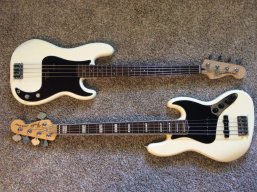
 
I think this further gets rid of the notion that basswood made for a bad sounding bass,even though their are tons of bongo owners who dished out almost 2 grand for that tone.

I'm glad someone finally did this. Although it seems there are still people who are going to ignore this. Same with the maple and rosewood debate.
 
Cool test. Should have known you'd do something like that based on the multiple choices offered. I'm still glad I got it half right, gives me more faith in my ear. Hope you're grading on a curve.

When are you doing necks and fingerboards? I'm really interested in comparing maple and rosewood to see if maple really is brighter like everyone says.
 
hehe nice one, Dan :D

It sure proves that the subtle difference between similar woods is definitely less important than the pickups you choose, etc. I think I heard the slightest difference between 1A and 1B, but nothing between 2A and 2B, but was therefore swayed into "believeing" that I heard the same difference... so yeah, we're easy to fool. :D

However, alder and ash are very similar tone woods... stolen from Warmoth's web page, they dial in very close on their "tone-o-meter":

Alder:
wood_toneometer_6.jpg

Ash:
wood_toneometer_7.jpg


It would be extremely interesting to see a similar test between woods that are much more different than this. Say, mahogany and maple.

Mahogany:
wood_toneometer_3.jpg

Maple:
wood_toneometer_10.jpg


If that doesn't yield any difference... then I'd say we're done discussing tone woods! :D
 
In some tests like these I also noticed that when a respectable member posts his observations and makes a choice, many people start "hearing" the same things said respectable member "heard" and vote the same way. Following the thread I think that is what happened here when one of the well regarded TBers got the ball rolling towards poll option 2.

Which is exactly why when I read the first post and saw the poll I got out my headphones and voted before I read any of the 4 pages of posts that were already up. By the time I finished listening and voting two more pages were posted so lively debate!:hyper:
 
I heard quite a big difference in the first take but wasn't so sure about the second one. One might think that the difference in wood doesn't matter but if you think that you can add also a bit different pickups, a bit different bridge, a bit different nut, a bit different ... and voi'la - two basses can sound quite different. There are always small things that finally count.
 
I heard quite a big difference in the first take but wasn't so sure about the second one. One might think that the difference in wood doesn't matter but if you think that you can add also a bit different pickups, a bit different bridge, a bit different nut, a bit different ... and voi'la - two basses can sound quite different. There are always small things that finally count.

But then that means the wood is not responsible. It's the collaboration of everything working together to make the overall difference, not just the wood.
 
Unfortunately I had a gig last night and I missed this but here's what I hear through my Bose Companion 3 system and Bose on-ear headphones.

I hear a definite difference in 1A and 1B but mostly in the low tones with 1B having more lows.

I hear no difference between 2A and 2B.
 
I'm not surprised by the results. Straight off listening for something in particular affects the way we perceive it. I heard a bigger difference on the first sample but also one on the second- it's because I was convinced intellectually they were different. This is not news and is something that only double blind tests can prevent when making comparisons, and large samples are needed to determine anything.

Now that you have proved how open to suggestion our perceptions are, are you prepared to put both A clips on a scope to see if they will match up? If they don't then your assertion is simply wrong and not borne out by the evidence. Your trick is useful only for muddying the issue rather than clarifying it.

In other words, just because we expect to hear differences somewhere and then do so, it doesn't negate the fact that there ARE measurable differences or not.

How many times have I thought I was changing the volume of my television via remote, and heard the volume rise, only to find out that I had hit the wrong button, leaving the level identical? Many. Does this prove that the level doesn't change when I hit the right button? Think about it.


Some might call this semantics but this is in no way a definitive answer to the question of whether different body woods sound different.

To the OP: do you honestly believe that all other things being equal, all basses constructed the same way with the same components will sound identical whether made with a medium weight mahogany body, a heavy northern ash one, or a lightweight maple one?

Scientific method is the ONLY way to answer this question. A well conceived double blind experiment involving many samples and proper measurement might be complicated but nothing short of it convince.

Please be aware I have no strong opinion as to whether different wood types have strong species related tonal similarities when used in a bass body, I am arguing only that each piece of wood is different and will have a greater or lesser effect on the final timbre of an instrument, depending on all the other factors.

My unscientific hunch based on my limited experience and already proven suggestibility points to wood density and age (affecting hardness) rather than species as being the most important factor in any tonal differences, and that neck wood(s) have a much bigger effect than body woods on an electric solid body bass.
 
To the OP: do you honestly believe that all other things being equal, all basses constructed the same way with the same components will sound identical whether made with a medium weight mahogany body, a heavy northern ash one, or a lightweight alder one?

Odd as it may seem I'm going to defend Dan a bit on this one. I've heard many instruments sound very different, but I've found that those differences can melt away in a band situation.
 
Odd as it may seem I'm going to defend Dan a bit on this one. I've heard many instruments sound very different, but I've found that those differences can melt away in a band situation.

That I agree with entirely. I've never bought a bass because it has X or Y woods, rather just because that particular one sounded good to me and works in a mix. I know I alter the tone far more with my fingers and EQ to make most instruments work, and I'm sure most of you can and do, too.

But if I was a luthier, I would naturally seek to use a combination of various elements to achieve a certain tonal goal, knowing that slight differences in each component will contribute to the final tone, sometimes, cumulatively and sometimes with multiplier effects. This is where things get complicated, cf: this thread and why Dan started it.
 
Well since you said there were two groups, and I figured the top two and bottom two were different basses, then I technically got it right since I only listened to the first clip of each set. :D I could tell that the first clip was definitely ash, you can hear the mid scoop, which is one thing I've never liked about it.
 
what does it matter if minute difference show up on a scope if we can't hear it ourselves? Just so people can justify why they thought they heard?

Because they might not be so minute; because they might become more audible when used in conjunction with other variables, because what sounds alike to me might not to you (I remember when all basses sounded the same to me, now I can hear differences even when they are not there, heh, heh) and what might be a slight difference to one set of ears is a huge gap to others, etc.

Stop mixing up motives with this, it has nothing to do with it. I am not afraid to be wrong nor do I hold any opinions so dear as to defend them in the face of proof, but sorry, this ain't proof and I ain't buying it, YET.
 
Lots of people definitely noticed a difference with 1A and 1B (I called this one right) , also a quite a few said that 2A and 2B sounded much alike. I felt this way between 2A and 2B but didnt think that the poster was possibly doubling the tracks purposely tryin to throw us off :(

Looks like people picked it out pretty well.
 
One Drop said:
Because they might not be so minute; because they might become more audible when used in conjunction with other variables, because what sounds alike to me might not to you (I remember when all basses sounded the same to me, now I can hear differences even when they are not there, heh, heh) and what might be a slight difference to one set of ears is a huge gap to others, etc.

Stop mixing up motives with this, it has nothing to do with it. I am not afraid to be wrong nor do I hold any opinions so dear as to defend them in the face of proof, but sorry, this ain't proof and I ain't buying it, YET.

Jeez.
 
what does it matter if minute difference show up on a scope if we can't hear it ourselves? Just so people can justify why they thought they heard?

In fact the only time there was ANY difference in sound..... people picked it out rather quickly.

It was only when there was a little trickery going on (to possibly skew results in his favor??)

Like I said... if there were only two clips, it would be a no brainer. It was. When there were different woods being used, the sounds were agreeably different.

It was only on the second clip where people though of there to be two different basses when it actualy wasnt, that it was "proven otherwise"