
lol, maybe still too soon for that reference!Why is there air?

TalkBass has been independent since 1998. Add your voice.
Create a free account to reply to discussions, view embedded media, and browse with fewer display ads.
Join free Log in
Want zero display ads or expanded classifieds tools? Compare plans.
lol, maybe still too soon for that reference!Why is there air?

yep! great reply.ask better questions, get better answers.

Why is there air?
lol, maybe still too soon for that reference!




Regarding piano, there's not much generally being played on the bottom say 1/2 octave because within a mix, it really becomes indistinct and many pianos struggle with it because it can excite non-musical "stuff" that is not terribly pleasant. Occasionally as an effect or where an arrangement might benefit, but as a generality it's avoided. I play piano and I certainly have no need for that bottom 1/2 octave, heft or no heft.
An example of this in practice is the Yamaha CP-70 which was the most toured electric piano (with a piano action and strings) in the world back in the day, intentionally dropped the lowest notes because they got in the way for most amplified music, and the number of strings per note (only one string on the lowest ~octave) was reduced to simplify the tone so that it would sit better in a mix. It was about cleaning up the tone for amplification and frankly it sounded better and was easier to mix without the low frequency mud. This is also what drives high pass filters, which have been around for 40 years in pro audio and used on a lot of "over-hefty" bass rigs to clean them up and sit them in a mix.
Heft or lack of heft (or slam, or whatever) is not about elite-ism, it's more about appropriateness and balancing the different needs for improved compromises that result in a better end product.

Of course you can hear all the keys. That said, you almost certainly can't hear 27.5hz unless you're a small child as people's hearing degrades at the extreme ends rather rapidly simply by aging. The frequencies you've listed are the fundamentals. The overtones are what you tend to hear down at the low end of a piano.An 88 key piano goes from 27.5 to 4,186.0 Hz. I can hear all of the keys.
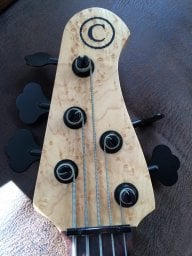
The sneaky thing about the B1K is its subtle top end roll-off. It’s a wonderful amp, and has been my main amp for a few years now. I think the way it rolls off up top makes it sounds bigger and fatter without the low end being all bloated. That, to me, is the biggest distinguishing factor between it and other amps that I would consider peers which I owned at the same time. I did an analysis of the top end roll-off I’m describing in the main Trickfish thread if you want to see the graphs and my long-winded write-up.So I'm no tech guy, but earlier noted that the Trickfish Bullhead 1K apparently has a Pascal Class D module that has been supplemented with additional capacitors - and it's the most slammin' Class D amp I've ever played through (albeit on the clean side). Thoughts?
Except that many SMPS in class D amps are unregulated and behave EXACTLY the same as unregulated line frequency power supplies but often with better performance. Some are regulated (including the ones that I typically use in this era) which does not have the inherent sag and deliver the same power even if the line voltage drops (something that line frequency supplies can't do).New to TB and retired EE. Cannot see any difference between tube, solid state AB and class D so far as the amplifying technology is concerned. The difference is in the power supply. Lead sleds use a "brute force" power supply with those huge "beer can" filter capacitors to filter the 120Hz pulsating DC to clean DC. Light weight SMPS power supplies are running at 30000 Hz or so and can use very small capacitors. Capacitors store energy.
Amplifier power is measured typically at 100% into full rated load, thus a transformer powered amp is measured with the supply voltage "sagged" to it's full load value, the SMPS powered amp's power supply is feedback regulated and doesn't rise or sag.
I have a Rane MA6, a professional multichannel amp that runs our wedges, on the bench to change the fan right now. Design similar to most AB amps. From the mfr's specs,150W RMS into 4 ohms, 6 separate channels, all channels driven. With full load, the supply rails are +-44 volts. With no signal, the rails rise to 63. Let's do the math. 44 squared X .707 X 50% (typical AB efficiency) /4=171 watts. Close to spec. Between notes the power supply recovers. Now at 63 volts - the voltage present during silence, 63 squared X .707 X 50% /4=350 watts. The stored energy in those massive capacitors is able to maintain that voltage for an 8th note or so before the voltage sags down. Thus that initial note, the one that slams, has a lot more available power behind it. Called transient power, a design shortcoming that just sounds great, just as the design flaws in the circuits copied and used used in most tube guitar amps created the defining sound of lead guitar.
In my younger, mentally diseased LOUD LOUD days, I was running two JBL double scoops off a Crest 8001, roughly 2400 watts RMS (off the 220 line that bands needed to run the 1000W par can lighting) Huge filter capacitors in that amp, still have and use one channel of it with smaller cabs (the other channel powers the low end of the PA). Could match the 100W Marshall stack the guitarist was using and louder It didn't slam, it punched you in the stomach!
Except that many SMPS in class D amps are unregulated and behave EXACTLY the same as unregulated line frequency power supplies but often with better performance. Some are regulated (including the ones that I typically use in this era) which does not have the inherent sag and deliver the same power even if the line voltage drops (something that line frequency supplies can't do).
What you are missing about SMPS is that more energy is stored in a lower value cap at the input of the switches because energy is a function of the square of the voltage, and with the bulk rail operating at ~350V, it doesn't take a lot of uF to store a LOT of energy. On the output the impedance of the switches is very low so the charge currents to the secondary caps is high. In the case of the SMPS I use, the secondary caps recharge about 200,000 times per second, so that voltage and current remain extremely robust. The caps HAVE to be large on a line frequency supply because the voltages are lower and they are only recharged 50-60 times per second and have to keep ripple under control or things become "noisy".
IMO, you are attributing an effect to something that is not really accurate. The "burst power" is defined typically as 20msec, which is about 1 cycle at 50Hz and it's rapidly depleted. There used to be a lot of marketing behind this concept, but it has more or less dissipated because there are things much more impactful in the bigger picture. That's my opinion as a (commercial) power amp designer of more than 40 years.
Very good point. Most SMPS I have encountered have an optocoupler circuit for feedback regulation of the output voltage. Any "surge power" as I referenced would only matter if the amplifier is being operated close to it's design power output, with the 2400 watt monstrosity I referenced, nowhere near that power was being used as my 4 JBL 2225s were only rated 200W each and I used a compressor set as a brickwall limiter to protect the speakers. The stomach punch in that case came from the 30ms or so it took for the limiter to drop the gain, but it sure felt good! High power, high speaker efficiency, rear loaded horn coupling, standing in the slip stream.Except that many SMPS in class D amps are unregulated and behave EXACTLY the same as unregulated line frequency power supplies but often with better performance. Some are regulated (including the ones that I typically use in this era) which does not have the inherent sag and deliver the same power even if the line voltage drops (something that line frequency supplies can't do).
What you are missing about SMPS is that more energy is stored in a lower value cap at the input of the switches because energy is a function of the square of the voltage, and with the bulk rail operating at ~350V, it doesn't take a lot of uF to store a LOT of energy. On the output the impedance of the switches is very low so the charge currents to the secondary caps is high. In the case of the SMPS I use, the secondary caps recharge about 200,000 times per second, so that voltage and current remain extremely robust. The caps HAVE to be large on a line frequency supply because the voltages are lower and they are only recharged 50-60 times per second and have to keep ripple under control or things become "noisy".
IMO, you are attributing an effect to something that is not really accurate. The "burst power" is defined typically as 20msec, which is about 1 cycle at 50Hz and it's rapidly depleted. There used to be a lot of marketing behind this concept, but it has more or less dissipated because there are things much more impactful in the bigger picture. That's my opinion as a (commercial) power amp designer of more than 40 years.

Very good point. Most SMPS I have encountered have an optocoupler circuit for feedback regulation of the output voltage. Any "surge power" as I referenced would only matter if the amplifier is being operated close to it's design power output, with the 2400 watt monstrosity I referenced, nowhere near that power was being used as my 4 JBL 2225s were only rated 200W each and I used a compressor set as a brickwall limiter to protect the speakers. The stomach punch in that case came from the 30ms or so it took for the limiter to drop the gain, but it sure felt good! High power, high speaker efficiency, rear loaded horn coupling, standing in the slip stream.
BTW my experience in musical electronics design has been building "boutique" tube guitar amps, and if you had a part in designing the Mesa F50, kudos! Our guitarist has one, excellent.
It is interesting reading these posts, many are relating the same experiences I have had using various class D rigs. It's not just me!
I am a super-lead sled owner, (Crest CA9 2x900w slave with a SansAmp RPM and 2x15 eq. 4 space rack, 65lbs.)
Anything below 1200w classD just falls flat compared to just 1 channel of my sled, even using the same preamp and speakers for consistency. We play at a strong drumset level.
What i have noticed is a lack of specifics as to power ratings, my Crest does 900w @.01% thd, I read an Ampeg spec of 1000w@ 10%. Many just say "800 watts" , but with no reference. I think that is where many players get confused as to why any one rig lacks the delivery they expect over another. I run big power for the headroom, lower volumes that float you in an ocean of warmth, yet can respond with crisp solid details, which never compete for wattage articulate themselves from your fingers.
Total control over the movement of the speaker. But then, i am an artist, not an engineer, my interpretation of the physics involved, the details of what circuitry yields what tone is probably miles off from reality. But I do know results, and so far nothing makes my ears smile the same way,.... yet. Thus i schlepp the weight.
I am have been looking to lighten my load with a high powered ClassD head, as opposed to another rack amp, at least for some smaller gigs. You guys have provided some great insights, we are all chasing the same thing, regardless of what you might call it.
Crest amps are amazing, they have been the go-to brand for touring sound for years. I do the same thing using only 1 channel, the other is used for the PA. As for distortion specs, 10% is high but subtract 2 or 3% from the spec'd wattage and it'll be clean at that level. And 2nd harmonic is often desirable - it's on key 1 octave up. The "cold clipper" stage of the venerable Marshall JCM800, Soldano amps and all the copies and clones is designed to do just that. In the 60's, recording studios rented intentional harmonic distortion by the minute (Aphex Aural Exciter). You hit it right on the nose about speaker control, big linear amps present almost a dead short to the back EMF from the speaker.It is interesting reading these posts, many are relating the same experiences I have had using various class D rigs. It's not just me!
I am a super-lead sled owner, (Crest CA9 2x900w slave with a SansAmp RPM and 2x15 eq. 4 space rack, 65lbs.)
Anything below 1200w classD just falls flat compared to just 1 channel of my sled, even using the same preamp and speakers for consistency. We play at a strong drumset level.
What i have noticed is a lack of specifics as to power ratings, my Crest does 900w @.01% thd, I read an Ampeg spec of 1000w@ 10%. Many just say "800 watts" , but with no reference. I think that is where many players get confused as to why any one rig lacks the delivery they expect over another. I run big power for the headroom, lower volumes that float you in an ocean of warmth, yet can respond with crisp solid details, which never compete for wattage articulate themselves from your fingers.
Total control over the movement of the speaker. But then, i am an artist, not an engineer, my interpretation of the physics involved, the details of what circuitry yields what tone is probably miles off from reality. But I do know results, and so far nothing makes my ears smile the same way,.... yet. Thus i schlepp the weight.
I am have been looking to lighten my load with a high powered ClassD head, as opposed to another rack amp, at least for some smaller gigs. You guys have provided some great insights, we are all chasing the same thing, regardless of what you might call it.



