• TalkBass has been independent since 1998. Add your voice.
    Create a free account to reply to discussions, view embedded media, and browse with fewer display ads.
    Join freeLog in
    Want zero display ads or expanded classifieds tools? Compare plans.

Class D amps sound inferior?

It should be recognized that this is a complicated topic, and it's not entirely black and white either. There are elements of both digital and analog in many processes which blur the lines, which adds to the confusion.

The first PWM application that I worked on (as a repair) was a cinema sound head exciter lamp power supply that used a crude PWM signal to control the intensity of the exciter lamp (the light source that illuminates the slit on an optical sound track, the light passes through the film and is detected by a photo-cell which converts the signal to an electronic analog signal). The intensity of the exciter lamp is quite important, especially in the older days where the line voltage would vary quite a bit and the bulbs themselves were inconsistent. There was a second photocell that read the intensity of the lamp and if the lamp got brighter the photocell voltage got larger which was used to reduce the voltage (and thus the current) to the exciter bulb. By doing this all at high frequency, the size of the power transformer was reduced. It's been a long time and don't remember the details, but it was reasonably effective (though ultimately it was easier and probably more reliable to regulate the AC voltage to the electronics with a small ferro-resonant transformer).

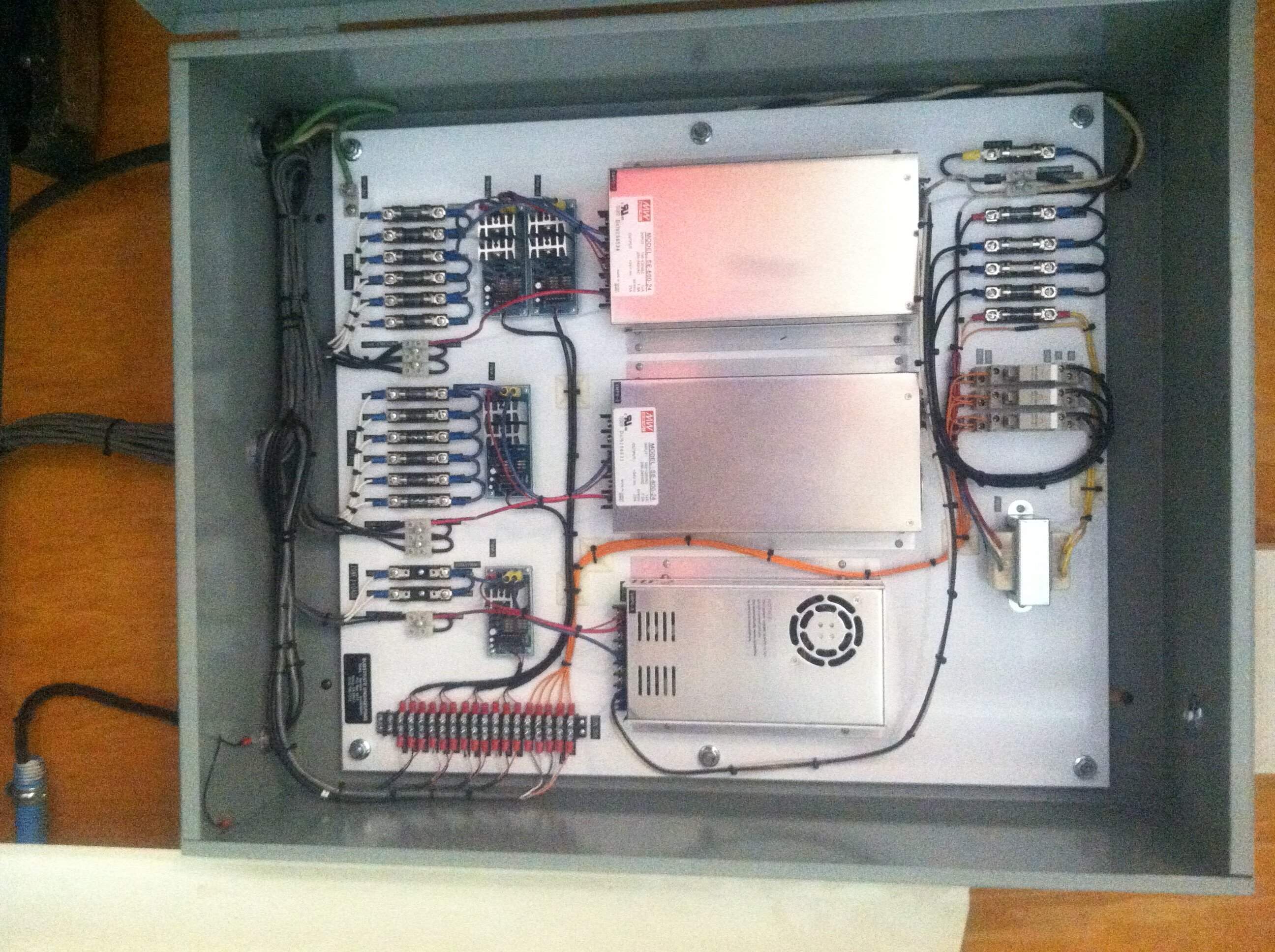
These days, most LED lighting dimmers are based on the PWM process, here's an example of an analog PWN control I designed for a VERY early LED lighting installation to prove the concept for a customer of mine in the industrial electronics industry, the PWM controllers are located to the left of the top two SMPS units. This was installed almost 20 years ago and has been running without issues, concept was sound but obviously the electronics packaging has evolved. This was a 600 watt installation which was massive for the time period:
IMG_0047.jpg
 
Since my background is as an analog design EE, I take the analog definition because the PWM process and theory was in use long before the "digital electronics" existed (going back easily into the early 1900's). The process has been used in generator control, lighting control, motor control, and frankly the theory extends outside of electronics and into the world of graphics and optics (the halftone graphic process being one process of PWM that has existed well before the world of digital electronics was even imagined.

That is my background as well.

Nobody is arguing about which came first. The age of the technology is irrelevant. You seem to be implying that PWM is superior just because the basic technology is older.

When an analog signal is reduced (converted) to a sequence of only two (binary) states, that's now in the digital realm. Even going back to the 1800's, it was still digital, even though the term didn't yet exist.

The PWM signal *itself* is digital. How you *convert* analog to PWM, or PWM to analog, can be argued either way, because the process crosses domains.

I really can't comprehend what all the pushback is for. Is the word "digital" so hated in the amplifier world that people will call the technology "non-linear analog" just to avoid it? That's known as political correctness - an oxymoron if I ever heard one. :)

If you go back through my posts, you'll see that I've never claimed one was better than the other.
 
This is a definitional argument, not a functional argument.

Is a Class D amp "digital?" That depends on how you define "digital." Defining "digital" vs. "analog" is sort of like defining "vegetable" vs. "fruit"...everyone knows what a vegetable is, and what a fruit is, but when you try to pin down a specific definition, you quickly realize that there are a lot of annoying edge cases, and it's more a matter of common use than botany.

Most musicians intuitively define "digital" as "a computer processed the audio signal." In that case, a class D amplifier is not, by itself, digital at all. (I don't know the internals of the ICEpower, TPA3116, and other common class D audio amplifiers, but you can generate PWM with just a sawtooth wave and a comparator.)

If you say "any bi-state signal is digital," then you have to call a CMOS fuzz "digital." It even uses a digital logic IC intended for use in a computer!

However, there are indeed class D amplifiers that are digital by the musician's definition. Some Class D amplifier ICs take a digital input signal, because it's simpler to convert to PWM or PDM than an analog signal...and there are several amplifier heads that take advantage of this to do their EQ and signal processing in the digital realm, not the analog realm. (I can name the Bergantino and the Fender Rumble 800 off the top of my head...I'm sure there are more.)
 
Last edited:
I’m not claiming that either the analog or digital domain is better or worse. It’s the use and in some ways the lack of precise definition of the terminology that I am frowning on.

Let’s look at the zero crossing detector of a phase control lighting dimmer. The gate drive of the thyrister is a pulse, it’s either on or off, it’s related directly to the AC power waveform in that the position of the pulse of the date drive determines conduction angle and thus dimming percentage.

Just because the pulse has 2 states does not make it digital, all the critical information is contained within the timing of the pulse relative to the zero crossing of the AC waveform, the pulse just turns the device on (the device turns itself off at the next zero crossing. (via option isolation)

This is, IMO, another example of a non-linear analog process. The percentage of dimming information is contained within the timing of the pulse. At 0% dimming, there is no pulse, and at 100% dimming there is just a DC voltage (no pulse in either case, normal operation)

[note that in this discussion, I am refraining from sarcasm, this is a confusing enough topic without it ;) ]
 
Last edited:
This is a definitional argument, not a functional argument.

Agreed.

Most musicians intuitively define "digital" as "a computer processed the audio signal."

I don't know if that's true or not. If it is, it would explain the careful tiptoeing around the word "digital".

Then again, several here have compared light switches to a digital signal, so there are some that "get it".
 
Last edited:
  • Like
Reactions: spatters
OK… I’m a musician. What I bring to the party is sound. One of my special qualities is hearing. I don’t care what is happening in the box that I plug my guitar/pedalboard into - but I really care what I sound like when I am crafting sound. I’ve been playing music now for more than 50 years… I’ve used class A amps and class A/B amps and now I use Class D amps. My hearing is remarkably good for how much loud music I’ve immersed myself in, and to my ears, the Class D amps I’m currently using sound as good or better than any Class A or A/B amp I’ve ever owned.

The only other thing I’m as sure of as my statement above is that the interweb is more than full of horse-pucky and people who think they are righter then everyone else.
 
Last edited:
I’m not claiming that either the analog or digital domain is better or worse. It’s the use and in some ways the lack of precise definition of the terminology that I am frowning on.

Let’s look at the zero crossing detector of a phase control lighting dimmer. The gate drive of the thyrister is a pulse, it’s either on or off, it’s related directly to the AC power waveform in that the position of the pulse of the date drive determines conduction angle and thus dimming percentage.

Just because the pulse has 2 states does not make it digital, all the critical information is contained within the timing of the pulse relative to the zero crossing of the AC waveform, the pulse just turns the device on (the device turns itself off at the next zero crossing. (via option isolation)

This is, IMO, another example of a non-linear analog process. The percentage of dimming information is contained within the timing of the pulse. At 0% dimming, there is no pulse, and at 100% dimming there is just a DC voltage (no pulse in either case, normal operation)

[note that in this discussion, I am refraining from sarcasm, this is a confusing enough topic without it ;) ]

I started to reply to this, and it turned out rather lengthy - then I remembered that we are in a bass forum, not an EE forum, so... let's agree to head back in the general direction of the thread topic, ok with you?

The original question was (I think) do Class D amps sound inferior?

My opinion is - in GENERAL - yes, if you mean faithfulness to the original signal. I need to qualify that and say that amps of any class can sound great, terrible, or anywhere in between. What I'm talking about is the RELATIVE fidelity of a purely analog amp versus a Class D amp of similar design quality. If I favor size, weight, and power consumption over absolute audio fidelity, I'd pick a Class D amp. Are there great sounding Class D amps? Of course. Are there better sounding Class AB amps? Of course. I don't want to lug them around, though. "Inferior" does not mean "crappy". It just means compromise.
 
Last edited:
One topic I think worth mentioning is serviceability. Maybe not an issue in US, but here in Brazil (and I bet in many other places), you'll get a hard time trying to fix a Class D amp, even by "authorized" service centers.
Most of them ends in a landfill.
In general, class D are easier to repair because many (not all) of the power supply/class D sections are replaceable fairly economically. That assumes that the service technicians are capable of solid basic troubleshooting, which is a bigger and bigger assumption these days.
 
That is my background as well.

Nobody is arguing about which came first. The age of the technology is irrelevant. You seem to be implying that PWM is superior just because the basic technology is older.

When an analog signal is reduced (converted) to a sequence of only two (binary) states, that's now in the digital realm. Even going back to the 1800's, it was still digital, even though the term didn't yet exist.

The PWM signal *itself* is digital. How you *convert* analog to PWM, or PWM to analog, can be argued either way, because the process crosses domains.

I really can't comprehend what all the pushback is for. Is the word "digital" so hated in the amplifier world that people will call the technology "non-linear analog" just to avoid it? That's known as political correctness - an oxymoron if I ever heard one. :)

If you go back through my posts, you'll see that I've never claimed one was better than the other.
The high frequency carrier could be considered digital, I suppose because it has only two states at the series pass device. However, the audio signal waveform simply changes the on and off time of the high frequency carrier. There isn't any binary data string encoding or decoding; it's strictly analog modulation of a non linear carrier.

The process is akin to amplitude modulating an RF oscillator of a radio transmitter, and finally at the receiver, stripping away the RF carrier through a detector, leaving the audio signal at the output.
 
The high frequency carrier could be considered digital, I suppose because it has only two states at the series pass device. However, the audio signal waveform simply changes the on and off time of the high frequency carrier. There isn't any binary data string encoding or decoding; it's strictly analog modulation of a non linear carrier.

The process is akin to amplitude modulating an RF oscillator of a radio transmitter, and finally at the receiver, stripping away the RF carrier through a detector, leaving the audio signal at the output.

Agreed. I never mentioned a binary data string. I think we're on the same page.
 
It should be recognized that this is a complicated topic, and it's not entirely black and white either. There are elements of both digital and analog in many processes which blur the lines, which adds to the confusion.

The first PWM application that I worked on (as a repair) was a cinema sound head exciter lamp power supply that used a crude PWM signal to control the intensity of the exciter lamp (the light source that illuminates the slit on an optical sound track, the light passes through the film and is detected by a photo-cell which converts the signal to an electronic analog signal). The intensity of the exciter lamp is quite important, especially in the older days where the line voltage would vary quite a bit and the bulbs themselves were inconsistent. There was a second photocell that read the intensity of the lamp and if the lamp got brighter the photocell voltage got larger which was used to reduce the voltage (and thus the current) to the exciter bulb. By doing this all at high frequency, the size of the power transformer was reduced. It's been a long time and don't remember the details, but it was reasonably effective (though ultimately it was easier and probably more reliable to regulate the AC voltage to the electronics with a small ferro-resonant transformer).

These days, most LED lighting dimmers are based on the PWM process, here's an example of an analog PWN control I designed for a VERY early LED lighting installation to prove the concept for a customer of mine in the industrial electronics industry, the PWM controllers are located to the left of the top two SMPS units. This was installed almost 20 years ago and has been running without issues, concept was sound but obviously the electronics packaging has evolved. This was a 600 watt installation which was massive for the time period:
View attachment 4265697

Sounds like it worked well, but my first thought when I looked at the picture was "very tidy design, exceptional workmanship". IME that would be top tier work in any industry.
 
I started to reply to this, and it turned out rather lengthy - then I remembered that we are in a bass forum, not an EE forum, so... let's agree to head back in the general direction of the thread topic, ok with you?

The original question was (I think) do Class D amps sound inferior?

My opinion is - in GENERAL - yes, if you mean faithfulness to the original signal. I need to qualify that and say that amps of any class can sound great, terrible, or anywhere in between. What I'm talking about is the RELATIVE fidelity of a purely analog amp versus a Class D amp of similar design quality. If I favor size, weight, and power consumption over absolute audio fidelity, I'd pick a Class D amp. Are there great sounding Class D amps? Of course. Are there better sounding Class AB amps? Of course. I don't want to lug them around, though. "Inferior" does not mean "crappy". It just means compromise.
Just curious which Class D amps you have played on gigs to arrive at this generalization. Thanks.
 
  • Like
Reactions: Dominic DeCosa
I did a side by side at a rehearsal, class d amps can sound really good but I prefer non class D-recently a Mesa Walkabout. I use earplugs in a band setting and class d amps to me get lost, non class d amps have more heft and i can hear them better at low volumes. Same cab, same setting, just a lack of presence in the room. On their own, they sound great and the weight is nice but I could never make the jump to class d.
I don't know man ... I'm a huge Walkabout fan and have gigged and recorded with mine (ver 2) for 15 years ... I use it whenever I can, but when the Walkabout runs out of gas, which with 300w @ 4ohms, it's been known to do, my WD800 fills in nicely and I have never noticed any lack of "heft" "slam" (or whatever term you want to cook up) from the WD800. IMO/IME (and many others too) the WD800 just takes what the Walkabout does so well and expands its capabilities in a great way. Nothing but love here for the class D power section of the WD800!
 
Opinions are subjective in all matters

482904000000000-00-290x290.jpg


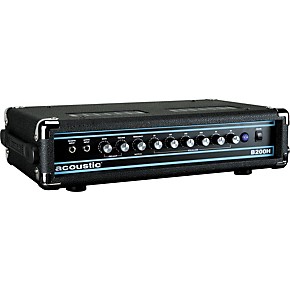
Here is a Gorgeous little Chinese Acoustic B200H
Ask talk bass how this amp sounds ? LOL

Most people haven't even heard one.
But will tell you how " bad" it is.

Reality it sounds like a bunch of other amps.
But the internet will say its bad because of its affiliation.

Now lets say Geddy Lee or James Jamerson did a Youtube demo with a B200H
within the first minute a lot of B200H would be sold.

Some people might have great advice, or strong opinions.
but yet they probably dont even know a minor or major scale.
So what is good or bad is always subjective.
 

Latest posts