• TalkBass has been independent since 1998. Add your voice.
    Create a free account to reply to discussions, view embedded media, and browse with fewer display ads.
    Join freeLog in
    Want zero display ads or expanded classifieds tools? Compare plans.

Club Sadowsky!!!

I just turn the knobs until it sounds good, left or right makes no difference.

Certainly. I rarely need to see the actual knob positions. The bigger point is that consistency is desirable, particularly when making adjustments on the fly.

I once read a book on website design called "Don't Make Me Think!" In short, when designing a business website (or most other kind of site), don't try to reinvent the wheel because that can cause confusion and users will leave if they can't quickly find what they want.

The Sadowsky pan choice isn't wrong, it isn't reinventing the wheel. But here's an example of something that does make me think: On basses with active EQ, treble is traditionally toward the neck and bass is toward the bridge, however a few bass manufacturers reverse this. That's from of a different view of consistency: the vast majority of "outboard" equalizers... and all spectrum graphs... and all pianos ;)... put bass left and treble right, but from a right-handed bass player's perspective looking down, neck (treble EQ) is left and bridge (bass EQ) is right on traditional actives.

So reversal is logical. Somewhat: after decades of playing active basses my brain is wired to accept the traditional placement of onboard EQ. I never even thought that it might be considered "wrong" until 2 years ago when I got a bass with "reverse" EQ, and a friend told me "that's not a mistake, it's customary for this brand" and explained the reasoning. If that was my only bass then I'd quickly adjust, but I usually play Sadowsky, so whenever I play this bass I am forced to think about the reverse placement when I make EQ adjustments. OK, that's less true after 2 years, but the inconsistency with all other actives in my collection (and most other actives overall) still gives me OCD jitters.


TL;DR: Slow day here in quarantine. ;) Point is: personal preference; arguments on both sides are valid.
 
  • Like
Reactions: kittywithabanjo
the one with a control plate and pick guard was kinda a one-off.
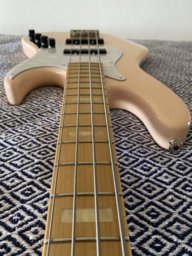
Roger just listed this one - that is a one-off of a one-off. A Verdine White with guard and plate AND in ash/maple. One of the last of NYC Satin Series, I suppose, and an unusual build at that. Incoming.....

8845_3-scaled.jpg
 
VM model has an undersized body and is 1.5 at the nut , this was one of the few that had the vintage upgrade of a pickguard and control plate.

As I understand it, the Sadowsky Standard model bass has a different control knob layout than the Sadowsky Vintage model bass. Roger has said that for that reason, you cant add a typical Vintage model control plate to a Standard model bass.

i also thought that the VW model had the same control knob layout as the Sadowsky Standard model.

if true, does this one-off VW bass have a control plate that is a different design from the Vintage model control plate? Or does this one-off bass have the same control knob layout as a Sadowsky Vintage model?
 
...does this one-off VW bass have a control plate that is a different design from the Vintage model control plate? Or does this one-off bass have the same control knob layout as a Sadowsky Vintage model?
The bass was titled "Verdine White 5-21 Vintage", so I assume its the Sadowsky Vintage control plate and knob layout. Thats what it looks like to me. Whatever the title, its Satin Series PJ5 in ash/maple, exactly what I wanted - and I think pretty rare.
 
  • Like
Reactions: Lex P.
As I understand it, the Sadowsky Standard model bass has a different control knob layout than the Sadowsky Vintage model bass. Roger has said that for that reason, you cant add a typical Vintage model control plate to a Standard model bass.

i also thought that the VW model had the same control knob layout as the Sadowsky Standard model.

if true, does this one-off VW bass have a control plate that is a different design from the Vintage model control plate? Or does this one-off bass have the same control knob layout as a Sadowsky Vintage model?
Think of it as a Vintage with a PJ pickup arrangement.
 
As I understand it, the Sadowsky Standard model bass has a different control knob layout than the Sadowsky Vintage model bass. Roger has said that for that reason, you cant add a typical Vintage model control plate to a Standard model bass.

i also thought that the VW model had the same control knob layout as the Sadowsky Standard model.

if true, does this one-off VW bass have a control plate that is a different design from the Vintage model control plate? Or does this one-off bass have the same control knob layout as a Sadowsky Vintage model?

There have been other Verdine White basses with guard and control plate, they’re just not as common as the bare ones. Also, the vintage style (with guard and plate) cost a bit more, about an extra $100.

There were quite a few of them on the web site at around the same time the announcement came out concerning the end of the satin series.
 
Certainly. I rarely need to see the actual knob positions. The bigger point is that consistency is desirable, particularly when making adjustments on the fly.

I once read a book on website design called "Don't Make Me Think!" In short, when designing a business website (or most other kind of site), don't try to reinvent the wheel because that can cause confusion and users will leave if they can't quickly find what they want.

The Sadowsky pan choice isn't wrong, it isn't reinventing the wheel. But here's an example of something that does make me think: On basses with active EQ, treble is traditionally toward the neck and bass is toward the bridge, however a few bass manufacturers reverse this. That's from of a different view of consistency: the vast majority of "outboard" equalizers... and all spectrum graphs... and all pianos ;)... put bass left and treble right, but from a right-handed bass player's perspective looking down, neck (treble EQ) is left and bridge (bass EQ) is right on traditional actives.

So reversal is logical. Somewhat: after decades of playing active basses my brain is wired to accept the traditional placement of onboard EQ. I never even thought that it might be considered "wrong" until 2 years ago when I got a bass with "reverse" EQ, and a friend told me "that's not a mistake, it's customary for this brand" and explained the reasoning. If that was my only bass then I'd quickly adjust, but I usually play Sadowsky, so whenever I play this bass I am forced to think about the reverse placement when I make EQ adjustments. OK, that's less true after 2 years, but the inconsistency with all other actives in my collection (and most other actives overall) still gives me OCD jitters.


TL;DR: Slow day here in quarantine. ;) Point is: personal preference; arguments on both sides are valid.
C’mon man, it’s backwards. Lol
 
  • Like
Reactions: Fuzzbass
Roger just listed this one - that is a one-off of a one-off. A Verdine White with guard and plate AND in ash/maple. One of the last of NYC Satin Series, I suppose, and an unusual build at that. Incoming.....

View attachment 3877338

They've got one of these at Corner Music in Nashville:

[Invalid or Expired Link Removed]

Played it while back. Very nice bass.
 
Check out our live video from our show a few weeks ago. Using my Sadowsky Satin Series Modern 4!


That's the way bass should sit in the mix! Killer all around: playing, tone, band.

I've had the good fortune of playing in a couple of Journey/Styx/Foreigner/Rush style bands. Most recent one broke up a decade ago. Mine weren't FJ level, but still kept busy with gigs. Those bass lines were so much fun, especially at nicer venues when the sound guy showed them the love and I could feel 'em in FOH. The outro to Stone In Love might have been my favorite but there were too many close seconds to list.
 

Latest posts