• TalkBass has been independent since 1998. Add your voice.
    Create a free account to reply to discussions, view embedded media, and browse with fewer display ads.
    Join freeLog in
    Want zero display ads or expanded classifieds tools? Compare plans.

Club Sadowsky!!!

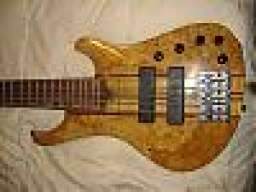
Did a rehearsal last night for a Christmas gig. This one has the strings and the whole bit. Lots of instruments and lots going on.

The conclusion: The modern is me, and I am the modern.

The thing was a well-focused, bottom end tone laser that seated itself boldly and confidently in its rightful place down low. This was my first test of it in a real-life application like this. I don't know how he does it, but it is truly remarkable how a Sadowsky really doesn't shine in all its glory until its working with all the other instruments. Even with a string section (including a DB), piano, acoustic guitar, electric guitar, drums, aux perc and even another set of keys padding the strings, the Modern held its ground FIRMLY.

Any comments I have made about Sadowsky B strings, I have to apologetically retract. At least in the case of this bass. We were doing a ballad last night where I was playing two tied wholes on the low C (Is that C1?) on the B at about 55-60 bpm. My bass was clearly the strongest, clearest and most present part of that foundation.

Can anyone tell I love my modern? :)

That's is what I've always said about Sadowsky's. Roger knows what he's doing and does it so well. These basses just plain work for any gig from rock to jazz to country to R&B etc....
 
I've owned a number of 35" scale fivers. The Modulus Quantum B string is as good as any I've heard (except perhaps Dingwall), but overall the Q5 has a modern sound due to the composite neck... and I'll say the same about Dingwall because of the fanned frets. The reason I prefer Sadowsky is because they (the P's and J's anyway) have a more traditional timbre, not too far from Fender, yet the B strings are still incredible, even on my ultra-vintage P-basses that are P-only, no J.
 
Did a rehearsal last night for a Christmas gig. This one has the strings and the whole bit. Lots of instruments and lots going on.

The conclusion: The modern is me, and I am the modern.

The thing was a well-focused, bottom end tone laser that seated itself boldly and confidently in its rightful place down low. This was my first test of it in a real-life application like this. I don't know how he does it, but it is truly remarkable how a Sadowsky really doesn't shine in all its glory until its working with all the other instruments. Even with a string section (including a DB), piano, acoustic guitar, electric guitar, drums, aux perc and even another set of keys padding the strings, the Modern held its ground FIRMLY.

Any comments I have made about Sadowsky B strings, I have to apologetically retract. At least in the case of this bass. We were doing a ballad last night where I was playing two tied wholes on the low C (Is that C1?) on the B at about 55-60 bpm. My bass was clearly the strongest, clearest and most present part of that foundation.

Can anyone tell I love my modern? :)

Glad I was able to help you find it!
 
I've owned a number of 35" scale fivers. The Modulus Quantum B string is as good as any I've heard (except perhaps Dingwall), but overall the Q5 has a modern sound due to the composite neck... and I'll say the same about Dingwall because of the fanned frets. The reason I prefer Sadowsky is because they (the P's and J's anyway) have a more traditional timbre, not too far from Fender, yet the B strings are still incredible, even on my ultra-vintage P-basses that are P-only, no J.

I would agree, except that the Q5 B can almost be too big. You have to be careful with it. Although, it does have clarity and sustain that is superior to most.

The most impressive thing about the Dingwall is the balance and continuity across the strings. The notes on the B are perfectly balanced in timbre, clarity, output and energy with the notes on the other strings. Even Sadowsky can't approach it from that point of view. Of course, the trade off is the non-traditional design and feel.

This modern is somewhere in the middle. It doesn't have the power/sustain of the Q5 nor the balance of the Dingwall, but it does have plenty enough of each to make for an excellently performing fiver.
 
I've owned a number of 35" scale fivers. The Modulus Quantum B string is as good as any I've heard (except perhaps Dingwall), but overall the Q5 has a modern sound due to the composite neck... and I'll say the same about Dingwall because of the fanned frets. The reason I prefer Sadowsky is because they (the P's and J's anyway) have a more traditional timbre, not too far from Fender, yet the B strings are still incredible, even on my ultra-vintage P-basses that are P-only, no J.
With the Dingwall, keep in mind the Super J's are still only 35" scale on the B. His other models, however, are 37" due to the fanned fret system.

This has been debated ad nauseum here on TB, but I don't believe a great B requires a longer scale (tho I do feel it's easier to get a B string to sound good if it is longer.) Just means materials and construction play a bigger role in the shorter scales, since you're getting further and further from the natural string length for the fundamental.

IMHO :)
 
I would agree, except that the Q5 B can almost be too big. You have to be careful with it. Although, it does have clarity and sustain that is superior to most.

The most impressive thing about the Dingwall is the balance and continuity across the strings. The notes on the B are perfectly balanced in timbre, clarity, output and energy with the notes on the other strings. Even Sadowsky can't approach it from that point of view. Of course, the trade off is the non-traditional design and feel.

I've owned a couple of Quantums and have played a few fanned-fret Dingwalls, and IMO both have remarkable balance and continuity across the strings, along with "modern" timbre and clarity. However I decided that I'm not looking for a bass that sounds like it has just one string... I like getting a different tone when I play the same note in a different position. And while I typically use bright "modern" tones, I prefer them to be based on the Fender archetype. I get all that with the Sadowsky vintage basses, along with an excellent B string, which is as good as many nice 35"ers including the MTD 535 IMO/IME.
 
. . materials and construction play a bigger role in the shorter scales, since you're getting further and further from the natural string length for the fundamental.

IMHO :)

I would have to agree. I think this is best demonstrated with basses like Zon and Modulus, which by their nature, ought to have the most consistency in the necks without regard to scale length.

With both of those makers, you see very difference in performance between the 34" and 35" B strings.

I know that memories can be short. But, I am convinced that the B string on this Modern is more articulate, has more sustain and just out right performs better than either of the two NYCs I had before. And, there is no question it is better than the Metro PJ I have now.

There are lots of factors that may contribute. It's a different design, different woods, different PU and placement. It's just a different bass. It is also a newer NYC with graphite in the neck. I can't say that it contributes, but it is a variable.
 
I know that memories can be short. But, I am convinced that the B string on this Modern is more articulate, has more sustain and just out right performs better than either of the two NYCs I had before. And, there is no question it is better than the Metro PJ I have now.

There are lots of factors that may contribute. It's a different design, different woods, different PU and placement. It's just a different bass. It is also a newer NYC with graphite in the neck. I can't say that it contributes, but it is a variable.

My hunch is that pickup location is largely responsible. By that same token, I'm not sure the Modern would be my cup of tea. But hey... does it really matter? :p You've got a drop-dead gorgeous bass that pleases your ears as much as your eyes.

 
. . . I like getting a different tone when I play the same note in a different position. . .

I'm smelling what you are cookin'. But there are times when the phrasing or key forces you into a position where you are going to cross. If one of those notes stands out, it can be less than desirable. It's as much technique as instrument. I'll grant that, but there's nothing like the instrument helping you out now and then. :)
 
Chasarms:

Nice on the Seuss reference. As someone who has read that book to his daughter countless times over the last decade, I appreciate it.

Personally, I like flats in some contexts, but I have never tried them on a Sadowsky. I'm thinking of giving them a try on my PJ for the heck of it. I play mainly hard rock on gigs so it's doubtful I'd keep them on the PJ for a long time, but I do like them in some situations, like on a P bass for R&B or on a Reverend.
 
Since when has graphite been put in the NYC bass necks?

Thank you.

About the B string discussion, it can often come down to simply variations between different string brands, gauge, composition and age, and especially different distance between string and pickup. Very small fractions of an inch can make a very big difference.
 
Personally, I like flats in some contexts, but I have never tried them on a Sadowsky. I'm thinking of giving them a try on my PJ for the heck of it. I play mainly hard rock on gigs so it's doubtful I'd keep them on the PJ for a long time, but I do like them in some situations, like on a P bass for R&B or on a Reverend.

I now have two Sadowsky P-basses, so I'm going to keep flats on one for my occasional R&B gigs, and leave rounds on the other for my frequent hard rock gigs. That'll also allow me to keep the R&B P-bass in standard tuning, and the hard rock P-bass a half-step flat, rather than having to de-tune and re-tune when I switch genres. :hyper:
 
......Personally, I like flats in some contexts, but I have never tried them on a Sadowsky. I'm thinking of giving them a try on my PJ for the heck of it. I play mainly hard rock on gigs so it's doubtful I'd keep them on the PJ for a long time, but I do like them in some situations, like on a P bass for R&B or on a Reverend.

As a word of encouragement Bart: I think the easiest way to kill your enthusiasm for flats is to go with a set that is too light in gauge. With the J neck on your P/J4 you may be tempted to do just that. Light gauge flats lack "fullness",or "body", in comparison, which is what you really want in a "P/flats" tone. A heavier gauge has slightly more tension but you can lower the action a tad to compensate. That Sad J neck aint gonna fold on ya. You will be surprised at how comfy they feel if you don't have to fight 'em. The Sadowsky SBF45's are excellent strings.
Another consideration is to NOT set the pup ht. too high. Again - higher set = volume - lower set = tone. Experiment w/ this some.
PS: I am REALLY looking forward to hearing about it if you pull the trigger on a set. You have a great bass for it, & if you think your rock gigs aren't the place for them - LOOK OUT sports fans. Don't forget you have a J pup sitting on the back burner bro. Make them BOTH work on those flats for ya.
B.
EDIT: As for anyone - It's just another flavour to taste.
Worth a look: http://www.talkbass.com/forum/showpost.php?p=9739194&postcount=85 Put a right angled crimp w/ pliers (about 4" past post) before cutting excess off, leaving a very short bend that will fit into the post hole. Make sure the string's end ball is free to spin until you've wound the string tight, so there's no twist in the core. I've never had an issue when doing this. I also never string flats thru the body on a Fender.
 
I've owned a number of 35" scale fivers. The Modulus Quantum B string is as good as any I've heard (except perhaps Dingwall), but overall the Q5 has a modern sound due to the composite neck... and I'll say the same about Dingwall because of the fanned frets. The reason I prefer Sadowsky is because they (the P's and J's anyway) have a more traditional timbre, not too far from Fender, yet the B strings are still incredible, even on my ultra-vintage P-basses that are P-only, no J.

+1 here also. My Q5 was a huge solid B and it sounded GREAT but like you said - too modern.
 
Yup, I was a Modulus guy as well. I had 3 total. 2 Q5 sweetspots and one Q5.
The B was outstanding but I too grew tired of that modern sound.
Plus, the weight of those things were pushing 12 lbs!!

I then bought a Sadowsky to get a little more traditional but with a slight modern edge. SOLD!!!
The rest is history!
 
Yup, I was a Modulus guy as well. I had 3 total. 2 Q5 sweetspots and one Q5.
The B was outstanding but I too grew tired of that modern sound.
Plus, the weight of those things were pushing 12 lbs!!

I then bought a Sadowsky to get a little more traditional but with a slight modern edge. SOLD!!!
The rest is history!


Another Modulus lover checking in. I've had five. Three Q5, including an absolutely amazing fretless, a fretted G5 and a fretless G5.

I actually loved the tone of my "original" fretted quilt top Q5. And, it was quite light. Only about 8.5 lbs. It had the Bart 2-band. The recent one I had was 10 lbs. + and had the Aggie 3-band. It was less appealing to me. That bass was very dark sounding.

I still have a serious affection for them. It's just that the Sadowskys are SO much more comfortable to play, and there is a musicality to the Sadowsky pre that nothing else offers.

I wonder if I could get Roger and co to build me an M24-5 with a graphite neck? :eek: I'm guessing probably not. :) Although, it would be an interesting beast.